
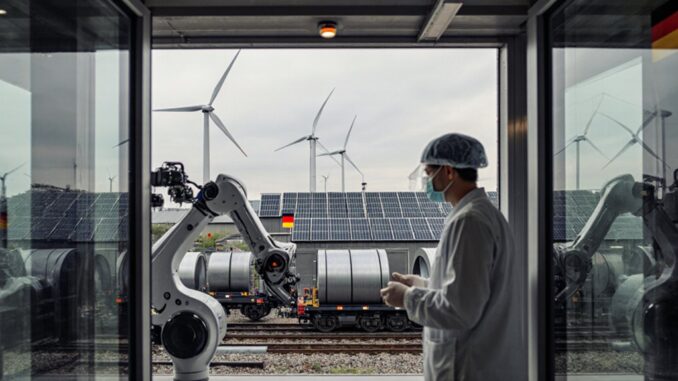
Germany’s economy is powered by export-oriented manufacturing, which contributes about one-fifth of gross value added. Automotive, machinery, chemicals, pharmaceuticals, electrical equipment, and industrial services lead production across major regional clusters. Mittelstand firms and the dual-training system support specialized skills and global niche exports. Electrification, battery supply chains, renewable power, digitalization, and EU emissions rules are reshaping investment, while high energy costs and labor shortages raise pressure. The following sections outline how these sectors compete and transform.
Germany’s Key Industries at a Glance
Germany’s economy is anchored by a diversified industrial base in which automotive manufacturing, machinery and engineering, chemicals and pharmaceuticals, electrical equipment, and industrial services generate a substantial share of output, exports, and research investment. Manufacturing contributes roughly one-fifth of gross value added, a higher proportion than in most large European economies, while industrial clusters span Baden-Württemberg, Bavaria, North Rhine-Westphalia, and Lower Saxony.
Automotive production remains central, but electrification, battery supply chains, and emissions regulation are reshaping capital allocation. Machinery producers support factory automation, energy systems, and precision equipment; chemical and pharmaceutical firms underpin materials, life sciences, and health security. Electrical engineering benefits from grid modernization, semiconductors, and digital infrastructure. Policy priorities include affordable energy, faster permitting, resilient supply chains, and innovation incentives. Workforce mobility matters as regions compete for technical labor, while vocational apprenticeships supply standardized practical training for industrial occupations. These sectors face aging demographics, decarbonization costs, and intensified global competition, yet remain core to domestic investment and productivity.
Exports, Skills, and the Mittelstand Model
Exports remain a defining channel for German industry, with manufacturers of vehicles, machinery, chemicals, electrical equipment, and precision components serving global markets through dense supplier networks. Advanced exports depend less on volume alone than on engineering content, certification standards, after-sales service, and reliable delivery capacity. This structure leaves industrial firms exposed to shifts in foreign demand, trade rules, energy costs, and supply-chain disruptions.
The Mittelstand—typically family-owned, export-oriented small and medium-sized firms—anchors many regional production clusters. Its companies often hold global niche expertise in specialized machine tools, industrial software, measurement systems, components, and process technologies. Long-term ownership can support patient investment, although succession constraints and financing needs are growing concerns.
Germany’s dual vocational training system combines classroom instruction with paid workplace apprenticeships, supplying technicians, mechatronics specialists, and skilled production workers. It supports manufacturing productivity by aligning qualifications with employer needs. Policy priorities include expanding digital skills, easing skilled-labor shortages, accelerating investment, and preserving open export markets.
Germany’s Automotive Industry
At the core of German manufacturing, the automotive industry combines vehicle assembly with extensive supply chains in engines, batteries, electronics, software, tooling, and industrial services. Volkswagen, Mercedes-Benz, BMW, Porsche, and major commercial-vehicle producers anchor production networks spanning large manufacturers, specialist suppliers, logistics firms, and research institutions. The sector remains a leading employer, exporter, and investor in industrial research and development, while its performance strongly affects regional economies in Baden-Württemberg, Bavaria, Lower Saxony, and North Rhine-Westphalia.
Electric mobility is reshaping capital spending, model portfolios, and workforce needs. EU emissions rules, German purchase incentives, charging deployment, and global competition have accelerated investment in electric platforms and digital vehicle systems. Battery suppliers have become strategically important, although domestic cell capacity is still developing and dependence on Asian producers remains significant. Automakers are balancing the transition away from combustion engines with export demand, affordability concerns, supply-chain resilience, and the need to preserve skilled employment during a technology-intensive restructuring.
Germany’s Machinery, Chemicals, and Pharma Sectors
Beyond vehicle production, machinery, chemicals, and pharmaceuticals form a second industrial pillar, linking Germany’s Mittelstand engineering base with globally active corporations. Machinery makers supply factory equipment, automation components, and process systems to export markets, supported by Niche Manufacturing and Precision Engineering capabilities. Chemical producers remain central to industrial supply chains, although energy costs, carbon pricing, and tighter environmental rules have increased pressure on basic chemicals.
- Machinery: machine tools, industrial pumps, packaging systems, and production equipment.
- Chemicals: polymers, coatings, catalysts, and high-value Specialty Chemicals.
- Pharmaceuticals: branded medicines, generics, vaccines, and contract production.
- Policy priorities: research incentives, resilient supply chains, skilled labor, and competitive energy inputs.
Life Sciences Manufacturing clusters around established research centers and logistics networks, connecting laboratories, suppliers, and regulated production sites. Large firms provide scale in global markets, while specialized medium-sized companies contribute critical components and formulations. Regulatory standards, patent protection, and EU market access shape investment decisions.
Renewable Energy and Digital Technology
Renewable energy and digital technology have become strategic growth sectors as Germany pursues decarbonization, energy security, and industrial competitiveness. Wind and solar capacity expansion is central to the country’s energy transition policy, alongside grid modernization, storage investment, and faster permitting. Renewable electricity is increasingly important for chemicals, steel, transport, and data-intensive services, although high power prices and transmission bottlenecks remain constraints.
Germany’s digital sector combines industrial software, automation, telecommunications, cybersecurity, and semiconductor-related investment. Its strength lies in applying digital tools to established manufacturing networks rather than relying solely on consumer platforms. AI manufacturing applications support predictive maintenance, quality control, energy management, and more flexible production lines across automotive, machinery, and electronics plants.
Public funding, EU regulation, and private capital are shaping both sectors. The challenge is to scale clean-energy infrastructure and digital capacity quickly enough to protect export competitiveness while meeting climate targets and reducing dependence on imported fossil fuels.
The Industry & Manufacturing Editorial Team focuses on Germany’s industrial economy and the technologies transforming production. Coverage includes mechanical engineering, manufacturing, automation, robotics, process industries, supply chains and industrial digitalisation. Particular attention is given to the German Mittelstand, specialised manufacturers and hidden champions that play an important role in global industrial markets.