
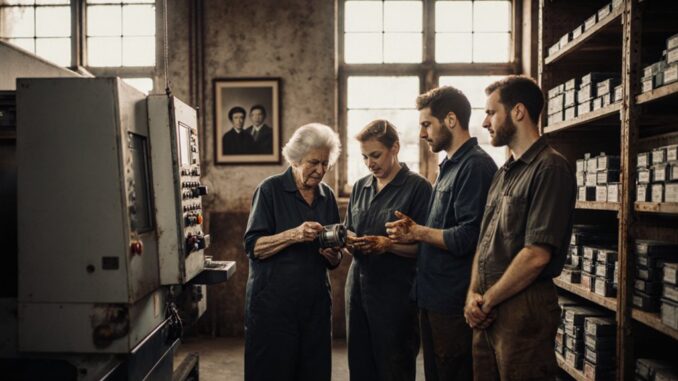
Family-owned companies matter in Germany because they underpin the Mittelstand’s long-term investment, specialized production, and regional employment. Concentrated ownership supports patient capital for training, research, machinery, and energy efficiency, while conservative financing can improve resilience in downturns. These firms often retain skilled workers, build durable supplier and customer relationships, and export high-value niche products. They also support local apprenticeships and community institutions. Their role, pressures, and future handover needs are examined below.
What Are Germany’s Family-Owned Mittelstand Firms?
Germany’s family-owned Mittelstand firms are largely small and medium-sized enterprises characterized by concentrated ownership, long-term management horizons, and specialization in industrial or business-to-business markets. The Mittelstand definition is broader than a revenue or employee threshold: it commonly combines enterprise size with independent control by an owner, family, or small shareholder group. Germany’s Institute for SME Research often classifies SMEs as firms with fewer than 500 employees and annual sales below €50 million, although many Mittelstand businesses exceed those limits while retaining owner management.
Their ownership structure typically places voting rights and strategic control with founding families, sometimes across several generations. These companies operate across manufacturing, engineering, chemicals, logistics, software, and specialized services. Many occupy narrow export-oriented niches, supplying components, machinery, or technical expertise to larger domestic and international customers. The category accordingly includes local craft businesses alongside globally active “hidden champions.” Family ownership is common, but not every Mittelstand company is family-owned, and not every family company is a Mittelstand enterprise.
Why Long-Term Thinking Shapes Family Firms
The concentrated ownership that distinguishes many family-owned Mittelstand firms also encourages decisions measured over decades rather than quarterly reporting cycles. Owners frequently combine management control with an intention to transfer the business to subsequent generations, reducing incentives to maximize short-term distributions at the expense of productive capacity. This structure can support sustained investment in specialized machinery, research, workforce training, and energy efficiency, even when returns emerge slowly.
Long term resilience is strengthened when firms preserve conservative balance sheets, retain earnings, and limit dependence on volatile external financing. Such policies can provide greater room to maintain investment during cyclical downturns. Regional commitment also shapes capital allocation: production sites, supplier networks, and technical apprenticeships are often maintained in smaller industrial regions where the company has operated for decades. The approach does not eliminate risks, including succession constraints or delayed strategic change, but it can align ownership horizons with investments requiring patience, continuity, and accumulated industrial expertise.
How Family Firms Build Stakeholder Trust
Because family ownership often links corporate reputation to a recognizable owner name, many German family firms build trust through consistent commitments to employees, customers, suppliers, and local communities. Their credibility is reinforced when stated values align with observable decisions, including product quality, payment reliability, and responsible investment.
- Trust governance: Supervisory structures, family councils, and clear succession rules can reduce uncertainty over decision-making authority and accountability.
- Long term transparency: Regular communication on ownership, strategy, financial resilience, and sustainability targets helps stakeholders assess continuity beyond annual results.
- Reciprocal reliability: Stable supplier relationships, responsive customer service, and local engagement create repeated interactions that make performance easier to verify.
Research on relationship-based business systems indicates that trust lowers transaction costs, supports information sharing, and improves cooperation during market disruptions. For German family firms, reputation thus functions as an economic asset: it is accumulated over time, monitored by identifiable owners, and damaged quickly when commitments are not met. This direct reputational exposure strengthens incentives for disciplined stakeholder management.
How German Family Firms Create Stable Jobs
Long planning horizons are a central mechanism through which German family firms support employment stability. Owners typically evaluate staffing decisions against multiyear production, market, and succession needs rather than quarterly earnings targets. This approach can reduce incentives for abrupt layoffs during cyclical downturns and encourage temporary measures such as reduced hours, redeployment, or internal training.
A legacy commitment also links employment policy to the firm’s reputation in its region, where many businesses are major local employers. Stable workforces preserve specialized operational knowledge and lower the costs associated with recruiting and replacing experienced staff. Employee retention is consequently both a social and economic objective: longer tenure can improve continuity, quality control, and customer relationships. Germany’s co-determination framework, sectoral training systems, and short-time work arrangements further reinforce this pattern. Family ownership does not eliminate restructuring risk, particularly in export-dependent industries, but concentrated control can enable faster, patient decisions when demand weakens.
How Family Firms Support German Innovation
Employment stability also strengthens the innovation capacity of German family firms by preserving the technical expertise needed for cumulative research and development. Lower turnover protects tacit knowledge, while concentrated ownership can align investment decisions with multiyear technical priorities rather than quarterly earnings targets.
- Patient capital enables funding for prototyping, process upgrades, and applied engineering projects whose payoffs may emerge slowly.
- Long term resilience improves when firms reinvest retained earnings in digital systems, energy efficiency, and workforce training, reducing dependence on short-term external finance.
- Regional research benefits from durable relationships with universities, vocational schools, suppliers, and local institutes, which facilitate knowledge transfer and specialized experimentation.
These structures create innovation incentives that differ from purely market-driven models. Owners with intergenerational horizons can accept uncertain development cycles when technologies strengthen future competitiveness. The effect is especially relevant in machinery, chemicals, medical technology, and industrial software, where innovation depends on repeated refinement, certified quality, and experienced technical teams.
How Hidden Champions Drive German Exports
Germany’s export performance is reinforced by “hidden champions”: often family-owned, medium-sized firms that hold leading positions in narrow global markets. These companies frequently supply specialized machinery, industrial components, measurement systems, and process technologies, generating demand beyond Germany’s domestic economy.
Their niche market leadership is supported by regional manufacturing expertise, which combines skilled labor, engineering capabilities, and tightly controlled production processes. A sustained commitment to quality helps firms meet demanding technical standards and reduce replacement or maintenance risks for international buyers.
Resilient export strategies also depend on diversified customer bases, local sales subsidiaries, and long term customer partnerships. Such relationships can stabilize order flows in cyclical industries and provide feedback for product adaptation.
A global supply chain focus enables these exporters to source inputs internationally while retaining critical design, testing, and final-production functions in Germany. This model strengthens competitiveness in high-value segments, where price is often less decisive than reliability, customization, certification, and delivery performance.
How Family Firms Strengthen Local Communities
Beyond their export role, family-owned firms often act as stable economic anchors in German towns and regions. Their influence extends through employment, procurement, training, and civic participation, particularly in smaller industrial districts where a single employer can shape local demand. Evidence from regional labor markets indicates that owner-managed businesses commonly retain production and decision-making closer to their home base, supporting workforce stability and predictable municipal tax revenues.
- Community investment: Firms often fund local infrastructure, cultural associations, sports clubs, and social services, supplementing public and nonprofit resources.
- Long term commitment: Multi-generational ownership can encourage patient capital allocation, preserving facilities, supplier relationships, and apprenticeships during normal business cycles.
- Local mentorship: Company leaders frequently participate in chambers, vocational schools, and startup networks, connecting students and smaller enterprises with technical expertise.
These activities create spillover effects beyond direct payrolls. Stronger training pipelines, resilient supplier ecosystems, and sustained civic engagement can improve a region’s capacity to retain skilled workers and attract complementary investment over time.
Challenges Facing German Family-Owned Companies
German family-owned companies face mounting succession pressures as aging owners approach retirement and fewer heirs are prepared to assume leadership. At the same time, digital transformation requires substantial investment in software, cybersecurity, skills, and process modernization. These combined demands can constrain capital allocation and threaten long-term competitiveness, particularly among smaller firms.
Succession Planning Pressures
Succession planning is a growing constraint for family-owned companies, as many founders and long-serving owners approach retirement without a clearly prepared next-generation successor. The issue is especially acute among Mittelstand firms, where ownership, management expertise, and regional employment are closely linked. Delayed decisions can weaken leadership continuity, unsettle lenders, and complicate workforce retention.
Key pressures include:
- Younger family members may pursue careers outside the business or lack required managerial experience.
- Valuation, inheritance tax, and financing arrangements can delay transfers or require external investors.
- Conflicting family expectations may impede transparent governance and timely selection processes.
Companies with formal succession timetables, independent advisory boards, and development programs generally reduce transition risk. Where no internal candidate exists, professional external management can preserve operational stability, although it may alter traditional family control.
Digital Transformation Costs
Even where ownership succession is well managed, digital modernization can impose significant financial and organizational demands on family-owned firms. Investments in cloud systems, enterprise software, automation, data infrastructure, and external expertise may require multi-year budgets that compete with capital spending on production capacity. Smaller Mittelstand businesses often face limited internal IT teams, making implementation delays and vendor dependence more likely.
Workforce skilling adds recurring costs through training, recruitment, and temporary productivity losses during system changeovers. Cyber readiness also requires expenditure on security tools, monitoring, incident-response planning, and regulatory compliance. These pressures are amplified when legacy machinery must be integrated with new digital platforms. While digitization can improve efficiency, forecasting, and customer service, returns vary by sector and depend on disciplined project governance, measurable milestones, and sufficient financing.
Succession, Digitalization, and Family Firms’ Future
Generational succession is a critical continuity issue for German family-owned companies, particularly as many owners approach retirement without confirmed leadership plans. At the same time, digital transformation is reshaping competitiveness through automation, data systems, and new customer channels. Firms that align succession planning with targeted technology investment are better positioned to preserve ownership stability and adapt to changing markets.
Managing Generational Succession
As Germany’s family-owned companies confront an aging leadership base, managing generational succession has become a strategic issue with implications for ownership continuity, investment capacity, and regional employment. Successful successions require early planning, transparent governance, and measurable preparation of potential successors. Evidence from German SME surveys indicates that delayed handovers can constrain financing decisions and weaken workforce engagement, particularly where key managers lack clarity about future leadership.
- Families should formalize ownership, voting, and inheritance arrangements before retirement deadlines.
- Firms should assess successors against operational, financial, and leadership criteria, including external experience.
- Advisory boards can mediate conflicts and address regulatory complexity in tax, labor, and inheritance requirements.
Where no family successor is available, management buyouts or external executives may preserve operations. Clear succession processes in turn protect long-term competitiveness and local economic stability.
Accelerating Digital Transformation
Succession planning increasingly intersects with digital transformation, because incoming leaders must inherit not only ownership and governance responsibilities but also the capacity to modernize business models, production systems, and customer relationships. For German family firms, this transition is especially significant because many Mittelstand companies compete through specialized engineering, long-term customer ties, and export-oriented production. Incoming successors must assess where automation, cloud systems, data analytics, and AI can improve productivity or protect margins. Investment decisions may be constrained by conservative financing preferences, yet delayed adoption can widen gaps with digitally advanced competitors. Successful transformation depends on governance structures that combine family oversight with external expertise. Firms also require digital talent capable of translating operational knowledge into scalable technology initiatives. Emerging technologies can support predictive maintenance, customized manufacturing, and digital sales channels, strengthening resilience while preserving the firms’ distinctive long-term orientation.

The Business & Economy Editorial Team covers Germany’s economy, companies, markets and international trade. Its reporting focuses on economic developments, investment, exports, the Mittelstand, major corporations and the conditions affecting businesses in Germany. The team combines current economic news with background articles and analysis to explain what developments mean for companies, investors and international readers.