Volkswagen is Germany’s largest automaker, founded as a state-backed “people’s car” project in 1937 and rebuilt around the Beetle after 1945. Today, its global group spans mass-market, premium, commercial-vehicle, truck, motorcycle, and luxury brands. Its German plants, suppliers, exports, and logistics networks support employment across major industrial regions. Volkswagen also drives electric-vehicle investment through plant conversions, battery capacity, and software platforms. Its performance consequently shapes orders, jobs, and competitiveness across Germany’s automotive economy. The sections ahead outline these links.
Volkswagen’s Rise in Germany
Volkswagen emerged in Germany in 1937 as a state-backed initiative to create an affordable “people’s car” for the mass market. Its World War origins shaped its early industrial base: production shifted toward military vehicles, while the Wolfsburg plant became a strategically important manufacturing asset. Civilian output remained limited until 1945, when British administration restarted operations and prioritized the Beetle for domestic mobility and export revenue.
Volkswagen’s Postwar resurgence reflected disciplined manufacturing, standardized design, and expanding dealer networks. The Beetle’s low operating costs, durability, and recognizable styling supported demand across rebuilding European markets and later in North America. By the 1950s, Volkswagen had become a major German exporter, generating foreign exchange and reinforcing the country’s reputation for engineering-led industrial recovery. Its growth also anchored employment in Lower Saxony, strengthened supplier ecosystems, and demonstrated how scale production could convert a politically created enterprise into a commercially resilient automotive manufacturer.
Volkswagen Group Brands and Global Reach
Through a portfolio spanning volume, premium, luxury, performance, commercial-vehicle, and financial-services segments, the Volkswagen Group has evolved beyond its original passenger-car brand into one of the world’s largest automotive groups. Its Brand Portfolio includes Volkswagen Passenger Cars, Škoda, SEAT/CUPRA, Audi, Porsche, Bentley, Lamborghini, Ducati, Volkswagen Commercial Vehicles, Scania, and MAN, allowing the group to address distinct price points, customer profiles, and regional demand patterns.
Volkswagen’s scale is reinforced by operations and sales networks across Europe, China, the Americas, and other major markets. China has remained its largest single national market, while Europe provides a core base for multiple brands and vehicle categories. This geographic diversification supports Global Sales volumes and reduces reliance on any one product line or region. Strategically, the group combines shared platforms, procurement, software development, and battery investments with differentiated brand positioning. That structure enables cost efficiencies while preserving separate identities in mass-market, premium, luxury, and commercial mobility segments worldwide.
Volkswagen’s Jobs and Export Impact in Germany
Volkswagen is a major employer across German manufacturing regions, with its plants anchoring labor markets in Lower Saxony, Saxony, Hesse, and beyond. Its export-oriented production strengthens Germany’s automotive trade position by supplying vehicles and components to global markets. The group’s purchasing and manufacturing network also supports extensive employment among domestic suppliers, logistics providers, and service firms.
Employment Across German Regions
Across Germany, Volkswagen functions as a major regional employment anchor, with its production, research, logistics, and supplier networks concentrated in Lower Saxony, Saxony, Hesse, and other industrial states. Its Workforce distribution shapes local incomes, training pipelines, housing demand, and supplier capacity, making plant decisions economically significant beyond company payrolls.
- Wolfsburg remains the central employment hub, linking assembly, engineering, and administration.
- Zwickau and Chemnitz support eastern German manufacturing specialization and technical skills.
- Kassel anchors component production, logistics, and industrial services in Hesse.
- Hanover and Braunschweig reinforce Lower Saxony’s research, commercial-vehicle, and supplier ecosystem.
Volkswagen’s scale stabilizes Regional labor markets through apprenticeships, long-term procurement, and specialized occupations. Strategic restructuring, electrification investment, and productivity measures as a result carry material consequences for municipal revenues, workforce planning, and supplier employment across affected regions.
Export Strength and Trade
Germany’s automotive export position is materially reinforced by Volkswagen’s global sales, overseas production links, and cross-border supply chains. The group exports vehicles, components, engineering services, and premium brands from German facilities to major markets across Europe, China, North America, and other regions. Its scale supports export performance by spreading research, manufacturing, and marketing costs across high-volume international sales. Volkswagen’s German production base also benefits from brand recognition and established dealer networks, which sustain demand for vehicles made in Germany. Trade policy remains a material variable: tariff leverage affects pricing, model allocation, and decisions on local assembly versus direct exports. When tariffs rise or market-access rules tighten, Volkswagen can adjust regional production and sourcing strategies, but German export volumes may face pressure. Its results accordingly influence Germany’s automotive trade balance and industrial competitiveness.
Supply Chain Job Effects
Beyond its direct workforce, Volkswagen supports a broad German employment base through suppliers of parts, machinery, logistics, software, engineering, energy, and business services. Its production volumes influence capacity planning across industrial clusters, particularly in Lower Saxony, Saxony, Bavaria, and Baden-Württemberg. Supplier dependency can amplify regional exposure when model demand, export orders, or factory output shifts. Local subcontracting also channels spending into smaller firms that provide tooling, maintenance, transport, and specialized technical labor.
- Tier-one suppliers gain predictable scale from platform contracts.
- Small manufacturers benefit from recurring component and service orders.
- Logistics operators depend on vehicle and parts flows to ports and plants.
- Export competitiveness sustains jobs linked to German-made vehicles abroad.
Electrification changes this employment mix, raising demand for batteries, semiconductors, and software while pressuring combustion-engine specialists. Strategic support for the shift to electrification remains critical for regional labor resilience.
Volkswagen’s Influence on Germany’s Auto Supply Chain
Volkswagen sits at the center of Germany’s automotive supply chain, linking domestic manufacturers of components, machinery, software, steel, and logistics services to one of Europe’s largest vehicle-production networks. Its purchasing volumes shape capacity planning across thousands of firms, from precision-engineering specialists in Baden-Württemberg to metal processors and transport operators in Lower Saxony and Saxony.
This scale creates supplier dependency where factories rely heavily on Volkswagen orders for revenue visibility, investment decisions, and production scheduling. The regional knock on extends beyond direct plants: tier one employment supports subcontractors, maintenance providers, toolmakers, and local business services. Volkswagen’s co developer networks also influence product specifications, quality systems, and research priorities among suppliers seeking long-term platform contracts.
Its production footprint sustains logistics demand across rail, road, ports, warehousing, and finished-vehicle distribution. Meanwhile, centralized materials procurement affects demand for steel, aluminum, plastics, electronics, and industrial inputs, giving Volkswagen substantial leverage in supplier negotiations and helping set commercial standards throughout Germany’s automotive ecosystem.
Volkswagen’s EV Investment in Germany
Volkswagen’s EV strategy in Germany centers on expanding battery capacity and converting major plants for electric vehicle production. Investments in cell manufacturing, battery supply chains, and dedicated EV platforms are intended to lower costs and strengthen domestic production resilience. This industrial shift positions Germany as a core hub for Volkswagen’s European electrification targets.
Battery Plant Expansion
In Germany, Volkswagen has positioned battery-cell production as a core element of its electric-vehicle strategy, investing in domestic capacity to strengthen supply security, reduce logistics costs, and support higher EV output. Its Salzgitter battery hub illustrates a broader industrial approach focused on scale, cost control, and regional resilience. Key strategic effects include:
- New EV jobs across cell manufacturing, engineering, and maintenance.
- Workforce training programs aligned with high-voltage systems and digital production.
- Greater opportunities for local suppliers in materials, equipment, recycling, and services.
- Rising grid capacity requirements, prompting coordination with utilities and public authorities.
The expansion also aims to limit exposure to imported cells and volatile transport routes. By clustering battery operations in Germany, Volkswagen can improve procurement visibility, shorten supply chains, and reinforce the country’s position in Europe’s battery-industrial market.
Electric Vehicle Production
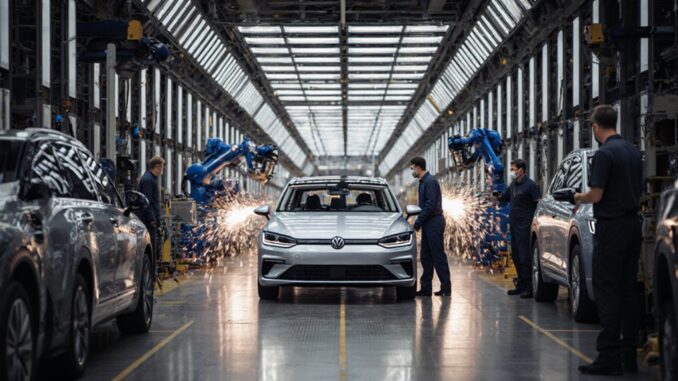
Across Germany, Volkswagen’s electric-vehicle investment is reshaping manufacturing capacity around dedicated EV platforms, digitalized assembly, and higher-volume battery-electric output. Plants in Zwickau, Emden, Hanover, and Wolfsburg anchor the shift, converting legacy production assets toward modular electric architectures and improving scale efficiencies. The strategy supports Volkswagen’s position in Europe’s competitive EV market, where pricing, battery costs, charging access, and model availability increasingly determine demand. German production also links vehicle assembly to domestic battery supply chains, helping reduce logistics exposure and strengthen industrial value creation. Investments in software platforms are intended to improve vehicle updates, connected services, and fleet data capabilities across brands. Autonomous technology remains a longer-term commercial priority, requiring integrated sensors, computing capacity, and regulatory approval. Volkswagen’s manufacturing shift thus affects employment, supplier investment, export competitiveness, and Germany’s broader ability to retain automotive leadership during electrification.
How Volkswagen’s Challenges Affect German Industry
Because Volkswagen is Germany’s largest automaker and a major buyer of steel, electronics, chemicals, and logistics services, its production cuts, restructuring plans, and margin pressure can quickly affect industrial orders across the country. Lower vehicle output reduces demand throughout supplier networks, particularly in manufacturing-heavy regions such as Lower Saxony, Saxony, and Baden-Württemberg.
- Suppliers face weaker volumes, delayed contracts, and tighter pricing negotiations.
- Wage pressure rises as unions defend jobs while management seeks lower fixed costs.
- Regional disparities may widen where local economies depend heavily on Volkswagen plants and tier-one suppliers.
- Investment decisions in batteries, software, and charging infrastructure can slow if cash flow is redirected toward restructuring.
For German industry, Volkswagen’s difficulties are as a result more than a corporate issue. They influence capacity utilization, employment expectations, export competitiveness, and capital spending. A prolonged downturn could constrain supplier innovation, while an effective turnaround could stabilize orders and reinforce Germany’s position in global automotive value chains.

The German Companies Editorial Team profiles the businesses behind Germany’s economy. Coverage ranges from internationally known corporations and DAX companies to family-owned Mittelstand businesses, hidden champions, technology companies and startups. Profiles place companies within their industry, region and economic context rather than simply presenting corporate information.