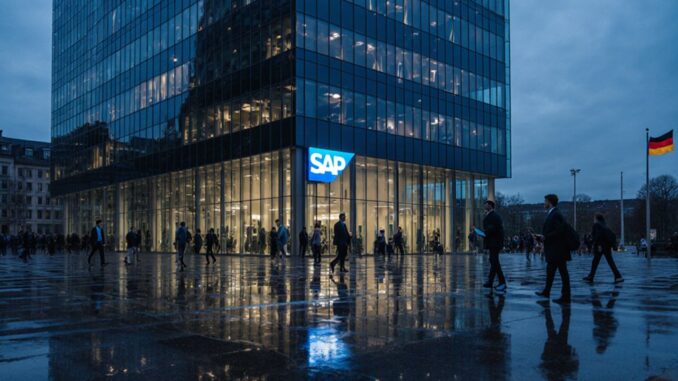
SAP is Germany’s largest software company and a global leader in enterprise technology. Founded in 1972, it built its position through ERP systems that connect finance, supply chains, production, HR, and sales. Its Walldorf-centered operations support high-skilled jobs, research, exports, and a large network of consultants and software partners. SAP also helps manufacturers modernize through cloud, analytics, and AI tools. Its influence extends across Germany’s digital economy, with further context below.
Why SAP Matters to Germany’s Economy
SAP occupies an outsized position in Germany’s economy as the country’s largest software company and one of its few globally dominant technology groups. Its scale gives the domestic technology sector a major export-oriented anchor, with software revenues, high-skilled employment, research spending, and supplier demand concentrated around its Walldorf headquarters and broader partner network. SAP’s market capitalization also makes it a significant component of German equity markets, influencing international perceptions of the country’s capacity to produce scalable digital businesses.
The company’s German enterprise impact extends beyond its own operations. Manufacturers, insurers, retailers, utilities, and public institutions rely on its platforms to manage finance, procurement, logistics, payroll, and customer data. This ERP backbone importance makes SAP central to operational continuity across large parts of the economy. Its investment cycle supports consulting firms, cloud providers, system integrators, universities, and specialized software vendors. Consequently, SAP’s performance affects not only technology-sector employment and investment, but also the digital modernization capacity of Germany’s industrial base.
How SAP Became a Global Enterprise Leader
How did a German software supplier evolve into a global enterprise leader? SAP built scale by turning standardized business software into a system of record for finance, procurement, manufacturing, and supply chains. Founded in 1972 by five former IBM engineers, it expanded from real-time enterprise resource planning into a broad portfolio serving multinational customers across industries.
Its growth model combined direct sales to large corporations, extensive implementation partners, recurring maintenance revenue, and targeted acquisitions. SAP’s 1992 R/3 launch accelerated international adoption, while later products strengthened its position in analytics, customer management, human capital, and procurement. By serving complex, regulated organizations, the company developed high switching costs and durable customer relationships.
The strategic shift toward subscription revenue and its cloud platform has reshaped the business for digital operations. S/4HANA, cloud applications, and industry-specific offerings position SAP to compete with Oracle, Microsoft, and Salesforce as enterprise technology spending moves from on-premises systems to cloud-based services globally.
How SAP Software Supports German Businesses
For German businesses, SAP software centralizes finance, supply-chain, human-resources, and production workflows, reducing process fragmentation across complex operations. Its integrated data platforms give managers near-real-time visibility into costs, demand, inventory, and performance indicators. This operational efficiency and data-driven decision-making capacity helps firms compete in export-oriented manufacturing, services, and regulated industries.
Streamlining Business Operations
Across Germany’s industrial and service economy, SAP software helps businesses consolidate finance, procurement, supply chains, manufacturing, and human-resources data within shared operational systems. This process integration reduces fragmented workflows that can delay orders, complicate inventory management, and increase administrative costs. For manufacturers, connected production and purchasing functions can align material requirements with supplier schedules and shop-floor activity. Retailers and logistics providers can standardize replenishment, invoicing, and fulfillment processes across locations.
The automation benefits are particularly relevant in Germany’s export-oriented Mittelstand, where firms must manage complex supplier networks while controlling overhead. SAP platforms support standardized approvals, recurring transaction processing, and compliance-oriented documentation. By replacing disconnected legacy applications with common workflows, businesses can improve operational consistency, shorten handoffs, and scale procedures as domestic and international operations expand. This supports competitiveness in sectors facing labor constraints, cost pressure, and demanding delivery expectations.
Enabling Data-Driven Decisions
As German businesses face volatile energy costs, supply disruptions, and shifting demand, SAP software turns operational data into timely management insight. Its platforms combine finance, procurement, production, sales, and workforce information, giving executives a clearer view of margins, inventory exposure, and customer demand across sites and markets. Real time analytics can flag late supplier deliveries, unusual cost movements, or weakening order pipelines before they materially affect performance.
For Germany’s export-oriented manufacturers and Mittelstand firms, this visibility supports faster scenario planning and more disciplined capital allocation. SAP’s forecasting tools also help companies compare demand signals with capacity, labor availability, and raw-material prices. Decision automation can route approvals, trigger replenishment actions, and prioritize exceptions, reducing delays in routine processes. The result is a more responsive operating model, with data increasingly shaping commercial and operational choices.
How SAP Shapes Germany’s Software Economy
At the center of Germany’s software economy, SAP functions as both its largest enterprise vendor and a demand engine for a broad ecosystem of cloud, consulting, cybersecurity, and implementation firms. Its scale supports high-value employment, supplier revenues, and export-oriented digital services, extending economic effects beyond its headquarters in Walldorf.
SAP’s enterprise platforms create recurring demand for systems integrators, managed-service providers, independent software vendors, and specialist developers. The company’s partner networks also lower market-entry barriers for smaller firms that build add-ons, industry applications, and data tools around its products. This creates innovation ecosystems in which German companies can commercialize specialized expertise while accessing global customers.
The effect is especially significant because SAP anchors domestic software spending in a market otherwise shaped by U.S. hyperscalers and enterprise vendors. Its investment in cloud infrastructure, artificial intelligence, and business software helps retain technical capability locally, while its international customer base converts German-developed software and services into export revenue.
How SAP Powers German Manufacturing
SAP’s economic influence is particularly visible in German manufacturing, where its enterprise software coordinates production, procurement, logistics, finance, and compliance across complex industrial networks. Its platforms connect major automotive, machinery, chemicals, and electronics groups with suppliers and distributors, supporting standardized processes across domestic plants and export markets.
For manufacturers operating under volatile energy costs, component shortages, and strict EU reporting rules, SAP provides supply chain visibility across inventories, orders, and transport flows. Real time monitoring helps managers identify production bottlenecks, forecast material requirements, and adjust schedules before delays spread through multi-tier supplier networks. Automated routing can direct orders, approvals, and shipments through predefined business rules, reducing administrative friction. Meanwhile, industrial automation integration links enterprise planning systems with shop-floor equipment and operational data. This connection supports more accurate capacity planning, maintenance decisions, quality control, and traceability. By anchoring digital operations in widely used systems, SAP strengthens Germany’s ability to coordinate high-value manufacturing at scale while protecting reliability, compliance, and export competitiveness.
SAP Jobs and Digital Skills in Germany
SAP’s installed base across German industry sustains demand for consultants, developers, cloud architects, and data specialists. As firms migrate to S/4HANA and expand AI-enabled operations, demand is shifting toward skills in cloud platforms, cybersecurity, analytics, and process automation. This creates a workforce-development challenge for employers, universities, and training providers seeking to close persistent digital talent gaps.
SAP Talent Demand
Germany’s enterprise software labor market is closely tied to SAP’s technology roadmap, with demand concentrated in S/4HANA migration, cloud implementation, data analytics, cybersecurity, and AI-enabled business processes. SAP hiring trends reflect the shift from legacy ERP maintenance toward project-based roles that combine functional process knowledge with cloud architecture and integration expertise. Demand is strongest among manufacturers, automotive suppliers, utilities, retailers, and public-sector organizations managing complex modernization programs. Consultancies and SAP partner firms also compete for experienced developers, solution architects, project managers, and specialists in SAP Business Technology Platform. Germany’s shortage of a skilled workforce increases recruitment pressure, particularly for professionals able to translate operational requirements into scalable enterprise systems. As customers approach S/4HANA migration deadlines, talent availability can influence implementation schedules, project costs, and the pace of digital transformation across the German economy.
Digital Skills Development
Digital skills development has become a central constraint on the pace and cost of SAP-led modernization in Germany. Demand for consultants, developers, data specialists, and cloud architects has risen as companies migrate from legacy ERP systems to S/4HANA and adopt analytics, AI, and automation tools. However, the supply of experienced professionals remains limited, particularly among Mittelstand manufacturers and regional employers competing with large enterprises. SAP training programs, including certification pathways and university partnerships, help expand the talent pipeline, but course completion does not immediately replace implementation experience. Workforce upskilling programs are consequently increasingly embedded within transformation budgets, targeting finance, supply-chain, and IT teams. Their effectiveness influences project timelines, reliance on external contractors, and long-term software returns. Germany’s ability to scale digital expertise will shape both SAP adoption rates and the domestic software sector’s competitiveness.
SAP’s Partner, Consultant, and Startup Network
Scale is central to SAP’s influence on Germany’s software sector: its ecosystem includes global systems integrators, specialist consultancies, independent software vendors, and startup partners that build, implement, and extend SAP-based enterprise systems. This network broadens SAP’s commercial reach while distributing implementation, customization, training, and industry-specific support across thousands of firms.
Partner network strategies give German consultancies access to certification, sales channels, technical resources, and large enterprise accounts. In turn, SAP gains sector expertise in manufacturing, automotive, chemicals, retail, and public administration without directly supplying every service. The model supports recurring demand for developers, project managers, cybersecurity specialists, and business-process advisers.
Startup onboarding programs connect younger software companies with SAP customers and partner marketplaces, helping them validate products against established enterprise requirements. For Germany, this creates a practical route from niche software innovation to international procurement opportunities. The ecosystem also reinforces regional clusters around Walldorf, Munich, Berlin, and other technology centers, where partner employment and SAP-related investment support broader software-sector activity.
SAP’s Cloud and AI Strategy
SAP’s cloud and AI strategy is reshaping its role from an on-premises enterprise-software supplier into a provider of subscription-based business platforms and data-driven automation. The shift centers on S/4HANA Cloud, Business Technology Platform, and industry applications that combine transactional data, analytics, integration, and workflow tools. Recurring cloud revenue has become a central investor metric, reflecting demand for modernization among large enterprises while reducing reliance on traditional license sales.
The company is also embedding generative AI through Joule, its digital assistant, and AI-enabled functions for finance, procurement, supply chains, and human resources. Its advantage lies in access to business-process data, although customer permission, data residency, and system interoperability remain material constraints. Cloud adoption barriers include migration costs, customization complexity, skills shortages, and concerns over operational disruption. SAP’s AI ethics governance emphasizes responsible deployment, human oversight, privacy safeguards, and compliance-oriented controls, particularly for regulated customers.
What SAP Means for Germany’s Tech Future
Beyond its cloud and AI roadmap, SAP serves as a bellwether for Germany’s ability to convert industrial expertise into globally competitive digital products. Its performance influences investor confidence in a domestic software sector often overshadowed by US hyperscalers and Asian hardware leaders. As Europe’s largest software company, SAP anchors high-value engineering, enterprise sales, and research employment across Germany.
Its strategic importance also extends through suppliers, Mittelstand manufacturers, and public-sector customers adopting cloud-based systems. Industry modernization depends on integrating production data, supply chains, finance, and sustainability reporting—areas where SAP’s installed base creates substantial migration demand. This ecosystem can stimulate local startups specializing in cybersecurity, process automation, data analytics, and sector-specific AI.
However, Germany’s long-term gains depend on execution beyond one company. Workforce upskilling in cloud architecture, data governance, and AI deployment remains essential as legacy IT roles change. SAP’s ability to scale innovation internationally will in turn signal whether Germany can retain industrial leadership while building durable digital competitiveness.
The German Companies Editorial Team profiles the businesses behind Germany’s economy. Coverage ranges from internationally known corporations and DAX companies to family-owned Mittelstand businesses, hidden champions, technology companies and startups. Profiles place companies within their industry, region and economic context rather than simply presenting corporate information.