
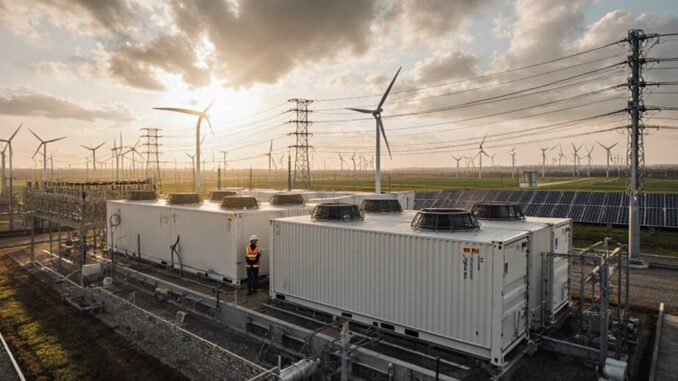
Battery storage is changing Germany’s energy system by absorbing surplus solar and wind power, then discharging during higher-demand, higher-price periods. Millisecond-response batteries provide frequency containment reserves, reduce curtailment, and limit reliance on gas-fired peakers. Residential systems raise rooftop-solar self-consumption, while grid-scale projects trade across balancing, intraday, and wholesale markets. Growth is accelerating, but grid connections, charging rules, and shrinking reserve revenues remain constraints. The sections ahead explain these market and grid effects.
Why Battery Storage Matters in Germany
Germany’s power system requires battery storage to manage the growing mismatch between variable renewable generation and electricity demand. Solar output peaks around midday, while residential and commercial loads often rise later, creating intraday price spreads, curtailment risk, and balancing requirements. Wind production adds further variability across hours and regions.
Batteries respond within milliseconds, supplying frequency containment reserves, redispatch support, peak shaving, and energy shifting. This flexibility reduces reliance on gas-fired peakers and helps distribution networks accommodate electrification from heat pumps, electric vehicles, and decentralized generation without equivalent grid expansion.
For households and businesses, behind-the-meter systems increase Electricity autonomy by storing surplus photovoltaic output for later use and limiting exposure to volatile retail prices. At the local level, batteries can underpin resilient microgrids, maintaining critical loads during grid disruptions when combined with islanding controls and dispatchable backup. Their value depends on cycling economics, tariff structures, ancillary-service revenues, and interconnection rules.
Germany’s Growing Battery Storage Market
Driven by falling lithium-ion costs, high retail electricity prices, and rapid photovoltaic deployment, the German battery-storage market has expanded across residential, commercial, and utility-scale segments. Installed battery capacity has risen sharply since 2020, supported by declining cell prices, grid-balancing revenues, and increasing renewable curtailment risks. Market growth is shifting from small distributed systems toward larger projects designed to trade across frequency-control, intraday, and wholesale power markets.
Utility scale adoption trends indicate accelerating project pipelines, particularly near transmission constraints and renewable-generation centers. Stand-alone systems and co-located batteries are increasingly sized for two- to four-hour durations, although revenue stacking remains essential to investment cases. Developers are targeting ancillary-service markets while positioning assets for price spreads created by variable wind and solar output.
Financing and regulation remain central constraints. Bankability depends on contracted revenues, merchant-risk assumptions, connection timelines, and evolving grid-fee treatment. Clearer permitting procedures and market rules could reduce development risk and unlock larger institutional capital allocations.
Home Battery Storage and Rooftop Solar
German households are increasingly pairing rooftop photovoltaic systems with batteries to raise on-site solar self-consumption and reduce exposure to retail electricity prices. Storage economics depend on PV yield, load profiles, tariff structures, and battery cycling, while full energy independence remains limited by seasonal generation variability. Smart, connected batteries can also shift charging and discharge in response to grid signals, creating potential flexibility value for households and distribution networks.
Self-Consumption And Energy Independence
Home battery storage paired with rooftop photovoltaics is increasing household self-consumption in Germany by shifting surplus midday generation into evening demand periods. Typical residential lithium-ion systems store several kilowatt-hours, reducing grid purchases when solar output falls and improving the economics of behind-the-meter generation. Higher retail electricity prices relative to export remuneration strengthen the investment case, particularly for households with heat pumps or electric vehicles. Demand shifting allows stored solar electricity to cover cooking, lighting, and overnight base loads, while Peak shaving can limit short-duration imports during high-use intervals. This increases Energy autonomy without eliminating seasonal reliance on the distribution network. At market scale, lower household imports can moderate local demand peaks and provide indirect grid support, although system value depends on installation costs, cycling behavior, tariff design, and available photovoltaic capacity.
Smart Batteries And Grid Flexibility
Smart home batteries coupled with rooftop solar can extend their role beyond self-consumption by responding to price signals, distribution-grid constraints, and aggregation requests. Through energy-management systems, batteries can charge during midday photovoltaic surpluses or low wholesale-price periods and discharge during evening peaks, reducing local transformer loading. Aggregators can pool thousands of residential units into virtual power plants, creating dispatchable capacity for Grid Services. Bidirectional inverters enable rapid Frequency Support by adjusting output within seconds when system frequency deviates from 50 hertz. Market participation depends on metering, communication standards, regulatory access, and compensation sufficient to offset cycling costs. As dynamic tariffs and smart-meter deployment expand, household storage can shift from a passive resilience asset to a flexible distributed resource, supporting renewable integration while generating incremental revenue.
How Batteries Balance Wind and Solar
Battery systems absorb surplus wind and solar generation during low-price periods, reducing curtailment and shifting output to higher-demand hours. Their fast-response capability supplies frequency-containment reserves, supporting grid stability as variable renewable penetration rises. By arbitraging intraday price spreads and relieving peak demand, storage improves the market value and dispatchability of renewable electricity.
Storing Surplus Renewable Power
As wind and solar output increasingly diverge from hourly demand in Germany, battery storage absorbs surplus electricity during high-generation periods and discharges it when system prices and residual load rise. This shifts generation across intraday intervals, reducing reliance on gas-fired marginal units and improving renewable capture rates. Utility-scale systems typically charge during midday photovoltaic peaks or windy overnight hours, then export during evening demand peaks. Revenue depends on day-ahead and intraday price spreads, cycling costs, grid charges, and available connection capacity. Curtailing renewable surpluses becomes less necessary where batteries can be co-located with solar or wind plants, although storage duration limits the volume shifted across multi-day weather events. Peak shaving strategies also lower procurement exposure for industrial consumers and aggregators by reducing withdrawals during expensive settlement periods. Deployment thus increases the economic value of variable generation without requiring corresponding demand growth.
Stabilizing Grid Frequency
Germany’s power system requires frequency to remain close to 50 Hz, and battery energy storage can respond within milliseconds to deviations caused by forecast errors, wind ramps, solar fluctuations, or generator outages. Unlike thermal plants, batteries provide bidirectional power without startup delays, injecting electricity during under-frequency events and charging during over-frequency conditions.
This capability supports fast frequency containment, reducing the reserve capacity required from conventional generators. Grid operators procure such services through balancing markets, where battery projects compete on availability, response speed, and delivered energy. Market frequency response revenues increasingly improve project economics, particularly for systems located near volatile renewable generation or constrained network zones. By supplying precisely metered power under automated control, batteries help limit frequency excursions, maintain operational security, and integrate higher shares of variable wind and solar generation.
Shifting Energy Demand
Beyond sub-second frequency services, battery storage shifts electricity across hours to align supply with demand. It charges during solar midday surpluses or high-wind periods, then discharges when residual load and wholesale prices rise. This time shifting reduces curtailment, moderates Peak demand, and improves renewable asset revenues.
- Noon charging absorbs low-priced photovoltaic output.
- Evening discharge supplies households after solar generation falls.
- Wind-linked charging captures output during overnight oversupply.
- Arbitrage follows day-ahead, intraday, and balancing-market price spreads.
- Capacity located near constraints can defer network reinforcement.
For Germany, economics depend on cycle efficiency, degradation, connection fees, and market access. Four-hour systems increasingly target evening scarcity windows, while shorter-duration fleets stack ancillary services with intraday trading. As variable generation expands, batteries convert intermittent production into dispatchable, price-responsive supply, narrowing the gap between renewable availability and consumption patterns.
How Grid-Scale Batteries Stabilize the Grid
Grid-scale batteries stabilize Germany’s power system by responding within milliseconds to deviations between electricity supply and demand, thereby helping maintain the 50-hertz grid frequency required for reliable operation. Their inverters can inject or absorb power almost instantaneously, making them effective providers of frequency containment reserve and other fast-response balancing products.
Unlike conventional generators, battery assets do not require fuel combustion or ramp-up time. They measure grid conditions continuously and execute automated dispatch signals through transmission-system-operator markets. This capability is increasingly valuable as variable wind and solar output expands while synchronous fossil capacity retires.
Aggregated installations can also operate as virtual powerplants, combining distributed battery capacity into dispatchable portfolios. These portfolios bid into reserve auctions, optimize state of charge, and deliver contracted grid services under defined availability and response requirements. Revenue depends on technical prequalification, cycling limits, connection capacity, and market clearing outcomes. By supplying rapid reserves locally, batteries can reduce operational stress on network assets and support secure system balancing.
How Battery Storage Affects Electricity Prices
As battery capacity expands, it reshapes wholesale electricity prices by charging during low-price periods—often marked by high wind or solar generation—and discharging when demand and marginal generation costs are higher. This arbitrage narrows intraday price spreads, although its effect depends on installed capacity, round-trip efficiency, and trading behavior.
- Charging increases demand in oversupplied hours, supporting depressed prices.
- Discharging adds supply during peak hours, moderating price spikes.
- Faster response strengthens market price signals across day-ahead and intraday auctions.
- Aggregated batteries can reduce Electricity volatility caused by forecast errors and abrupt renewable-output changes.
- Price impacts diminish as storage fleets compete for the same spreads.
In Germany’s merit-order market, batteries do not set prices continuously; they alter residual demand at specific intervals. Their value rises when hourly spreads exceed efficiency losses, network charges, and transaction costs. As deployment scales, declining spreads may reduce arbitrage returns while increasing the importance of capacity-aware dispatch, congestion pricing, and ancillary-market revenues.
How Batteries Reduce Fossil Fuel Use
Battery storage reduces fossil fuel use by shifting low-carbon electricity from periods of surplus wind and solar generation into hours that would otherwise require output from gas- or coal-fired marginal plants. In Germany’s wholesale market, this arbitrage lowers residual demand during evening peaks and reduces the running hours of thermal units at the margin.
Peak shaving is especially valuable when demand is high and renewable output falls quickly. Batteries can discharge within seconds, limiting the need to start or ramp gas turbines and reducing coal generation during constrained periods. Their effect depends on charging sources, round-trip efficiency, dispatch timing, and local grid conditions.
Renewable smoothing also reduces curtailment: electricity that might otherwise receive low or negative prices can be stored and sold later when system value is higher. As solar and wind capacity expands, storage increasingly substitutes for short-duration fossil flexibility. The resulting emissions reduction is greatest when batteries charge during renewable surpluses and displace carbon-intensive generation during peak-price hours.
How EV Batteries Could Support the Grid
Electric vehicles could become a distributed storage resource in Germany because most cars remain parked for long periods while connected at home, workplaces, or public chargers. Managed charging can shift demand toward low-price, renewable-rich hours, while bidirectional vehicles can export electricity during evening peaks. At scale, aggregated fleets could operate as Virtual powerplants, supplying flexibility measured in megawatts rather than relying solely on stationary assets.
- Smart charging absorbs midday solar generation.
- Vehicle-to-grid discharge reduces peak procurement costs.
- Aggregators pool thousands of batteries into dispatchable capacity.
- Frequency-response services create additional revenue streams.
- Fleet operators can optimize charging against wholesale prices.
A million connected vehicles with 50 kWh usable capacity would represent 50 GWh of theoretical storage, although only a share would be market-available at any time. EV batteries are best suited to intraday balancing, congestion management, and reserve markets; they are not a primary tool for seasonal arbitrage. Their economic value depends on availability windows, cycling limits, tariff design, and wholesale-price spreads.
Barriers to Battery Storage Growth in Germany
Despite rapid deployment, Germany’s battery-storage market faces constraints that limit project economics and system integration. Permitting and interconnection requirements vary by distribution-system operator, creating uncertain timelines, duplicate studies, and substantial development costs. Grid access delays are particularly material in congested regions, where available connection capacity may not match project-ready storage sites.
Revenue stacking also remains constrained. Frequency-control markets have attracted batteries, but increasing capacity compresses ancillary-service prices and reduces merchant returns. Wholesale arbitrage margins depend on intraday volatility, balancing-market rules, network charges, and bidirectional metering arrangements. Storage projects can face tariffs or levies that treat charging as final consumption, despite subsequent grid discharge.
Technical standards add complexity: operators must demonstrate controllability, remote communication, protection coordination, and compliance with connection codes. Financing thus depends heavily on contracted revenues or conservative assumptions about degradation, augmentation costs, and utilization. For smaller systems, fragmented market access and aggregator fees can further reduce net returns. These barriers slow conversion of announced capacity into operational assets.
What’s Next for Battery Storage in Germany
Germany’s next phase of storage growth will depend less on announced capacity than on faster grid connections, clearer charging-treatment rules, and revenue models that extend beyond frequency containment reserves. Deployment is likely to shift toward co-located solar, wind, and transmission-constrained nodes, where batteries can defer reinforcement and capture intraday spreads.
- Next policy incentives could prioritize connection queues, flexibility procurement, and locational signals.
- Grid scale expansion requires standardized permitting, transformer availability, and transparent curtailment data.
- Market redesigns may widen participation in balancing, congestion management, and capacity-like mechanisms.
- Bankable revenue models will require contracted floors alongside merchant arbitrage income.
- Four-hour systems could gain value as renewable output rises and coal capacity exits.
For investors, the central test is revenue stacking under realistic degradation, cycling, and grid-charge assumptions. Germany’s storage pipeline is large, but commissioned capacity will be determined by interconnection execution and dispatch economics. Distribution-network batteries may also become material where electrification raises local peaks, provided tariffs reward avoided network costs.

The Energy & Infrastructure Editorial Team covers Germany’s changing energy and infrastructure landscape. Key topics include the Energiewende, renewable energy, electricity grids, hydrogen, energy storage, industrial energy supply and major infrastructure projects. The editorial focus is on explaining how energy policy, technology and infrastructure affect German industry, businesses and the wider European economy.