
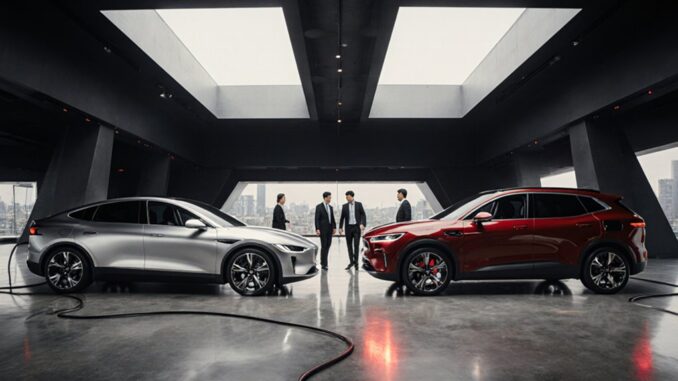
German carmakers are responding to Chinese EV competition by lowering costs through dedicated platforms, standardized batteries, LFP chemistry, and shared components. Volkswagen, BMW, and Mercedes-Benz are rebuilding vehicles around modular, software-defined architectures that support over-the-air upgrades and faster feature releases. They are also localizing battery supply, expanding charging networks, and using leasing incentives to narrow price gaps. Their ability to match China’s refresh speed and mass-market pricing remains decisive, as the competitive details show.
Why Chinese EV Brands Are Winning in Europe
Chinese EV brands are gaining traction in Europe by combining lower prices, fast product cycles, and increasingly competitive technology. Their expansion has coincided with tighter household budgets, reduced EV subsidies in several markets, and demand for affordable electric models. Chinese manufacturers benefit from vertically integrated battery supply chains, domestic scale, and shorter development timelines, allowing frequent model updates and aggressive pricing.
Market timing has also benefited new entrants. European consumers are shifting from early-adopter purchases toward mass-market segments, where monthly payments, charging range, and delivery availability often outweigh heritage. Brands such as BYD, MG, and NIO have expanded dealer networks, leasing offers, and localized marketing while European incumbents manage costly platform transitions.
Brand perception remains mixed: established German marques retain stronger associations with engineering, safety, and residual values. However, awareness of Chinese EVs is improving as products receive stronger safety ratings, longer warranties, and more visible retail presence. This gradual normalization supports market share gains across price-sensitive European segments.
Where Chinese EVs Outperform German Carmakers
The competitive advantage is most visible in high-volume EV segments, where Chinese manufacturers often offer lower entry prices, more standard equipment, and faster delivery than German rivals. Models from BYD, MG, and GWM commonly bundle large touchscreens, advanced driver-assistance features, heat pumps, and battery warranties that may remain optional or cost extra on comparable German vehicles. Their Lower manufacturing cost structure, supported by integrated battery supply chains and scale in lithium-ion production, enables aggressive pricing in compact SUVs and city cars.
Chinese brands also demonstrate faster local adaption. European-market vehicles increasingly receive localized software, multilingual interfaces, dealer-backed service networks, and charging compatibility tailored to regional standards. Product-development cycles can be shorter, allowing Chinese makers to update infotainment, battery chemistry, and trim specifications more frequently. German manufacturers retain advantages in premium branding, engineering reputation, and fleet relationships, but Chinese competitors are strongest where buyers prioritize upfront value, digital features, and immediate availability over established badge prestige.
How German Carmakers Are Cutting EV Costs
German carmakers are targeting lower EV prices through dedicated platforms, battery standardization, and leaner production, responding to Chinese rivals whose cost advantages are strongest below the €40,000 segment. Volkswagen, BMW, and Mercedes-Benz are reducing model complexity, increasing common parts usage, and negotiating longer-term cell supply contracts to lower material and procurement expenses. Battery scaling is central: higher-volume cell formats, simplified pack designs, and greater use of lithium-iron-phosphate chemistry can reduce battery costs versus nickel-rich alternatives.
Manufacturing efficiency is also becoming a decisive metric. German groups are consolidating EV output in selected plants, automating body assembly, and shortening development cycles to improve factory utilization. Chinese producers retain advantages in local supply chains, faster sourcing, and lower labor costs, but German manufacturers can offset part of the gap through scale and premium pricing discipline. The immediate objective is not matching China’s lowest prices, but restoring margins on compact and mid-size electric models while maintaining established safety, quality, and service standards.
How German Carmakers Are Rebuilding EV Platforms
German automakers are replacing legacy EV architectures with modular platforms designed to support multiple brands, vehicle segments, and battery formats at lower unit costs. Software-defined vehicle systems are becoming central to this shift, enabling over-the-air upgrades and reducing the hardware complexity that has slowed European development programs. The objective is to shorten product cycles toward the pace set by Chinese EV competitors while preserving premium engineering margins.
Next-Generation Modular Architectures
Against Chinese EV specialists built around software-defined, high-volume architectures, Germany’s leading carmakers are consolidating fragmented vehicle platforms into modular EV systems designed to cut development time, reduce component complexity, and support faster software updates. Volkswagen’s MEB and forthcoming SSP, BMW’s Neue Klasse, and Mercedes-Benz’s MMA aim to serve multiple segments with shared battery, motor, and electrical foundations. This modular scalability reduces tooling duplication and raises purchasing volumes across compact cars, SUVs, and premium models. BMW expects Neue Klasse production to begin in 2025, while Volkswagen targets SSP deployment later this decade across millions of vehicles. The strategic objective is rapid integration of new battery chemistries, powertrain variants, and manufacturing processes without redesigning each model independently. Compared with Chinese rivals’ vertically integrated scale, German groups are using standardized architectures to improve cost discipline and accelerate model renewal.
Software-Defined Vehicle Platforms
As electric vehicles become increasingly defined by software rather than mechanical differentiation, German manufacturers are redesigning their platforms around centralized computing, over-the-air updates, and fewer electronic control units. Volkswagen’s software strategy, BMW’s Neue Klasse electronics, and Mercedes-Benz’s MB.OS illustrate a shift from distributed vehicle functions toward domain and zonal architectures. These systems consolidate processing capacity, reducing wiring complexity and enabling features to be deployed after sale. Chinese competitors such as BYD and NIO have already integrated digital services tightly with vehicle hardware, raising expectations for interface quality and update reliability. German groups are responding with proprietary operating systems, supplier partnerships, and cloud architecture that links vehicles, factories, and customer services. The commercial objective is recurring software revenue, while agile delivery improves validation, cybersecurity management, and feature consistency across increasingly standardized EV model ranges worldwide.
Faster Development Cycles
The competitive gap is increasingly measured in development speed rather than battery range alone. Chinese EV manufacturers can typically move from concept to launch in 18 to 30 months, compared with traditional German programs that have often required four to five years. Volkswagen, BMW, and Mercedes-Benz are responding by consolidating vehicle architectures, reducing component variation, and shifting more validation into virtual engineering.
Rapid prototyping enables earlier testing of battery packs, electronics, and software integrations, limiting costly late-stage revisions. Modular platforms such as Volkswagen’s MEB and forthcoming SSP are intended to support multiple models with shared hardware and standardized interfaces. German groups are also pursuing agile supply chains, bringing suppliers into design decisions earlier and regionalizing procurement for critical components. The objective is not simply shorter launches, but faster upgrades, lower development costs, and greater responsiveness to changing customer expectations.
How Germany Is Closing the Software and Battery Gap
Germany’s response to China’s EV lead is increasingly centered on software-defined vehicles and localized battery supply chains. German manufacturers are restructuring engineering around centralized computing, over-the-air updates, and proprietary operating systems, areas where Chinese competitors have benefited from faster consumer-electronics integration.
- Volkswagen’s software unit and partnerships seek to reduce reliance on fragmented supplier code while accelerating feature deployment.
- BMW and Mercedes-Benz are introducing next-generation electrical architectures designed to support continuous upgrades, advanced driver assistance, and lower wiring complexity.
- Battery supply investments, including cell plants and materials partnerships, aim to improve cost control, traceability, and production resilience.
Localized manufacturing is equally important because transport costs, trade exposure, and carbon-accounting rules increasingly influence battery economics. German groups remain behind leading Chinese firms in cell-scale capacity and software iteration speed, but their advantages include premium-brand pricing, established engineering standards, and deeper European supplier relationships. The strategy is to narrow capability gaps through vertical integration rather than merely sourcing Chinese technology.
Can German Carmakers Regain Ground in Europe?
German carmakers’ ability to regain European EV share will depend on narrowing price gaps with Chinese rivals while accelerating competitive model refreshes. Charging-network coverage and reliability remain key purchase variables, where coordinated investment can strengthen domestic brands’ value proposition. EU incentives, tariffs, and fleet-emissions rules will further shape whether German manufacturers convert industrial scale into market-share recovery.
Pricing and Model Refreshes
Price competition has become a central test of whether Europe’s established automakers can defend share against Chinese EV entrants: brands such as BYD and MG have paired lower-cost vehicles with frequent product updates, while German groups have relied more heavily on premium positioning and longer refresh cycles.
Dynamic pricing strategies are narrowing that gap, particularly through leasing incentives, dealer subsidies, and software-led feature bundles. German manufacturers must protect margins while responding to rivals whose vertically integrated supply chains support aggressive discounts.
- BYD and MG target high-volume segments with lower entry prices.
- Volkswagen, BMW, and Mercedes-Benz emphasize residual values and brand equity.
- Frequent model refreshes improve perceived technology without full redesign costs.
The competitive benchmark is shifting from headline list prices to monthly payments, equipment levels, and delivery speed. German groups can regain ground if revised platforms reduce costs quickly enough to support competitive offers.
Charging Networks and Policy
Although vehicle pricing shapes purchase decisions, charging access and regulatory design increasingly determine whether European buyers view German EV brands as practical alternatives to Chinese rivals. Germany’s manufacturers are expanding branded networks through Ionity, Mercedes-Benz Charging and Volkswagen’s Elli, while Chinese entrants often rely on roaming agreements and third-party operators. Ionity’s high-power footprint offers a competitive advantage on motorway corridors, but coverage gaps in apartment-dense cities remain material.
Policy is equally decisive. EU Alternative Fuels Infrastructure Regulation targets chargers every 60 kilometres on core transport routes, strengthening baseline access for all brands rather than protecting incumbents. German groups can differentiate through reliable payment systems, battery preconditioning and grid interoperability across networks. National fast charging incentives may accelerate deployment, although fragmented permitting and distribution-grid constraints continue to delay stations. Superior uptime, transparent pricing and seamless cross-border charging could materially narrow Chinese brands’ convenience advantage.
The Automotive & Mobility Editorial Team follows one of Germany’s most important industries and its transformation. Coverage ranges from automotive manufacturers and suppliers to electric vehicles, batteries, automotive software, autonomous driving, rail, logistics and new mobility concepts. The team examines both established German mobility companies and the technologies that could shape transportation in the future.