
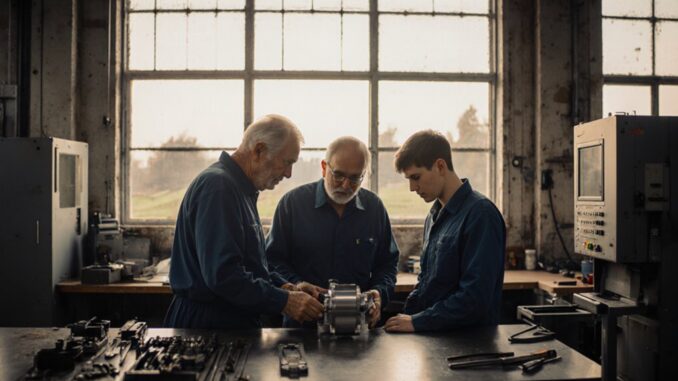
The German Mittelstand is a broad economic and social formation of small and medium-sized firms, often family controlled and rooted in regional communities. It has historically emphasized patient investment, skilled labor, technical specialization, and durable customer relationships. Many firms export niche products and become global “hidden champions” while retaining domestic production and decision-making. Germany has no single legal Mittelstand definition; SME thresholds are mainly statistical tools. Its ownership, training, and strategic practices explain its wider importance.
What Is the German Mittelstand?
Many such companies operate in manufacturing, engineering, business services, and specialized consumer markets. Their influence rests on patient investment, technical expertise, and durable relationships rather than short-term capital-market pressures. Family control commonly aligns ownership with management, although professional executives increasingly supplement founding families.
The *Mittelstand* also supports export capacity through niche products and internationally recognized quality standards. Cross border growth has extended the reach of many firms while preserving domestic production and decision-making centers. At the same time, succession planning has become a central institutional concern, as aging owners must transfer leadership, ownership, and strategic knowledge without weakening continuity.
How Germany Defines the Mittelstand
Germany defines the Mittelstand through both measurable size thresholds and institutional features that developed over time. Employment and turnover criteria provide a statistical framework, while family ownership and managerial control often determine whether a firm is regarded as Mittelstand in practice. Qualitative traits—such as long-term orientation, regional commitment, and independent decision-making—therefore remain central to the category.
Quantitative Size Criteria
No single statutory threshold defines the German *Mittelstand*; instead, public institutions and researchers commonly apply the European Commission’s SME criteria, under which firms employ fewer than 250 people and have annual turnover of no more than €50 million or a balance-sheet total below €43 million. These limits provide a standardized administrative framework for statistical comparison, funding eligibility, and policy analysis across member states. In German practice, however, classifications often use broader employee ranges and revenue thresholds to distinguish micro, small, medium-sized, and larger firms. The IfM Bonn, a prominent research institute, has historically employed its own categories, commonly defining small and medium enterprises through workforce and sales measures. Such quantitative indicators clarify the economic scale of firms, but they remain analytical conventions rather than a legally exclusive definition. Consequently, institutions may report differing totals depending on the criteria adopted.
Family Ownership and Control
- Ownership commonly remains concentrated among founders or descendants.
- Voting rights enable owners to direct major strategic decisions.
- Succession planning preserves control through generational changes.
- Intergenerational governance structures formalize family representation and authority.
Institutional definitions, particularly those associated with the IfM Bonn, thus distinguish between legal ownership and operational leadership while treating both as relevant. A firm may qualify when a limited circle of owners controls its capital and exercises management directly or through appointed executives. This criterion explains why some comparatively large, privately held firms are counted within the *Mittelstand*, whereas similarly sized companies with dispersed ownership are not.
Qualitative Mittelstand Characteristics
Ownership and management criteria provide the institutional core of the *Mittelstand*, but German usage also denotes a broader set of qualitative characteristics. Historically, these firms have been associated with long planning horizons, regional embeddedness, and durable relationships with employees, suppliers, and customers. Their identity is shaped less by formal size thresholds than by responsible entrepreneurship and independence in strategic decisions. An Employee Centric Culture commonly appears through apprenticeship, internal advancement, and retention during cyclical downturns, reinforcing local skills and institutional continuity. A Continuous Innovation Mindset complements this stability: firms refine specialized products, production methods, and export capabilities over decades rather than pursuing short-term expansion. Such traits are neither universal nor legally binding. Nevertheless, they explain why German policy, research, and public debate often treat the Mittelstand as an economic and social formation, not merely a statistical category.
What Makes Mittelstand Companies Different?
Mittelstand companies are often distinguished less by size than by their ownership structures and strategic time horizons. Family or closely held control has historically encouraged patient investment, continuity in management, and independence from short-term market pressures. These firms also frequently achieve global leadership in narrow technical niches, combining specialization with export-oriented production.
Long-Term Ownership Focus
A defining feature of German Mittelstand firms is their long-term ownership structure, often rooted in family control across several generations. This arrangement historically supports continuity in governance, investment, and local employment rather than short-term financial extraction. Ownership and management frequently remain closely connected, reinforcing institutional memory and accountability.
- Succession planning is treated as a strategic process, preparing heirs or external managers years in advance.
- Patient capital permits investment decisions based on durability, modernization, and resilience.
- Family oversight often preserves company values, regional ties, and established supplier relationships.
- Employee apprenticeship programs receive sustained support because skills development is viewed as an intergenerational asset.
Such ownership patterns do not eliminate risk or conflict, but they encourage decisions measured against the firm’s future viability, workforce stability, and reputation within its community.
Specialized Global Leadership
What distinguishes many German Mittelstand companies is their ability to command global markets through narrow technical specialization. Often rooted in industrial districts and family ownership, these firms refine particular components, machinery, chemicals, or production systems over decades. Their competitive position rests less on scale than on accumulated engineering knowledge, dependable quality, and close integration with customer processes.
Such specialization has historically enabled relatively modest enterprises to become “hidden champions” in export markets. Global leadership traits emerge through patient investment in research, apprenticeship, and international service networks rather than rapid expansion alone. Managers must also possess cross cultural management skills, since sales, maintenance, and supplier relationships increasingly span distinct regulatory and commercial environments. The Mittelstand model thus combines local institutional continuity with outward-looking technical authority, allowing firms to retain domestic roots while shaping specialized segments of global industry.
Why Family Ownership Is Common
Family ownership is common in the German Mittelstand because many firms developed as long-lived local enterprises rather than as vehicles for outside investment. Their governance structures were shaped by postwar reconstruction, regional lending institutions, and legal traditions that favored continuity over rapid turnover. Ownership often remains concentrated, allowing strategic decisions to reflect preservation, employment stability, and accumulated reputation.
- Cross generational succession keeps control within families and supports long planning horizons.
- Regional business networks connect firms with local banks, chambers, suppliers, schools, and municipal authorities.
- Family shareholders can retain earnings for modernization without facing constant pressure for short-term distributions.
- Concentrated ownership may also preserve a company’s identity during economic disruption, acquisitions, or leadership transitions.
This model is not universal, and some family firms employ external managers or seek outside capital. Nevertheless, family control has historically provided an institutional framework for patient investment, workforce attachment, and durable local accountability. It also links commercial authority to inherited responsibility, reinforcing continuity across changing markets and generations.
Mittelstand Hidden Champions and Niche Expertise
Often described as “hidden champions,” many Mittelstand firms occupy specialized global markets while remaining little known to the general public. This designation, popularized in management research from the late twentieth century, identifies companies whose revenues may be modest relative to multinational conglomerates but whose technical positions are unusually strong.
Their niche expertise commonly emerges from long investment cycles, close relationships with industrial customers, and accumulated engineering knowledge. Rather than diversify broadly, such firms pursue highly focused strategies in fields such as precision components, measurement systems, industrial software, or specialized machinery. Specialized production enables adaptation to demanding applications and regulatory standards that discourage rapid entry by competitors.
Many consequently become global market leaders within narrowly defined product categories. Their advantage rests less on mass visibility than on reliability, incremental innovation, service capacity, and operational excellence. Institutional continuity supports the preservation of technical capabilities across generations, while export-oriented customer networks provide feedback that refines products. The hidden-champion model hence reflects sustained specialization rather than anonymity alone.
The Mittelstand’s Role in Germany’s Economy
Within Germany’s coordinated market economy, the Mittelstand forms a central institutional base for employment, vocational training, regional production, and export capacity. Its importance developed through postwar reconstruction, when family-owned manufacturers, specialized suppliers, and service firms anchored industrial renewal beyond major metropolitan centers. Their long-term ownership structures commonly connect commercial strategy with local labor markets and civic institutions.
- Employment stability: Mittelstand firms sustain a substantial share of private-sector jobs across towns and industrial districts.
- Workforce training: Through dual-system apprenticeships retention, companies preserve technical knowledge and create durable pathways into skilled occupations.
- Regional supply chains: Dense networks of suppliers, machine builders, logistics firms, and customers support decentralized production and specialized collaboration.
- Export resilience: Niche producers diversify Germany’s external trade by serving global markets in industrial equipment, components, chemicals, and precision technologies.
Collectively, these enterprises translate vocational institutions, local investment, and specialized production into a broadly distributed economic structure.
Challenges Facing the Mittelstand Today
Despite its institutional strengths, the Mittelstand faces pressures that challenge established models of ownership, production, and workforce development. Rising energy costs, disrupted supply chains, and intensified global competition have narrowed margins for firms long accustomed to specialized, export-oriented manufacturing. Digital transformation urgency has become particularly acute as smaller companies must modernize data systems, automation, cybersecurity, and customer interfaces without the investment capacity of larger corporations.
Demographic change compounds these difficulties. Skilled-labor shortages affect technical occupations, while vocational training systems struggle to replace retiring workers. At the ownership level, succession planning pressures confront many family enterprises whose founders or heirs lack willing, prepared successors. This can encourage sales to external investors, potentially altering traditions of local control and long-term stewardship.
Regulatory complexity and decarbonization requirements further demand administrative and financial resources. The Mittelstand’s resilience remains substantial, but adaptation increasingly depends on access to capital, digital expertise, and qualified labor.

The Business & Economy Editorial Team covers Germany’s economy, companies, markets and international trade. Its reporting focuses on economic developments, investment, exports, the Mittelstand, major corporations and the conditions affecting businesses in Germany. The team combines current economic news with background articles and analysis to explain what developments mean for companies, investors and international readers.