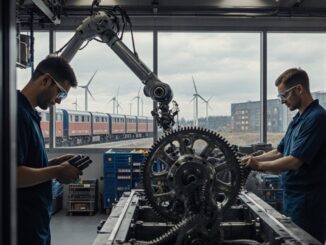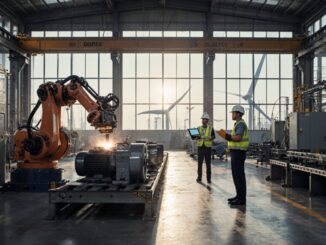
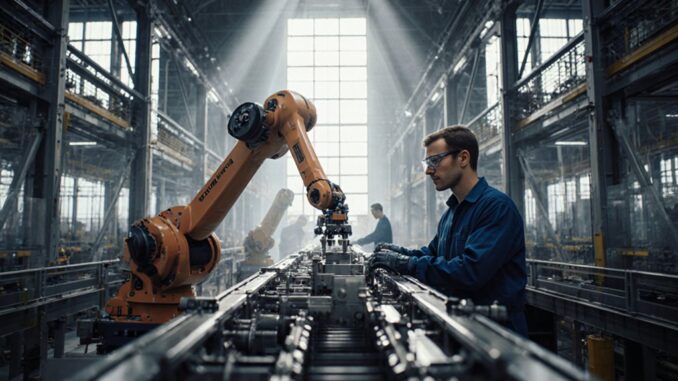
Manufacturing matters to Germany because it produces about one-fifth of gross value added and directly employs roughly eight million people. Automotive, machinery, chemicals, electrical equipment, and pharmaceuticals drive high-value exports and support extensive supplier, logistics, and business-service networks. Dual training and innovative Mittelstand firms sustain specialised skills and productivity. Yet high energy costs, global competition, and decarbonisation are reshaping industrial policy. The following sections explain these forces in greater detail.
How Manufacturing Supports Germany’s Economy
Manufacturing remains a central pillar of Germany’s economy, accounting for roughly one-fifth of gross value added and employing about eight million people directly. Its influence extends through supplier networks, business services, logistics, energy systems, and regional labour markets, supporting investment and productivity beyond factory floors.
The sector is concentrated in automotive, machinery, chemicals, electrical equipment, pharmaceuticals, and metalworking, giving policymakers a broad industrial base rather than dependence on a single activity. Manufacturing also sustains research and development expenditure, technical training, and demand for skilled engineering occupations. These links strengthen Macroeconomic resilience by diversifying employment and maintaining domestic capabilities during shifts in demand or supply disruptions. Integration into global value chains provides firms with specialised inputs and scale, while domestic supplier clusters retain significant economic activity within Germany. Policy priorities also include reliable energy, modern transport and digital infrastructure, workforce development, competitive financing, and predictable regulation. Such measures help preserve industrial capacity, support regional cohesion, and improve the economy’s ability to absorb external shocks.
Why German Manufacturing Powers High-Value Exports
Beyond its domestic role, German industry underpins an export model centred on high-value, specialised goods. Machinery, vehicles, chemicals, electrical equipment, medical technology and industrial automation account for a large share of merchandise exports, linking production capacity to overseas investment cycles and global demand. Germany’s export leadership rests less on commodity volume than on engineering-intensive products embedded in complex supply chains, where reliability, certification, after-sales service and technical standards raise entry barriers.
This structure is reinforced by policy frameworks supporting research, export finance, trade agreements, infrastructure and European single-market access. Automotive exports remain important, but capital goods and advanced components broaden the base, reducing reliance on any one product category. Demand from EU partners, North America and Asian industrial markets supports scale, while German producers benefit from reputations in precision manufacturing and process quality. The resulting trade profile generates substantial foreign revenue and helps finance imports of energy, raw materials and intermediate inputs, making industrial competitiveness central to Germany’s external economic position.
German Manufacturing, Skilled Jobs, and Mittelstand Firms
Manufacturing sustains a large share of Germany’s skilled employment through dual vocational training, engineering education, and sector-specific apprenticeships. Mittelstand firms reinforce this base by linking long-term investment, specialized production, and incremental innovation in export-oriented industrial niches. Policies that expand training capacity, digital skills, and financing for smaller manufacturers are accordingly central to preserving high-value jobs.
Skilled Workforce Development
Germany’s manufacturing base depends on a large pool of skilled workers trained through its dual vocational education system, which combines classroom instruction with paid company apprenticeships. Apprenticeship programs supply technicians, machinists, mechatronics specialists, and industrial electricians to automotive, machinery, chemicals, and electrical-equipment producers. Training standards are jointly shaped by employers, chambers of commerce, vocational schools, and union partnerships, helping align curricula with workplace requirements and wage agreements.
This system reduces school-to-work __transfers__ and supports production quality in export-oriented sectors. However, demographic ageing and competition for digital skills are tightening labor supply. Federal and state policy __as a result__ emphasizes expanded vocational-school capacity, retraining for automation-related roles, faster recognition of foreign qualifications, and targeted recruitment of younger workers. For manufacturers, workforce development is increasingly a capacity constraint rather than solely a human-resources function.
Mittelstand Innovation Culture
The Mittelstand—predominantly small and medium-sized, often family-owned firms—anchors innovation across Germany’s machinery, automotive supply, precision engineering, electrical equipment, and chemical sectors. Their competitiveness rests on long-term investment horizons, close customer relationships, and incremental improvements in specialized products and production processes. Many firms occupy global niche positions, exporting highly customized components, industrial tools, sensors, and automation systems. Policy support strengthens this model through tax incentives, technology-transfer networks, export finance, and regional innovation clusters. Research funding, including programs linked to applied institutes and university partnerships, helps smaller manufacturers adopt digital production, advanced materials, energy-efficient equipment, and industrial AI. The resulting innovation system diffuses technical capabilities beyond major corporations, sustaining dense supplier networks and reinforcing Germany’s capacity to commercialize engineering research in globally traded manufacturing markets.
High-Value Employment
Beyond its contribution to output and exports, German manufacturing sustains a large share of high-value employment in engineering, skilled trades, technical services, and industrial research. Automotive, machinery, chemicals, electrical equipment, and precision instruments depend on technicians, toolmakers, software specialists, and production engineers whose skills support productivity and quality control. Mittelstand firms are especially important because they anchor employment in smaller cities and industrial regions, often maintaining long-term supplier networks and local training capacity. Apprenticeship pathways connect vocational schools with employers, helping firms replenish specialized capabilities as experienced workers retire. This system can strengthen workforce stability, but demographic ageing and shortages in digital, electrical, and metalworking occupations raise policy challenges. Investment in vocational education, reskilling, childcare, and targeted skilled migration is thus central to preserving Germany’s industrial labor base and its capacity for technological upgrading.
How Innovation Keeps German Manufacturing Competitive
Innovation sustains German manufacturing’s competitiveness by translating high research intensity into advanced products, efficient production systems, and export capacity. Industrial firms channel substantial R&D spending into automotive engineering, machinery, chemicals, medical technology, and industrial software. This specialization supports premium pricing and reinforces supplier networks across regions.
- Digital automation raises precision, throughput, and quality control in factories.
- Research partnerships connect companies with universities, Fraunhofer institutes, and applied-science centers.
- Public incentives accelerate commercialization in batteries, semiconductors, robotics, and hydrogen equipment.
- Standards leadership helps German producers shape global markets for safety, efficiency, and interoperability.
Policy instruments such as R&D tax allowances, innovation grants, and technology-transfer programs reduce the gap between laboratory research and scalable production. Mittelstand firms benefit particularly from shared testing facilities and sector-specific advisory networks. The result is not innovation in isolation, but a manufacturing ecosystem able to upgrade products, processes, and skills continuously. That capacity protects Germany’s position in complex, knowledge-intensive value chains worldwide.
Energy Costs and Global Competition Challenge Industry
Yet Germany’s innovation-led industrial model faces mounting pressure from comparatively high energy prices and intensifying global competition. Electricity and gas costs weigh heavily on chemicals, metals, glass, paper, and other energy-intensive sectors, where margins depend on predictable input costs. The end of cheap Russian pipeline gas exposed structural vulnerabilities, while network charges, taxes, and carbon-related obligations can widen cost gaps with the United States, China, and parts of the Middle East.
Policy debates accordingly focus on energy intensive pricing arrangements, faster grid expansion, and targeted relief that complies with EU state-aid rules. Manufacturers also confront competitors supported by larger domestic markets, lower labor costs, or aggressive industrial subsidies. Automotive suppliers face price pressure from Chinese producers, while machinery exporters contend with weaker global investment demand and protectionist procurement policies.
Supply chain resilience has become equally important. Firms are diversifying sourcing, holding selected inventories, and reassessing dependence on single-country suppliers, increasing operating costs but reducing disruption risks.
How Green Technology Is Reshaping German Manufacturing
Green technology is changing German manufacturing by redirecting investment toward electrified production, renewable-energy equipment, low-carbon materials, and circular processes. The Green transition is reshaping competitiveness as EU emissions rules, carbon pricing, and German subsidy programs alter capital-allocation decisions across chemicals, steel, automotive, machinery, and construction materials.
- Steelmakers are deploying electric-arc furnaces and hydrogen-ready direct-reduction plants to cut coal dependence.
- Chemical producers are prioritizing industrial electrification, heat pumps, and renewable heat for steam-intensive operations.
- Automotive factories are expanding battery-cell production, recycling capacity, and energy-efficient assembly lines.
- Mittelstand suppliers are using factory retrofits to reduce energy demand, digitize controls, and meet customer emissions targets.
Policy support remains decisive. Contracts for difference, climate-protection agreements, grid expansion, and faster permitting can narrow the cost gap between conventional and low-carbon production. Yet implementation depends on dependable electricity supplies, affordable clean hydrogen, and skilled labor. Firms that modernize early may secure export demand in markets where product-level carbon footprints increasingly influence procurement and regulation.
The Industry & Manufacturing Editorial Team focuses on Germany’s industrial economy and the technologies transforming production. Coverage includes mechanical engineering, manufacturing, automation, robotics, process industries, supply chains and industrial digitalisation. Particular attention is given to the German Mittelstand, specialised manufacturers and hidden champions that play an important role in global industrial markets.