
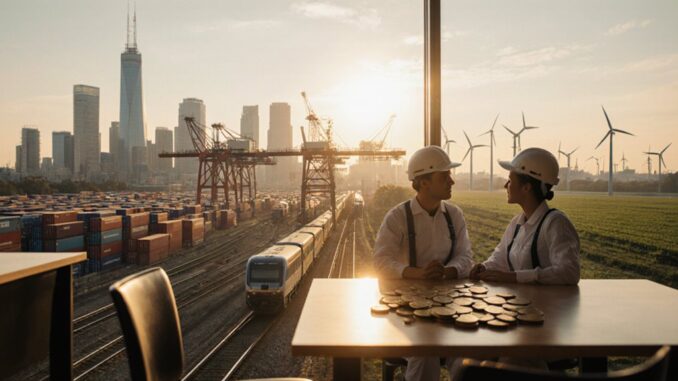
Germany has Europe’s largest economy, with GDP above €4 trillion and roughly one-quarter of EU output. Manufacturing, autos, machinery, chemicals, and the Mittelstand anchor exports near half of GDP. EU single-market access and the euro support trade. Yet high energy and labor costs, aging demographics, regulation, and weak investment constrain growth. Renewable expansion, grid upgrades, digital infrastructure, skilled migration, and supply-chain diversification are central policy priorities. The following facts explain these pressures and opportunities.
Germany Has Europe’s Largest Economy
Germany has Europe’s largest economy, with nominal GDP exceeding €4 trillion and accounting for roughly one-quarter of the European Union’s total output. Globally, it ranks among the world’s largest national economies, alongside the United States, China, Japan, and India, giving Berlin substantial influence over European economic policy.
Its scale reflects a diversified base spanning manufacturing, engineering, chemicals, pharmaceuticals, business services, and technology. Industry contributes a larger share of output than in many advanced economies, while high-value exports support employment and investment. However, domestic demand also matters: household consumption represents a major component of GDP and is shaped by wage growth, inflation, interest rates, and consumer confidence.
Fiscal policy is constrained by constitutional borrowing rules, although exceptions and investment programs have been used during crises. Policymakers face pressure to fund infrastructure, defense, energy transition, and digital modernization while preserving debt sustainability. Demographic aging and labor shortages could increasingly limit potential growth without productivity gains and workforce reforms.
The EU and Euro Support German Trade
Membership in the European Union and the euro area gives German firms tariff-free access to the EU single market, which absorbs roughly half of Germany’s goods exports. A shared currency also reduces exchange-rate costs and uncertainty across 20 euro-area economies, supporting predictable cross-border contracts.
Compared with exporters facing multiple currencies and customs regimes, German businesses benefit from common product rules, integrated logistics, and EU-wide competition policy. These advantages matter amid Brexit uncertainty and rising EU trade friction with major global partners.
- Families benefit when stable trade supports jobs and purchasing power.
- Small exporters gain confidence from simpler rules and lower transaction costs.
- Border regions depend on reliable daily movement of goods and workers.
- Policymakers face pressure to protect open markets during geopolitical shocks.
EU institutions consequently remain central to Germany’s trade strategy. Deepening the single market in services, digital commerce, energy, and capital could broaden resilience. At the same time, diversification beyond Europe remains important, because external demand, sanctions, and supply disruptions can still affect export revenues.
Manufacturing Powers the German Economy
Manufacturing remains a central driver of Germany’s economy, with automotive and machinery exports placing it among the world’s leading industrial suppliers. Innovation hubs across regions support advanced production, while coordinated research and industrial policy help firms compete globally. A highly skilled workforce, reinforced by vocational training, provides a key advantage over many comparable economies.
Automotive And Machinery Exports
Supported by dense industrial supply chains and advanced engineering, the automotive and machinery sectors remain central to Germany’s export economy. Vehicles, parts, machine tools, and production equipment underpin trade with EU partners, China, and the United States. Germany faces sharper competition from China’s Electric Vehicle producers and pressure to secure resilient Battery Supply networks. Policy thus emphasizes trade diversification, lower energy costs, charging infrastructure, and strategic investment rules.
- Export orders sustain skilled jobs across regions.
- Chinese price competition creates anxiety for suppliers.
- Disrupted components can halt factories within days.
- Cleaner technologies offer hope for industrial renewal.
Compared with France and Italy, Germany maintains a larger capital-goods base; compared with China, its producers command higher margins but face slower scale-up. EU industrial policy, open markets, and predictable standards will shape competitiveness.
Industrial Innovation Hubs
Germany’s industrial innovation hubs link research institutes, technical universities, specialized suppliers, and export manufacturers in regions such as Baden-Württemberg, Bavaria, North Rhine-Westphalia, and Saxony. These networks support advanced manufacturing clusters in automobiles, chemicals, machine tools, semiconductors, and industrial software. Germany invests roughly 3% of GDP in research and development, placing it among leading OECD economies and reinforcing commercialization links between laboratories and factories. Public policy supports collaboration through Fraunhofer institutes, federal research programs, regional development funds, and EU innovation initiatives. Saxony’s microelectronics base and Baden-Württemberg’s engineering ecosystem illustrate regionally concentrated specialization comparable to hubs in South Korea, Japan, and the United States. Renewable energy research also connects manufacturers with grid technologies, hydrogen systems, and efficiency equipment. This structure helps firms scale innovations while sustaining internationally competitive industrial supply chains.
Skilled Workforce Strength
A highly trained workforce is a central asset behind German manufacturing competitiveness, combining university engineering education with the dual vocational training system, which pairs classroom instruction with paid apprenticeships in firms. The Apprenticeship system helps firms align skills with machinery, quality standards, and export requirements. Vocational training supports Germany’s industrial employment base more effectively than in many advanced economies facing technician shortages.
- Young workers gain paid pathways into stable careers.
- Manufacturers retain expertise across generations.
- Communities benefit from lower youth unemployment risks.
- Exporters can sustain precision under global pressure.
Policy coordination among employers, chambers, unions, and schools strengthens certification and workplace learning. Germany’s aging population, however, intensifies competition for engineers, electricians, and digital specialists. Expanding recruitment, reskilling, and immigration remains essential to protect production capacity and innovation.
The Mittelstand Drives Innovation and Jobs
Often described as the backbone of the national economy, Germany’s Mittelstand consists largely of small and medium-sized, frequently family-owned firms that anchor industrial supply chains, exports, and regional employment. SMEs account for roughly 99 percent of German businesses and employ about 55 percent of the workforce, placing their role broadly in line with other advanced European economies but with an unusually strong manufacturing base.
Their importance lies in specialized production, long-term investment, and close links between companies, vocational schools, and research institutes. Mid market innovation is supported by applied research networks, public development lending, and tax incentives for research and development. Many firms lead global niches in machinery, industrial components, medical technology, and environmental equipment.
Regional entrepreneurship also distributes economic activity beyond major metropolitan areas, strengthening smaller cities and rural industrial districts. Policy challenges include succession planning, digital adoption, energy costs, and labor shortages. Effective measures increasingly focus on reducing administrative burdens, expanding financing, and accelerating technology transfer.
German Exports Connect Global Markets
As one of the world’s largest trading economies, Germany relies on exports of vehicles, machinery, chemicals, electrical equipment, and precision goods to link European production networks with markets in North America and Asia. Exports account for roughly half of GDP, a higher share than in France or the United States, reflecting deep industrial specialization and EU single-market integration.
- German components help factories across Europe remain competitive.
- Port, rail, and digital systems sustain livelihoods beyond national borders.
- Reliable Logistics and supply chains protect production during disruptions.
- Broad Global market access supports investment, skills, and regional employment.
Policy priorities include modernizing transport corridors, reducing customs friction, expanding trade agreements, and strengthening resilience for critical inputs. Germany’s export model also faces pressure to decarbonize freight, diversify suppliers, and meet stricter sustainability rules. Its performance consequently matters not only for domestic manufacturers, but for European value chains, global buyers, and workers whose jobs depend on predictable cross-border commerce.
China and the U.S. Shape German Trade
China remains a pivotal destination for German machinery, vehicles, and industrial goods, while the United States combines strong consumer demand with substantial investment links. Together, the two markets shape Germany’s export performance more than most bilateral relationships, reflecting their scale in global trade and capital flows. At the same time, geopolitical rivalry, supply-chain exposure, and tariff risks increase the policy importance of market diversification.
China as a Key Market
Germany’s trade exposure is strongly shaped by China and the United States, its two largest external economic partners. China remains key for German machinery, vehicles, chemicals, and industrial equipment, although competitive pressure from Chinese producers has intensified. Slower Chinese growth and shifting supply chains have made Export demand less predictable than during earlier export-led decades. Policymakers increasingly support China diversification through new markets, resilient sourcing, and European industrial capacity.
- Factory orders can weaken when Chinese investment slows.
- Automotive suppliers face mounting competition in electric vehicles.
- Smaller exporters confront uncertainty over regulations and logistics.
- Diversification offers reassurance, but transition costs remain substantial.
Compared with France or Italy, Germany’s manufacturing-heavy export model creates greater sensitivity to China’s industrial cycle. Trade policy accordingly emphasizes risk reduction rather than abrupt decoupling, balancing market access with strategic security and broader EU coordination.
U.S. Investment and Demand
The United States is Germany’s largest single-country export market, sustaining demand for automobiles, machinery, pharmaceuticals, chemicals, and industrial technology while also serving as a major destination for German direct investment. Bilateral goods trade exceeds that with most European partners, reflecting the scale of U.S. consumer demand and corporate purchasing power. German firms use U.S. investment to establish production, research, distribution, and service networks close to customers, reducing delivery times and supporting local employment. The United States also offers a large, high-income market with comparatively deep capital markets and strong demand for advanced manufacturing inputs. For German policymakers, transatlantic economic ties diversify export exposure beyond Asia and reinforce supply-chain links across sectors. Continued competitiveness depends on innovation, reliable energy, skilled labor, and predictable investment conditions on both sides of the Atlantic.
Trade Risks and Rivalry
Between the United States and China, Germany faces a trade structure increasingly shaped by strategic rivalry, export controls, subsidy competition, and supply-chain risk. China remains crucial for machinery, chemicals, and autos, while the United States is Germany’s largest single-country export market. Compared with France or Italy, Germany’s industrial exposure makes geopolitical volatility especially consequential.
- Factory orders can vanish when tariffs escalate.
- Semiconductor restrictions threaten production schedules.
- Chinese competition pressures German electric-vehicle margins.
- Dependence on distant inputs heightens public anxiety.
Policy responses emphasize diversified sourcing, EU trade-defense tools, and investment in domestic chips, batteries, and clean technologies. Supply chain friction raises costs even without formal sanctions, hence weakening competitiveness in export-intensive sectors. German policymakers therefore seek “de-risking,” not wholesale decoupling: preserving market access while reducing concentrated dependencies and protecting critical technologies, employment, and industrial capacity.
The Energy Transition Reshapes Industry
Since the 2011 nuclear phase-out and the 2022 energy crisis, Germany has accelerated a shift toward renewable electricity, grid expansion, and electrification while managing higher industrial energy costs than many competing economies. Wind and solar supplied a growing share of power generation, but variable output has increased the need for storage, flexible demand, and cross-border interconnection.
Renewable investment is supported through auctions, permitting reforms, and targets for faster deployment, while grid modernization aims to connect northern wind capacity with industrial centers in the south and west. Electricity prices remain a competitiveness concern for chemicals, steel, glass, and other energy-intensive sectors, particularly compared with producers benefiting from lower US natural-gas costs or subsidized Chinese inputs. Policy hence combines carbon pricing, compensation for network charges, and support for hydrogen and clean-manufacturing projects. The changeover is reshaping capital expenditure and supply chains: firms are investing in efficiency, electrified processes, and long-term power contracts, while weighing production locations against regulatory certainty and energy availability.
An Aging Workforce Constrains Growth
Demographic change is tightening Germany’s labor supply as large cohorts approach retirement and the working-age population is projected to decline without sustained immigration and higher labor-force participation. Germany’s old-age dependency ratio is among Europe’s highest, placing it closer to Japan’s demographic challenge than to younger economies such as the United States. The resulting Labor shortage affects engineering, health care, construction, and skilled trades, limiting output even when demand exists.
- Hospitals face staffing gaps that lengthen care waits.
- Small firms postpone orders because qualified workers are unavailable.
- Retirements drain experience from factories and public services.
- Younger workers shoulder rising pension and care obligations.
Policy responses center on faster recognition of foreign qualifications, targeted immigration, expanded childcare, later-life employment, and training for digital roles. Automation can ease pressure, but it requires investment and skills. Without reforms, fewer workers could deepen a productivity slowdown, restrain tax revenues, and complicate financing for pensions, health care, and infrastructure. Germany’s challenge is shared across advanced economies, but its manufacturing base makes timely action especially consequential.
High Costs Hurt German Competitiveness
Labor scarcity is compounded by a cost structure that has weakened Germany’s position relative to major industrial competitors. German manufacturers face electricity prices that remain above those in the United States, China, and several European rivals, particularly for energy-intensive sectors such as chemicals, steel, glass, and paper. Although wholesale prices have eased from their 2022 peak, network charges, taxes, and grid-transition costs continue to raise final bills.
Germany also has one of the OECD’s highest labor cost levels, reflecting high wages alongside substantial employer social-security contributions. This pressure is especially difficult for smaller exporters operating on narrow margins. A dense Regulatory burden adds compliance expenses and delays, spanning permitting, reporting, environmental rules, and tax administration.
Policy responses focus on reducing electricity-tax charges, accelerating industrial permits, and limiting non-wage payroll costs. The central challenge is preserving environmental and fiscal objectives while preventing production, employment, and export capacity from shifting to lower-cost locations.
Investment and Digitalization Shape Germany’s Future
Germany’s medium-term growth outlook depends heavily on whether public and private investment can close longstanding gaps in transport, energy networks, housing, schools, and digital infrastructure. Compared with leading digital economies such as Denmark, South Korea, and the United States, Germany has faced slower fiber deployment, complex permitting, and uneven public-sector digital services.
- Delayed rail upgrades leave commuters facing uncertainty and lost time.
- Weak mobile coverage can isolate rural firms from global markets.
- Overstretched schools risk limiting opportunities for younger generations.
- Vulnerable networks heighten concern about disruptions to essential services.
Policy priorities include faster planning approvals, predictable grid investment, interoperable digital administration, and incentives for high-speed connectivity. Cybersecurity policy must protect industrial systems and public databases as cloud adoption expands. AI workforce training is equally important: manufacturing, logistics, health care, and small businesses require workers able to deploy technology safely and productively. Sustained investment could raise productivity, strengthen resilience, and preserve Germany’s position in increasingly competitive global value chains.
The Business & Economy Editorial Team covers Germany’s economy, companies, markets and international trade. Its reporting focuses on economic developments, investment, exports, the Mittelstand, major corporations and the conditions affecting businesses in Germany. The team combines current economic news with background articles and analysis to explain what developments mean for companies, investors and international readers.