
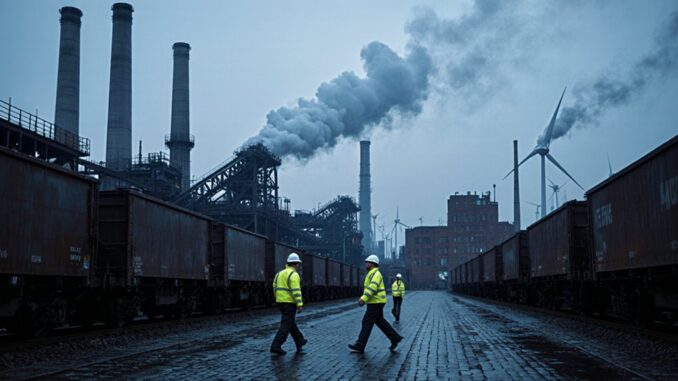
Germany’s industry is concentrated in regional clusters shaped by skilled labor, research, suppliers, and transport links. Rhine-Ruhr specializes in steel, chemicals, logistics, and industrial services, while Baden-Württemberg and Bavaria lead in vehicles, machinery, engineering, and aerospace. Hamburg combines port logistics with aviation, Lower Saxony centers on automotive production and wind power, and Saxony has become a microelectronics and advanced-manufacturing hub. These regions also show how infrastructure and innovation sustain specialization across Germany.
Germany’s Main Industrial Regions and Industries
Germany’s industrial economy is organized around several specialized regional clusters shaped by transport networks, skilled labor pools, and proximity to suppliers and markets. Bavaria, centered on Munich, combines automobiles, aerospace, electronics, and advanced engineering. Baden-Württemberg, around Stuttgart and Karlsruhe, concentrates vehicle manufacturing, machinery, automation, and precision instruments. North Rhine-Westphalia remains a major base for chemicals, steel, energy-intensive production, logistics, and industrial services, particularly across the Rhine-Ruhr corridor.
Lower Saxony links Wolfsburg’s automotive production with Hanover’s machinery and trade functions, while Hamburg supports aviation, shipbuilding, logistics, and port-related manufacturing. Saxony, focused on Dresden, Chemnitz, and Leipzig, has developed semiconductor, microelectronics, automotive, and mechanical-engineering activities. Rhineland-Palatinate and Hesse contain important chemical, pharmaceutical, and materials industries along Rhine transport routes.
These Industrial specializations reflect distinct urban centers, research institutions, and production traditions. Dense regional supplier networks connect large manufacturers with component producers, engineering firms, freight infrastructure, and specialized business services across each industrial area.
Why Industries Cluster in Germany
Industrial clustering in Germany is reinforced by dense transport and logistics networks that connect production centers to domestic and European markets. Regions also attract specialized firms through concentrated pools of skilled labor shaped by technical education and established industrial employment. Research institutions, suppliers, and manufacturers further create localized ecosystems that support innovation, coordination, and regional specialization.
Transport And Logistics Networks
Across Germany, dense transport and logistics networks reduce freight costs and connect industrial clusters to domestic and European markets. Rhine-Ruhr industries benefit from inland ports, motorway intersections, and rail freight corridors linking steel, chemicals, and machinery producers with Benelux seaports. Southern manufacturing zones around Stuttgart and Munich depend on high-capacity road and rail routes that integrate component suppliers with export gateways. Hamburg and Bremen extend northern clusters through maritime terminals, warehousing, and distribution services serving global trade. Eastern regions gain strategic access through Berlin, Leipzig, and Dresden, where cross-border routes support connections to Poland and the Czech Republic. A coordinated logistics hub strategy concentrates handling, storage, and intermodal transfer near production centers. Customs efficiency at major ports and border-facing terminals further shortens transit times, reinforcing Germany’s advantage as a centrally located industrial platform.
Skilled Workforce Availability
A highly skilled workforce anchors industrial clustering by aligning regional labor pools with specialized production systems. In Germany, manufacturing regions benefit when occupational skills match dominant activities, whether automotive engineering in Baden-Württemberg, chemicals in North Rhine-Westphalia, or precision machinery in Bavaria. Workforce training supports this geographic fit by supplying technicians, machinists, and production specialists familiar with local industrial requirements. Dual education links classroom instruction with workplace practice, creating predictable pathways into skilled employment and reducing recruitment uncertainty for employers. Concentrated job opportunities also strengthen talent retention, as workers can change firms without leaving the region or abandoning their occupational specialization. This mobility contributes to labor market stability, helping industrial districts maintain production capacity through shifting demand cycles. Over time, localized skills deepen regional specialization and make clustered industries more resilient to shortages.
Research And Supplier Ecosystems
Near major production centers, research institutions and specialized suppliers reinforce Germany’s industrial clustering by shortening the distance between innovation, component sourcing, and manufacturing. In regions such as Baden-Württemberg, Bavaria, and North Rhine-Westphalia, university research connects laboratories with automotive, machinery, chemical, and electronics firms. This proximity supports applied innovation, allowing prototypes, testing facilities, engineering services, and production lines to interact rapidly. Dense supplier networks provide precision parts, software, tooling, logistics, and maintenance within short transport corridors, reducing lead times and coordination costs. Industry collaboration also concentrates technical knowledge through joint projects, vocational partnerships, and technology parks. Smaller firms benefit from access to anchor manufacturers and research expertise, while large companies gain specialized inputs and adaptable capacity. These regional ecosystems strengthen cumulative advantages, making established industrial areas more resilient and attractive for further investment, expansion, and advanced production.
The Ruhr: Steel, Chemicals, and Logistics
Centered on the Rhine–Ruhr conurbation in western Germany, the Ruhr developed as a dense industrial cluster linking coalfields, steelworks, chemical plants, and inland ports. Its urban-industrial corridor extends across Duisburg, Essen, Dortmund, Bochum, and Gelsenkirchen, where proximity historically reduced transport costs between mines, coke ovens, blast furnaces, and downstream manufacturers. Duisburg’s Rhine port anchors bulk-material flows, connecting imported ore, coal, scrap, and finished goods to European waterways, rail networks, and highways.
Steel driven supply chains remain central, supporting metal processing, machinery, automotive components, construction materials, and recycling. Chemical production is interwoven with these networks through industrial gases, coatings, polymers, and process inputs, often located near shared pipelines, power systems, and logistics terminals. Although coal mining has ended, brownfield redevelopment has introduced technology, services, and clean-energy activities alongside heavy industry. Employment and unions continue to shape the region’s industrial governance, wage structures, training systems, and transition strategies.
Rhineland-Palatinate: Chemicals, Pharma, and Wine Production
Rhineland-Palatinate combines export-oriented chemical and pharmaceutical production with specialized winegrowing along the Rhine, Moselle, Nahe, and Ahr valleys. Its industrial geography is anchored by the Ludwigshafen chemical complex, one of Europe’s largest integrated production sites, and by pharmaceutical facilities around Mainz and Ingelheim. Rhine corridors provide dense transport links, access to inland ports, and connections to neighboring markets, supporting chemical inputs, packaging, research, and distribution networks.
Outside the major industrial nodes, steep valley slopes and favorable microclimates sustain vineyards producing Riesling, Pinot varieties, and sparkling wines. Wine estates, cooperatives, bottlers, and hospitality businesses form localized value chains tied to landscape conditions. Diversified agriculture also includes fruit cultivation, cereals, livestock, and vegetable production across upland and riverplain areas. Regional tourism growth reinforces this rural economy through wine routes, seasonal events, cycling corridors, and heritage towns. The state’s specialization consequently rests on the coexistence of high-value process industries and place-specific agricultural production.
Baden-Württemberg: Engineering and Premium Manufacturing
South of the Rhine-Main industrial corridor, Baden-Württemberg forms Germany’s leading concentration of advanced engineering, premium vehicle production, and specialized machinery. Its industrial geography centers on Stuttgart, where automotive headquarters, suppliers, design firms, and research institutes create dense production networks. Surrounding districts extend this specialization through toolmaking, automation equipment, robotics, and high-value components.
The Neckar valley and the Black Forest fringe support clusters of precision instruments, medical technology, measurement systems, and small-series machinery. Many firms remain export-oriented Mittelstand manufacturers, linking family ownership with intensive research, skilled labor, and global customer bases. This structure reflects deep German manufacturing heritage while sustaining precision engineering strengths across specialized niches.
Universities and applied research institutions reinforce regional capabilities, particularly in production technology, materials, and industrial software. Rather than relying on a single industrial center, Baden-Württemberg operates as an interconnected network of metropolitan plants, medium-sized towns, supplier corridors, and innovation-oriented manufacturing districts.
Bavaria: Automotive, Technology, and Aerospace
Bavaria combines major automotive manufacturing hubs around Munich, Ingolstadt, and Regensburg with dense supplier networks across the region. Munich also anchors technology and innovation clusters spanning software, electronics, and research-intensive firms. Aerospace engineering is concentrated around Munich and Oberpfaffenhofen, reinforcing Bavaria’s role in high-value industrial production.
Automotive Manufacturing Hubs
Centered on Munich and extending into Upper Bavaria and Franconia, Bavaria forms one of Germany’s most diversified automotive manufacturing hubs. Vehicle assembly, premium marques, component suppliers, and specialized engineering firms concentrate along corridors linking Munich, Ingolstadt, Regensburg, Nuremberg, and Würzburg. Munich functions as the principal coordination center, while Ingolstadt and Regensburg anchor large-scale production and supplier networks. Franconian locations support electronics, drivetrains, metalworking, and logistics, connecting Bavarian plants to central German markets. The region’s shift toward electric mobility is reshaping industrial land use and supplier relationships. EV battery plants and energy storage facilities are increasingly located near established manufacturing zones, transport routes, and power connections. Expanding charging infrastructure reinforces demand for electrical components and service networks. This clustered structure enables close coordination between assemblers, suppliers, freight operators, and regional energy systems.
Technology and Innovation Clusters
Across Munich, Ingolstadt, Augsburg, and the wider Upper Bavarian corridor, automotive production overlaps with major technology and aerospace clusters. Proximity links manufacturers, software firms, universities, suppliers, and research institutes, creating dense innovation networks across metropolitan and secondary-city locations.
- Munich concentrates Digital networking, mobility software, semiconductor design, and startup services.
- Ingolstadt connects vehicle engineering with applied research, testing facilities, and specialist suppliers.
- Augsburg supports advanced materials, automation, and production technologies serving regional manufacturers.
- University campuses and technology parks enable patent transfer, while venture capital supports scalable firms.
This spatial division combines established industrial capacity with knowledge-intensive services. Transport corridors between the cities facilitate labor mobility, supplier coordination, and collaborative development. Bavaria’s cluster structure therefore strengthens regional specialization without relying on a single metropolitan core.
Aerospace Engineering Excellence
Aerospace engineering forms a major pillar of Upper Bavaria’s industrial economy, with Munich and the surrounding corridor linking aircraft systems, satellite technology, propulsion research, and defense-related manufacturing. The cluster extends through Ottobrunn, Taufkirchen, Oberpfaffenhofen, and Manching, where major firms, research institutes, test facilities, and specialized suppliers occupy interconnected sites. Munich concentrates design, software, avionics, and corporate functions, while peripheral locations provide airfields, laboratories, production capacity, and secure testing environments. This geography supports workforce specialization across engineering, materials science, navigation, robotics, and systems integration. Universities and technical institutes reinforce knowledge transfer and recruitment. Aerospace supply chains connect precision manufacturers in Bavaria with national and European assembly programs, strengthening the region’s role in civil aviation, space infrastructure, unmanned systems, and defense procurement.
Lower Saxony: Cars, Aerospace, and Wind Power
Lower Saxony combines automotive manufacturing, aerospace engineering, and renewable-energy production within a broad industrial corridor linking Wolfsburg, Hanover, Braunschweig, and the North Sea coast. Its geography connects major assembly plants, research institutions, supplier networks, and coastal energy sites through dense road, rail, and grid infrastructure.
- Wolfsburg anchors automotive specialization, concentrating vehicle assembly, components, software development, and workforce training around Volkswagen’s extensive production ecosystem.
- Hanover and Braunschweig support aerospace engineering through research campuses, testing facilities, precision suppliers, and university-led technology transfer.
- Coastal districts around Cuxhaven, Emden, and Wilhelmshaven form a wind-power cluster, combining turbine manufacturing, offshore servicing, ports, and transmission connections.
- Economic transformation is shaped by green manufacturing, cross border investment, and industrial policy alignment between regional authorities, firms, and federal programs.
The region’s competitive advantage lies in linking established mechanical industries with electrification, hydrogen applications, and renewable-energy supply chains, while retaining strong manufacturing depth across inland and coastal locations.
Hamburg: Aviation, Ports, and Global Trade
Hamburg functions as Germany’s principal northern gateway, where port logistics, aviation manufacturing, and international commerce converge along the Elbe corridor. The Port of Hamburg anchors a dense waterfront economy of terminals, freight forwarders, warehousing, customs services, and inland distribution links. Its position on North Sea routes supports global shipping between Central Europe, Scandinavia, Asia, and Atlantic markets, while rail, road, and barge connections extend trade connectivity into the national hinterland.
Aviation hubs around Finkenwerder and Hamburg Airport reinforce the city’s specialized industrial profile. Aircraft assembly, cabin equipment, maintenance, engineering, and supplier networks form a concentrated aerospace cluster, closely connected to research institutions and skilled technical labor. This combination of maritime access and aviation production differentiates Hamburg from inland industrial regions. Commercial services, insurance, logistics technology, and trading firms cluster near the port and central business districts, translating physical cargo flows into high-value coordination, finance, and international market expertise.
Saxony: Semiconductors, Cars, and Electronics
Saxony has emerged as one of Germany’s most concentrated high-technology manufacturing regions, centered on the Dresden–Chemnitz–Leipzig urban corridor. Its industrial geography links research institutes, specialized suppliers, and major assembly sites through dense road and rail connections. Dresden anchors microelectronics fabrication, supporting Semiconductor supply networks that extend into materials, equipment, and chip design. Chemnitz contributes precision engineering and automotive component production, while Leipzig combines vehicle assembly, logistics, and electronics integration.
- Dresden’s “Silicon Saxony” cluster concentrates wafer fabrication, sensor technology, and applied research.
- Chemnitz specializes in machine tools, powertrain systems, and supplier-led engineering.
- Leipzig’s automotive plants create demand for batteries, software-enabled production, and regional logistics.
- Across the corridor, smart factory methods connect manufacturers with technical universities and testing centers.
The region’s specialization reflects electric mobility trends, particularly in battery-related components and electronically controlled vehicle systems. Proximity among firms shortens supplier distances, reinforces skilled-labor pools, and supports coordinated industrial production across Saxony’s principal urban nodes.
How German Industrial Hubs Are Evolving
German industrial hubs are evolving from stand-alone manufacturing centers into interconnected regional systems that combine production, research, logistics, and energy infrastructure. The Ruhr area is repositioning steel, chemicals, and engineering around hydrogen corridors, rail freight, and port-linked supply chains. In Bavaria and Baden-Württemberg, automotive clusters are adding battery development, software, power electronics, and testing facilities near established suppliers and universities. Saxony’s semiconductor network illustrates how fabrication plants, specialist suppliers, technical institutes, and skilled-labor pipelines reinforce one another across Dresden and surrounding towns.
Industrial transformation increasingly depends on regional coordination rather than isolated factory investment. Ports at Hamburg, Bremen, and Wilhelmshaven are becoming gateways for imported hydrogen derivatives, offshore wind components, and low-carbon materials. Decarbonization pathways differ by local assets: coastal regions emphasize renewable power and maritime logistics, while inland clusters focus on electrified processes, recycling, and shared heat networks. These changes are strengthening links between metropolitan research centers, secondary industrial cities, and transport corridors, reshaping Germany’s production geography.
The Industry & Manufacturing Editorial Team focuses on Germany’s industrial economy and the technologies transforming production. Coverage includes mechanical engineering, manufacturing, automation, robotics, process industries, supply chains and industrial digitalisation. Particular attention is given to the German Mittelstand, specialised manufacturers and hidden champions that play an important role in global industrial markets.