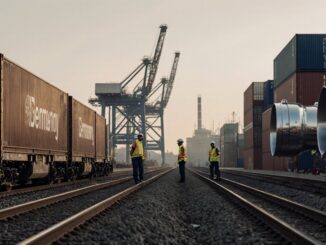
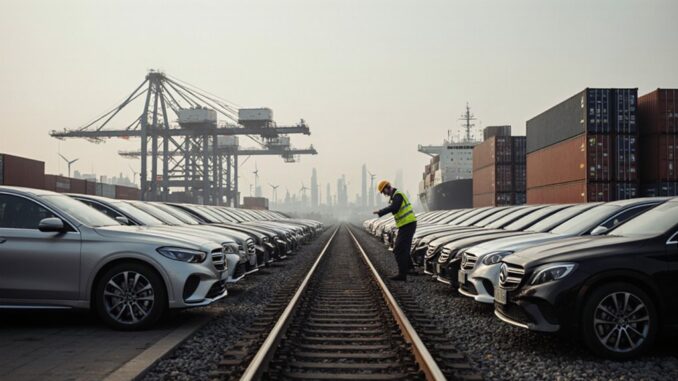
Germany’s export economy relies on high-value manufacturing, which contributes about one-fifth of gross value added, and exports equal roughly half of GDP. Vehicles, machinery, chemicals, pharmaceuticals, and electrical equipment lead sales abroad. EU single-market access, the euro, vocational training, supplier networks, and R&D strengthen competitiveness. France, the Netherlands, Poland, the United States, and China are major markets. However, energy costs, geopolitical shocks, tariffs, and weaker global demand pose risks. The sections below outline the model’s mechanics, partners, industries, and future pressures.
How Germany’s Export-Led Growth Model Works
Germany’s export-led growth model is built on a large manufacturing base that sells high-value goods—especially vehicles, machinery, chemicals, and industrial equipment—into global markets. Manufacturing contributes roughly one-fifth of German gross value added, a larger share than in France, the United Kingdom, or the United States. Exporters benefit from specialized engineering, dense supplier networks, vocational training, and sustained business investment in research and development.
The model converts productivity in tradable industries into foreign sales, employment, tax revenue, and demand for domestic services. Membership in the euro area supports currency competitiveness by preventing appreciation pressures that a standalone deutsche mark might have created. However, success also depends on imported energy, components, and raw materials, exposing firms to geopolitical and logistical shocks. Recent disruptions have increased policy emphasis on supply chain resilience, including supplier diversification, strategic inventories, and domestic capacity in critical technologies. Compared with more consumption-driven economies, Germany in consequence relies more heavily on external demand and industrial performance.
How the EU Supports German Exports
The European Union supports German exports primarily through the single market, which gives firms largely tariff-free access to 26 other member states under common product rules and competition standards. This framework reduces transaction costs relative to trade with non-EU markets, where separate certification, border procedures, and tariffs may apply.
- EU trade facilitation streamlines documentation, digital customs processes, and transport links, helping German firms serve integrated European supply chains efficiently.
- Customs harmonization applies a common external tariff and shared customs code, limiting administrative variation at internal borders while standardizing treatment of imports entering the EU.
- EU trade agreements extend preferential access beyond Europe, enabling German exporters to compete under negotiated tariff schedules and regulatory provisions.
The euro further reduces exchange-rate risk across much of Germany’s principal market. Compared with exporters in fragmented regional blocs, German companies benefit from predictable rules, enforceable competition policy, and a consumer market exceeding 440 million people. EU institutions also coordinate product safety, public procurement, and trade-defense measures, reinforcing market access while reducing policy uncertainty for cross-border investment.
Germany’s Leading Export Industries
Although export demand varies with global investment cycles, Germany’s export base remains concentrated in high-value manufacturing: vehicles and vehicle parts, machinery, chemicals and pharmaceuticals, electrical equipment, and precision instruments. Automotive manufacturing remains the largest industrial pillar, supported by integrated suppliers, engineering capacity, and substantial research spending. Its competitiveness, however, faces pressure from electrification, lower-cost producers, and stricter emissions rules.
Industrial machinery is similarly important, supplying factory automation, energy systems, machine tools, and process equipment. Compared with consumer-oriented exporters, Germany derives a larger share of export value from capital goods, making performance sensitive to business investment and construction cycles. Chemicals and pharmaceuticals add resilience through specialized inputs, patented products, and regulated production standards, while electrical equipment and precision instruments benefit from digitalization and medical demand.
Policy priorities include affordable energy, faster permitting, skilled-labor supply, and innovation incentives. These measures are intended to preserve technological leadership while reducing exposure to concentrated industrial sectors and transition-related costs.
Germany’s Top Export Trading Partners
European Union members, led by France, the Netherlands, and Poland, remain Germany’s most integrated export partners, supported by the single market and shared supply chains. Outside Europe, the United States and China are critical high-value markets, though trade policy, demand conditions, and geopolitical risk shape their relative importance. Expanding ties with markets such as India, Southeast Asia, and selected Gulf economies may diversify export demand and reduce concentration risks.
European Union Trade Leaders
Germany’s export geography is anchored in the European Union, where integrated supply chains, common regulatory standards, and tariff-free market access make neighboring member states its most important customers. France, the Netherlands, Poland, Italy, and Austria consistently rank among leading EU destinations, absorbing machinery, vehicles, chemicals, electrical equipment, and intermediate goods. Their importance reflects proximity and production integration rather than demand alone.
- France and Italy provide large consumer and industrial markets for German capital goods.
- Poland and the Czech Republic strengthen cross border supply chains in automotive, machinery, and components.
- The Netherlands functions as a logistics gateway, amplifying re-export flows through major ports.
EU trade priorities thus emphasize single market rules, customs harmonisation, tariff reduction deals, and regulatory alignment needs. Compared with more distant markets, EU partners reduce transaction costs, delivery times, and compliance uncertainty for German exporters.
Key Global Export Markets
Beyond the EU, Germany’s leading export markets include the United States, China, the United Kingdom, Switzerland, and Turkey, each contributing distinct demand and policy considerations. The US Market remains Germany’s largest non-European destination, absorbing high-value vehicles, machinery, chemicals, and medical technology, while tariff risks and industrial-policy incentives shape investment decisions. China combines major volumes in automobiles, capital goods, and chemicals with intensified competition from domestic producers and exposure to regulatory uncertainty. The United Kingdom and Switzerland provide stable, high-income demand but face differing market-access arrangements after Brexit. Turkey supports exports of machinery, vehicles, and intermediate goods, though currency volatility constrains purchasing power. Compared with these established partners, Emerging ASEAN and Latin America remain smaller destinations; their relevance lies in diversification potential rather than current export scale.
Emerging International Partnerships
Although emerging markets account for a smaller share of German exports than the United States, China, or core European partners, ASEAN, India, Mexico, Brazil, and selected Gulf states are increasingly important for diversification. Their demand supports machinery, vehicles, chemicals, renewable-energy equipment, and industrial services, while reducing concentration risks across mature markets. Policy initiatives, including EU trade agreements and investment guarantees, shape access and compliance conditions.
- ASEAN strengthens regional market expansion through growing manufacturing networks and consumer demand.
- India offers scale in infrastructure, digitalization, and clean-energy procurement, despite tariff and regulatory barriers.
- Mexico and Brazil provide industrial platforms for automotive and chemical exports, while Gulf states finance energy-transition projects.
Supply chain diversification is especially relevant as German firms seek alternative production bases and sourcing routes. Compared with established partners, these markets offer faster growth but higher political, currency, and logistics risks.
Why German Exports Compete Worldwide
German exports compete worldwide because firms concentrate on high-value manufacturing segments where quality, engineering reliability, and after-sales service matter more than price alone. Automotive systems, industrial machinery, chemicals, medical technology, and electrical equipment benefit from specialized expertise, dense supplier networks, and rigorous technical standards. This innovation driven manufacturing model supports productivity and allows producers to command premiums in markets where downtime, safety, and lifecycle costs influence purchasing decisions.
Germany also combines vocational training, applied research institutions, and export finance tools to reinforce industrial capabilities. Compared with lower-cost manufacturing economies, German firms compete less through labor expenses and more through process knowledge, customization, and certified performance. Supply chain efficiency is strengthened by central European logistics links, integrated procurement, and close coordination between manufacturers and component suppliers. European Union market access further reduces trade frictions and supports common regulatory standards. The result is a diversified export base that serves advanced economies and expanding industrial markets, sustaining competitiveness across numerous capital-intensive sectors.
Risks Facing Germany’s Export Economy
Germany’s export model is highly exposed to slowdowns in major markets, particularly the euro area, China, and the United States. Energy costs remain structurally higher than in several competing industrial economies, pressuring margins in chemicals, metals, and manufacturing. Meanwhile, tariffs, sanctions, and supply-chain restrictions can disrupt trade flows and increase the policy uncertainty facing exporters.
Global Demand Slowdowns
Global demand slowdowns pose a disproportionate risk to Germany because exports account for roughly half of its GDP, compared with lower export shares in larger domestic-demand economies such as the United States and France. Weak industrial orders in China, Europe, or North America rapidly affect German machinery, vehicles, chemicals, and capital-goods suppliers.
- A Chinese investment downturn reduces demand for German equipment more sharply than for consumption-led economies.
- Supply chain shocks can delay production and magnify falling foreign orders across Mittelstand suppliers.
- Tariff uncertainty discourages investment, particularly in autos and advanced manufacturing.
Policy responses emphasize export-market diversification, trade agreements, and domestic investment to cushion external volatility. France’s larger public and household-demand base offers greater insulation, while the United States benefits from a vast consumer market. Germany thus faces stronger pressure to broaden demand sources and improve competitiveness.
Energy Cost Pressures
Energy costs have become a major competitiveness risk for export-oriented manufacturing, particularly in energy-intensive sectors such as chemicals, steel, glass, and paper. Following the 2022 energy shock, German industrial electricity and gas prices remained structurally above many US and Asian competitors, despite declines from peak levels. This gap compresses margins, discourages investment, and increases incentives to shift production abroad.
Energy price variability also complicates long-term contracting and capital planning, especially for firms operating continuous processes. Government measures, including temporary relief schemes, grid-charge reforms, and renewable-energy expansion, aim to contain costs while supporting decarbonisation. However, policy uncertainty over electricity pricing, hydrogen infrastructure, and network investments limits predictability. Compared with countries benefiting from cheaper gas, nuclear capacity, or regulated power prices, Germany faces a persistent challenge: preserving industrial competitiveness while financing its energy transition.
Trade Policy Disruptions
Trade policy disruptions pose a growing risk to Germany’s export model because manufactured goods account for a larger share of its exports than in most advanced economies. Automotive, machinery, and chemical producers are especially exposed to tariff policy volatility in the United States, China, and key emerging markets. Compared with more services-oriented economies, Germany faces larger revenue losses when border measures target industrial inputs or finished goods.
- Higher tariffs can weaken price competitiveness and compress exporters’ margins.
- Rules-of-origin requirements raise compliance costs for firms using cross-border components.
- Supply chain shocks can delay production when critical semiconductors, metals, or chemicals are restricted.
EU trade agreements can diversify market access, but they cannot fully offset major-power disputes. Policy resilience depends on predictable WTO rules, coordinated EU retaliation tools, and broader sourcing networks for strategic inputs.
What Will Shape Germany’s Future Exports
Germany’s future export performance will depend less on traditional industrial scale than on its ability to adapt to shifting demand, technology, and policy conditions. Automotive machinery and chemicals remain central, but electric vehicles, industrial software, batteries, and low-carbon equipment will determine whether Germany retains premium-market share against China, the United States, and South Korea.
Demographics shifts may constrain manufacturing capacity through retirements and skilled-labor shortages, increasing pressure for automation, targeted immigration, and faster vocational training. Export competitiveness will also hinge on energy costs: compared with U.S. producers benefiting from cheaper gas, German firms require predictable power prices and expanded grids.
Sustainability investments can create advantages in hydrogen systems, energy-efficient machinery, recycling technologies, and clean industrial processes. EU carbon-border rules may protect compliant producers, yet they also require firms to document emissions across supply chains. Diversification toward India, Southeast Asia, and North America could reduce reliance on China, while trade agreements, digital standards, and investment incentives will shape market access and production decisions.
The Business & Economy Editorial Team covers Germany’s economy, companies, markets and international trade. Its reporting focuses on economic developments, investment, exports, the Mittelstand, major corporations and the conditions affecting businesses in Germany. The team combines current economic news with background articles and analysis to explain what developments mean for companies, investors and international readers.