Germany’s manufacturing jobs are shifting toward automation, electrification, and digital production rather than disappearing outright. Demand is growing for mechatronics, robotics, electronics, battery production, maintenance, quality control, and process-control workers. However, energy costs, export volatility, retirements, and regional shortages intensify pressure on routine and older workers. Policy priorities include paid retraining, recognized credentials, release time, and wage protection. The sections ahead outline where jobs are growing and how passages can be made fair.
Manufacturing Job Trends in Germany
Germany’s manufacturing employment has remained resilient relative to other advanced economies, but it is increasingly shaped by automation, energy costs, demographic aging, and shifts in global demand. The sector still supports roughly one in five German jobs directly or indirectly, with automotive, machinery, chemicals, and electrical equipment remaining major employers. However, output volatility since 2020 has weakened hiring momentum, particularly among energy-intensive producers and export-oriented suppliers.
Labor-market pressures are uneven. Southern industrial regions, including Baden-Württemberg and Bavaria, retain dense supplier networks and relatively strong skilled-workforce demand, while eastern regions face sharper demographic constraints and lower wage levels. These regional disparities complicate national workforce policy. Export demand from China, the United States, and European partners remains central to employment stability, yet slower global trade and competitive pressure are affecting orders. Policymakers are in turn emphasizing affordable energy, vocational training, infrastructure investment, and targeted support for small and medium-sized manufacturers to preserve productive, unionized industrial employment.
How Automation Is Changing Factory Jobs
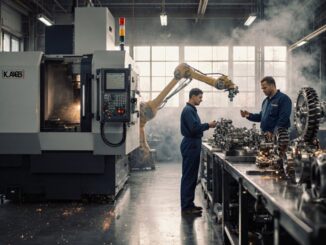
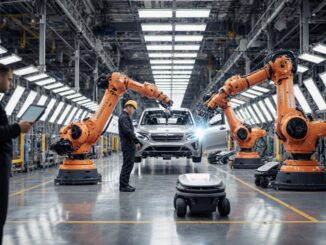
Automation is reshaping German factory work less through outright job elimination than through changes in tasks, skill requirements, and workplace organization. Robotics integration shifts repetitive handling, welding, and packaging toward machines, while workers increasingly monitor systems, resolve faults, and manage quality assurance. The impact varies by plant size, sector, collective agreement coverage, and access to training.
- For long-serving production workers, new digital controls can create anxiety when retraining is limited or schedules leave little learning time.
- For works councils, automation raises urgent questions about staffing levels, surveillance, workload, and fair distribution of productivity gains.
- For communities dependent on industrial sites, each redesigned assembly line can symbolize both resilience and uncertainty.
Policy responses therefore matter: publicly supported continuing education, enforceable consultation rights, and transition plans can reduce displacement risks. Employers also face pressure to document job redesign and provide paid training before deploying new systems. The central labor issue is not technology alone, but whether its benefits translate into safer, more sustainable work.
Fast-Growing Manufacturing Careers in Germany
As production becomes more digital, electrified, and resource-efficient, manufacturing demand is growing fastest for industrial mechatronics technicians, automation and robotics specialists, electronics technicians, battery-production operators, and skilled workers in semiconductor, medical-device, and renewable-energy supply chains. Germany’s industrial strategy, including support for battery gigafactories, chip fabrication, grid equipment, and clean-technology investment, is concentrating job market demand in regions with major automotive, engineering, and chemical clusters.
Worker shortages are particularly acute where new facilities require rapid staffing while experienced employees retire. Employers are expanding recruitment across eastern Germany and established industrial states, where investment in electric vehicles, power electronics, and precision production is reshaping local labor needs. Demand also extends to quality assurance, maintenance, process control, logistics coordination, and production planning roles that keep highly automated plants operating reliably. Public policy thus links industrial subsidies to domestic capacity, supply-chain resilience, and employment creation. The resulting growth favors occupations tied directly to strategic production rather than routine assembly alone.
Skills for Future Manufacturing Jobs in Germany
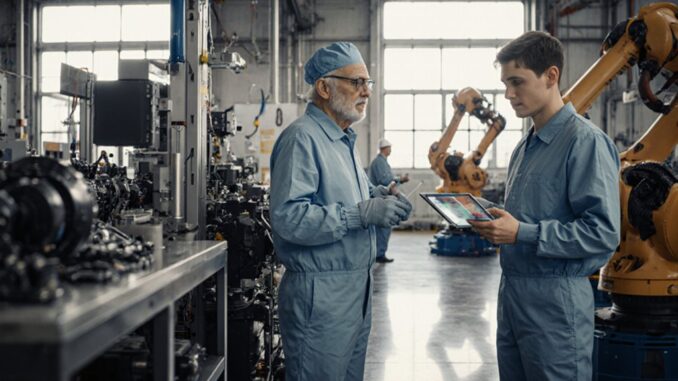
Future manufacturing employment in Germany increasingly requires hybrid technical skills that combine mechanical systems knowledge with digital production, electrical engineering, and data-based quality control. Factory roles increasingly depend on interpreting sensor data, operating connected machinery, and identifying process deviations before they disrupt output. Digital maintenance capabilities support uptime in automotive, machinery, chemicals, and battery production, while robotics safety knowledge remains essential as collaborative systems expand.
- Secure, well-paid work depends on workers being trusted to manage advanced equipment responsibly.
- Preventing a single defect can protect colleagues’ livelihoods, supplier contracts, and regional industrial stability.
- Safe human-robot collaboration can reduce injury risks while preserving meaningful technical responsibility.
Labor policy must recognize that these competencies are core production requirements, not optional add-ons. Employers need transparent skill classifications, works-council involvement in technology deployment, and occupational standards that cover cybersecurity, machine interfaces, and safety protocols. Demand is strongest for technicians and operators able to connect practical shop-floor judgment with measurable efficiency, quality, energy-use, and compliance outcomes.
Training and Transition Support for Workers
Building the required hybrid skills at scale will depend on training systems that protect workers from displacement rather than merely preparing employers for new technology. Germany’s dual vocational model remains a strong foundation, but it requires apprenticeship reform to incorporate robotics, data analysis, battery production, and low-carbon process skills across industrial occupations. Public funding should prioritize paid retraining, recognized credentials, and release time for workers in firms undergoing automation or restructuring.
Transition support must also reach older employees, temporary staff, and workers in supplier regions facing concentrated job losses. Sectoral training funds, jointly governed by unions, employers, and Länder authorities, could finance portable learning accounts and income support during training. Stronger employment-service capacity would improve matching between declining plants and expanding clean-tech, rail, and advanced-machinery employers. Policies supporting worker mobility should include relocation assistance, affordable housing, and family-care provisions, limiting the financial risks of changing regions or occupations. Success should be measured by wage retention, completion rates, and reemployment quality, not enrollment alone.
The Industry & Manufacturing Editorial Team focuses on Germany’s industrial economy and the technologies transforming production. Coverage includes mechanical engineering, manufacturing, automation, robotics, process industries, supply chains and industrial digitalisation. Particular attention is given to the German Mittelstand, specialised manufacturers and hidden champions that play an important role in global industrial markets.