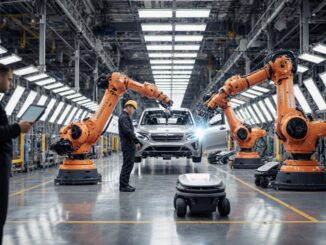
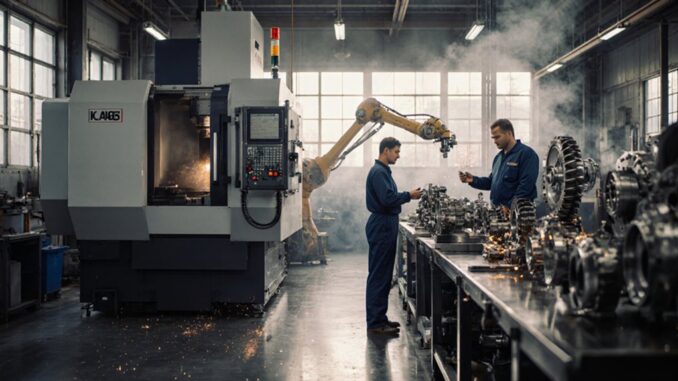
Germany’s machinery industry is a major export-oriented manufacturing sector spanning machine tools, automation, packaging, process equipment, robotics, and intralogistics. Roughly three-quarters of revenue often comes from foreign markets, especially the EU, United States, and China. Its competitiveness rests on precision engineering, customization, reliability, and lifecycle service. Mittelstand specialists coexist with global suppliers, while Industry 4.0, energy efficiency, and circular design reshape investment priorities. The following sections map its structure, markets, technologies, and risks.
Germany’s Machinery Industry: Size and Role
Germany’s machinery industry is one of the country’s largest manufacturing segments, encompassing mechanical engineering, industrial equipment, automation systems, and production technologies. It functions as a high-value export platform, supplying capital goods to global manufacturers while supporting domestic investment, productivity, and industrial modernization. The sector is characterized by a large base of specialized small and medium-sized enterprises alongside multinational suppliers, creating dense regional production and service networks.
Its economic role extends beyond direct output. Machinery producers enable process efficiency, precision manufacturing, digitization, and energy optimization across customer industries. Market segmentation is typically defined by equipment complexity, end-user requirements, export destination, and aftermarket service intensity rather than only product category. Revenue resilience depends heavily on international order cycles, investment confidence, financing conditions, and supply-chain availability.
Workforce development remains a strategic variable, as technical roles require engineering, software, mechatronics, and field-service capabilities. Firms increasingly combine vocational training, university partnerships, and reskilling programs to address demographic pressures and accelerate adoption of digital production tools.
Core Sectors in German Machine Building
Core sectors in German machine building span machine tools, automotive and production equipment, process and packaging machinery, materials-handling systems, power-transmission technology, agricultural machinery, construction equipment, and automation solutions. Together, these segments supply capital goods for manufacturing, logistics, energy, food processing, infrastructure, and primary production.
Machine tools support precision metalworking through cutting, forming, grinding, and additive processes. Automotive equipment covers assembly lines, testing systems, robotics, and battery-production machinery. Process and packaging suppliers serve chemicals, pharmaceuticals, beverages, and consumer goods, where throughput, hygiene, and traceability determine specifications. Materials-handling systems integrate conveyors, warehouse automation, lifts, and intralogistics software.
Power-transmission producers provide gears, bearings, drives, couplings, and electromechanical components used across industrial assets. Agricultural and construction machinery address mechanization, fleet productivity, and emissions requirements. Automation solutions combine sensors, controls, industrial software, and robotics. These Industry applications create specialized demand patterns, while engineering depth, installed-base support, and supplier networks shape sector competitiveness across individual product categories.
Why German Machinery Competes Globally
Across global capital-goods markets, German machinery competes through high engineering precision, application-specific customization, and strong lifecycle performance. Buyers often prioritize uptime, throughput consistency, energy efficiency, and maintenance predictability over initial purchase price, supporting demand in automotive, process industries, electronics, packaging, and advanced manufacturing.
A Skilled Workforce combines mechanical engineering, automation, software integration, materials science, and production know-how. This capability enables machines with tight tolerances, modular configurations, integrated sensors, and controls tailored to specific operating conditions. Continuous product refinement also supports compliance with demanding safety, environmental, and traceability requirements.
A deeply embedded Quality Culture reinforces reliability across long operating cycles. German equipment is commonly positioned in premium segments because it offers documented performance, robust components, serviceability, and long-term spare-parts availability. Export competitiveness is further supported by technical standards expertise, installed-base knowledge, and the ability to integrate machinery into digitally monitored production systems. These factors reduce total cost of ownership and protect customer productivity.
How German Machine Builders Are Structured
Rather than being dominated by a small number of conglomerates, Germany’s machinery sector is structured around a broad Mittelstand base of specialized small and medium-sized manufacturers, complemented by large listed groups and diversified industrial suppliers. Many firms occupy narrow technology niches, such as packaging lines, machine tools, process equipment, robotics components, or automation software, and compete through engineering depth rather than scale alone.
Ownership is frequently family-controlled, supporting long investment horizons, retained technical expertise, and close customer relationships. Larger groups provide capital-intensive systems, global service capacity, and integrated portfolios spanning drives, controls, sensors, and production equipment. The industry association VDMA represents thousands of member companies and organizes the sector into product-specific divisions, reflecting its fragmented specialization. Regional clusters in Baden-Württemberg, Bavaria, North Rhine-Westphalia, Saxony, and Lower Saxony link manufacturers with research institutes, suppliers, universities, and vocational-training networks. This decentralized structure supports rapid application development, supplier coordination, and incremental product innovation across distinct machinery segments.
German Machinery Exports and Key Markets
Germany is one of the world’s largest machinery exporters, with foreign sales accounting for roughly three-quarters of sector revenue in many years. Export demand is concentrated in the European Union, the United States, and China, although market shares vary by equipment category, investment cycle, and customer industry. Major destinations typically include France, Italy, Poland, the Netherlands, the United Kingdom, the United States, and China.
Intra-European trade benefits from integrated supply chains, common technical standards, and short delivery distances. North American demand is driven by automation investment, industrial modernization, and capacity expansion. China remains a large market but is increasingly competitive as local producers improve capabilities and procurement becomes more localized.
Emerging markets in Southeast Asia, India, Latin America, and parts of the Middle East offer growth potential tied to manufacturing buildout, infrastructure spending, and energy projects. Export performance is sensitive to exchange rates, financing conditions, trade barriers, and capital-expenditure cycles. Long-term revenues are also supported by spare parts, digital upgrades, maintenance contracts, and aftermarket services.
Major German Machinery Companies and Specialists
Germany’s machinery sector is anchored by global industrial leaders such as Siemens, Bosch, Trumpf, and KUKA, whose portfolios span factory systems, machine tools, and production technologies. Automation and robotics specialists strengthen the market through industrial control platforms, collaborative robots, and integrated software-hardware solutions. Precision engineering champions compete through high-tolerance components, advanced optics, and specialized equipment serving automotive, semiconductor, medical, and energy customers.
Global Industrial Leaders
Why do German machinery firms retain global influence across cyclical industrial markets? Their position rests on export-oriented portfolios, high installed bases, and specialization in capital-intensive production equipment. Companies such as Siemens Energy, Bosch Rexroth, Trumpf, Krones, GEA, Dürr, and Heidelberger Druckmaschinen serve distinct segments spanning process technology, machine tools, packaging, food systems, coating, and print production.
Competitive resilience derives from engineering depth, lifecycle service revenues, and supplier partnerships that support component availability and product customization. German manufacturers also shape industry standards through precision, safety certification, energy-efficiency requirements, and interoperable interfaces. This raises switching costs for industrial buyers and protects margins in technically demanding applications.
Market performance remains linked to global investment cycles, especially in automotive, chemicals, consumer goods, and infrastructure. Diversified regional sales networks partially offset weak domestic demand and enable recurring aftermarket income.
Automation And Robotics Specialists
Automation and robotics specialists form a high-value segment of German machinery manufacturing, supplying programmable logic controllers, motion systems, industrial robots, sensors, drives, and software for factory digitalization. Companies including Siemens, Beckhoff, Festo, KUKA, Bosch Rexroth, and SEW-Eurodrive serve automotive, electronics, logistics, food, and process-industry customers through integrated hardware and engineering platforms. Their competitive position rests on high reliability, open communication standards, safety systems, and lifecycle support. Demand is increasingly linked to Industry 4.0 investments, which connect production assets with cloud analytics, machine vision, digital twins, and predictive maintenance tools. Export revenues benefit from global demand for flexible, energy-efficient assembly and intralogistics systems. Retrofit services also provide recurring business, enabling manufacturers to modernize legacy equipment with updated controls, sensors, connectivity, and safety functions without requiring complete line replacement.
Precision Engineering Champions
Precision engineering is a core strength of German machinery manufacturing, centered on companies that produce high-tolerance machine tools, metrology systems, precision components, and specialized production equipment for automotive, aerospace, medical technology, electronics, and energy markets. DMG MORI, Trumpf, Heller, and Grob supply advanced CNC machining centers, laser systems, and flexible manufacturing cells. Zeiss, Hexagon Manufacturing Intelligence Germany, and Mahr anchor the metrology segment with coordinate measuring machines, optical inspection, and surface-analysis equipment. Their systems support micron-level quality control and traceability requirements across regulated supply chains. Germany’s Mittelstand specialists complement major OEMs through niche expertise in precision machining, spindle technology, tooling, gears, and motion components. Competitive advantage depends on engineering depth, software capability, and automation integration, enabling shorter cycle times, lower scrap rates, and scalable high-mix production. Export demand remains concentrated in industrialized markets.
Innovation in German Machine Building
German machine builders maintain precision-engineering leadership through high-tolerance machining, advanced metrology, and application-specific automation. Digital manufacturing investments are expanding the use of industrial IoT, digital twins, and AI-enabled quality control across production lines. These capabilities support higher throughput, lower defect rates, and differentiated export competitiveness in capital-equipment markets.
Precision Engineering Leadership
Supported by a dense network of specialist suppliers, research institutes, and export-oriented manufacturers, Germany’s machinery sector leads in high-precision machine tools, industrial metrology, optics, and production systems. Its competitive position rests on repeatable tolerances, application-specific engineering, and long service lifecycles across automotive, medical, semiconductor, and aerospace supply chains.
- Machine-tool producers supply multi-axis systems capable of micron-level positioning for complex components.
- Metrology specialists provide coordinate measurement, optical inspection, and calibration equipment that supports stringent quality control.
- Precision firms target micro manufacturing and niche applications, including implants, sensors, lenses, and specialized tooling.
Market strength reflects close customer collaboration and high domestic engineering depth. Export demand remains concentrated in capital-intensive industries where accuracy, reliability, and process stability justify premium equipment pricing. This specialization also supports resilient margins despite cyclical investment patterns.
Digital Manufacturing Advances
As manufacturers pursue higher throughput and lower lifecycle costs, German machine builders are embedding digital capabilities across equipment design, operation, and service. Digital twins, edge sensors, and AI-assisted controls enable predictive maintenance, process optimization, and faster commissioning across automotive, packaging, semiconductor, and process-industry installations. Equipment suppliers increasingly connect PLC, CNC, MES, and ERP layers through standardized interfaces, improving data interoperability between factories, suppliers, and service teams.
Market differentiation increasingly depends on software revenue, remote diagnostics, and performance-based service contracts rather than mechanical specifications alone. Cloud-enabled monitoring platforms can identify energy losses, tool wear, and quality deviations before unplanned downtime occurs. However, connected production assets require stronger Cybersecurity readiness, including segmented networks, secure firmware updates, identity management, and compliance with European industrial data and resilience requirements. This replacement supports export competitiveness while raising demand for automation engineers and software specialists.
Digitalization and Industry 4.0 Adoption
Digitalization is reshaping Germany’s machinery industry through connected production systems, industrial IoT platforms, digital twins, and AI-enabled maintenance. Adoption is strongest among export-oriented OEMs and automation specialists, where software increasingly differentiates equipment portfolios and recurring service revenues.
- Machine vision systems improve inspection accuracy, automate defect detection, and generate process data for closed-loop quality control.
- Predictive maintenance combines sensor streams, vibration analysis, and machine-learning models to reduce unplanned downtime and optimize spare-parts planning.
- Digital twins allow manufacturers to simulate machine behavior, validate configurations, and shorten commissioning cycles before physical deployment.
The market is shifting from standalone machinery sales toward connected, lifecycle-based offerings. Customers increasingly require secure remote monitoring, interoperable data interfaces, and measurable productivity gains. However, adoption remains uneven among small and medium-sized enterprises, constrained by integration costs, legacy controls, cybersecurity requirements, and shortages of data engineering talent. Vendors able to package hardware, software, and support into scalable platforms hold a stronger competitive position.
How Sustainability Is Changing German Machinery
Sustainability is becoming a design, procurement, and competitive-pricing factor across Germany’s machinery industry, alongside the shift toward connected equipment. Manufacturers are reducing energy consumption through high-efficiency drives, variable-speed controls, heat recovery, lightweight components, and optimized production cycles. Customer purchasing criteria increasingly include operating-cost reductions, carbon reporting, repairability, and equipment lifetime rather than initial capital expenditure alone.
Lifecycle engineering is consequently influencing machine architecture from material selection to remanufacturing. Producers are designing modular assemblies that simplify maintenance, upgrade electronics, and recover valuable metals at end of use. Renewable materials are entering selected applications, including bio-based lubricants, composites, packaging systems, and non-critical structural parts, where performance and certification requirements permit.
Environmental product declarations, supplier emissions data, and energy-performance benchmarks are becoming more relevant in tenders. This shifts competition toward measurable resource productivity: machines that deliver equivalent output with lower electricity, material, water, and service requirements can support stronger customer economics and differentiated market positioning.
Challenges and Outlook for German Machinery
Germany’s machinery industry faces a more demanding operating environment as weak global capital-investment cycles, elevated energy and labor costs, supply-chain volatility, and intensified competition from China pressure margins and order intake. Export-oriented producers are particularly exposed to softer demand in Europe and China, while customers delay automation, tooling, and factory-expansion projects.
- Cost competitiveness: Persistent energy cost pressure raises production expenses for metalworking, casting, and component-intensive equipment, challenging pricing discipline in global tenders.
- Technology and workforce: The workforce transition requires faster recruitment and reskilling in software, robotics, electrification, and data engineering. Aging technical staff heightens succession risks across specialized Mittelstand suppliers.
- Market outlook: Recovery depends on industrial investment, interest-rate normalization, and demand for energy-efficiency upgrades. Suppliers with installed-base service revenues, modular platforms, and digital monitoring capabilities should show greater resilience.
Medium-term prospects remain supported by automation shortages, decarbonization mandates, and advanced-manufacturing investment, although growth is likely to be uneven across end markets.
The Business & Economy Editorial Team covers Germany’s economy, companies, markets and international trade. Its reporting focuses on economic developments, investment, exports, the Mittelstand, major corporations and the conditions affecting businesses in Germany. The team combines current economic news with background articles and analysis to explain what developments mean for companies, investors and international readers.