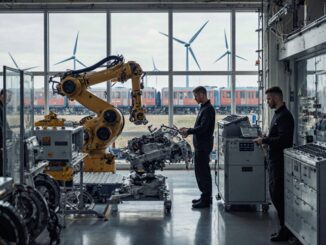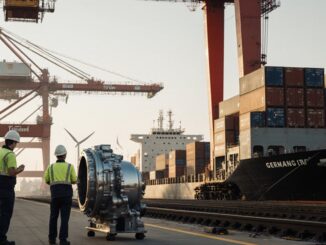
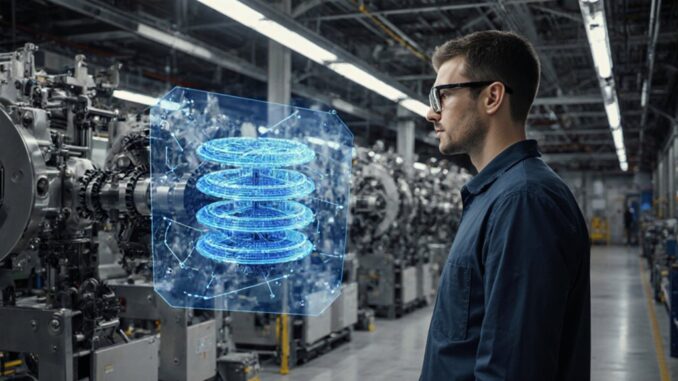
Digital twins are changing German industry by synchronizing physical assets with continuously updated engineering, sensor, PLC, MES, and ERP data. They help factories detect deviations earlier, improve root-cause analysis, optimize cycle times, and prioritize predictive maintenance. Automotive, machinery, chemical, energy, and logistics firms use them to model quality, material flows, energy demand, and disruptions. Their value depends on interoperable standards, governed data pipelines, secure connectivity, and skilled teams. The following sections explain the operating models, requirements, and future direction.
What Digital Twins Are in German Manufacturing
In German manufacturing, a digital twin is a continuously updated virtual representation of a physical asset, process, or production system. It combines engineering models, sensor streams, operational histories, and contextual data from PLCs, MES platforms, ERP systems, and industrial IoT networks. The model mirrors defined characteristics such as geometry, material state, machine configuration, energy inputs, and process parameters.
Unlike a static simulation, the twin maintains synchronization with its physical counterpart through governed data pipelines and standardized interfaces, including OPC UA and Asset Administration Shell frameworks. Its fidelity depends on data quality, update frequency, model assumptions, and traceable links between design, production, and service records.
German use cases span machine tools, automotive assembly cells, chemical plants, logistics equipment, and energy-intensive industrial applications. In each case, the digital twin functions as a structured information layer that connects physical operations with analytical models, enabling consistent lifecycle documentation and interoperable data exchange across engineering and manufacturing environments.
How Digital Twins Improve Factory Performance
By integrating live production data with validated process models, digital twins improve factory performance through earlier deviation detection, faster root-cause analysis, and more controlled optimization of equipment and workflows. Sensor streams, PLC signals, quality records, and energy meters are consolidated into a continuously updated operational model. This model compares expected and actual behavior at machine, line, and plant levels, identifying drift before it becomes scrap, downtime, or throughput loss.
Performance gains arise from closed-loop decision support. Predictive maintenance algorithms assess vibration, temperature, cycle-time, and fault-history patterns to estimate component degradation and prioritize interventions according to production risk. Simulation-based scheduling tests alternative settings, material flows, and maintenance windows without disrupting operations. Energy optimization evaluates load profiles, compressed-air demand, thermal conditions, and equipment idle states to reduce consumption while preserving output targets. Measurable indicators, including overall equipment effectiveness, first-pass yield, mean time between failures, and kilowatt-hours per unit, provide a common basis for continuous, auditable improvement.
Digital Twin Use Cases in German Industry
German industry applies digital twins across discrete manufacturing, process operations, energy systems, and logistics to link physical assets with continuously updated operational data. Automotive plants model body shops, paint lines, and battery assembly to test cycle-time changes, robot paths, and quality risks before altering production. Machinery builders use equipment twins to compare load profiles, vibration patterns, and thermal behavior against design limits.
In chemical, steel, and pharmaceutical operations, process twins simulate material flows, energy balances, and control responses, helping operators reduce off-spec output and stabilize throughput. Grid operators and industrial energy users model turbines, substations, and heat networks to forecast demand, evaluate dispatch scenarios, and identify losses.
Predictive maintenance is a major application: condition indicators can prioritize inspections, estimate remaining useful life, and reduce unplanned downtime. In logistics, warehouse, vehicle, and inventory twins support supply chain optimization by testing routing, storage capacity, delivery windows, and disruption scenarios. These models improve coordination across production sites, suppliers, and distribution networks while making operational trade-offs measurable.
Data, Software, and Skills for Digital Twins
Reliable digital twins depend on governed data pipelines that connect sensor streams, machine controls, enterprise systems, engineering models, and historical maintenance records. Data governance defines ownership, quality thresholds, access rights, retention rules, and traceability across these inputs. Without consistent asset identifiers, timestamp synchronization, and validated metadata, model outputs can misrepresent production conditions or maintenance risk.
Software interoperability is equally critical. German manufacturers commonly operate mixed environments of PLCs, SCADA platforms, MES, ERP suites, CAD tools, and cloud analytics services. Standardized interfaces, semantic data models, and APIs reduce integration friction and allow twin components to exchange operational context reliably. Edge processing can filter high-frequency machine data before transfer, limiting latency and network costs.
Workforce training must cover data literacy, model validation, cybersecurity, and cross-functional workflow design. Engineers, operators, IT specialists, and maintenance teams require shared procedures for interpreting twin recommendations, documenting overrides, and feeding verified outcomes back into the system.
The Future of Digital Twins in Germany
As industrial data infrastructures mature, digital twins in Germany are likely to evolve from isolated engineering models into continuously updated systems that coordinate design, production, maintenance, energy use, and supply-chain decisions. Their effectiveness will depend on interoperable data models, high-frequency sensor streams, and secure links between operational technology and enterprise platforms.
Edge predictive analytics will increasingly process machine data near production assets, reducing latency for fault detection and adaptive control. Industry standards, including common asset administration shells and semantic interfaces, can enable twins to exchange information across suppliers, factories, and lifecycle stages. Digital identity mechanisms will be required to verify equipment, software components, data provenance, and authorized model updates.
Germany regulations on cybersecurity, data protection, product traceability, and environmental reporting will shape deployment architectures. Firms that combine governed data spaces with simulation, AI, and real-time monitoring can use digital twins to improve resilience, reduce downtime, document compliance, and optimize resource allocation across distributed industrial networks.
The Industry & Manufacturing Editorial Team focuses on Germany’s industrial economy and the technologies transforming production. Coverage includes mechanical engineering, manufacturing, automation, robotics, process industries, supply chains and industrial digitalisation. Particular attention is given to the German Mittelstand, specialised manufacturers and hidden champions that play an important role in global industrial markets.