
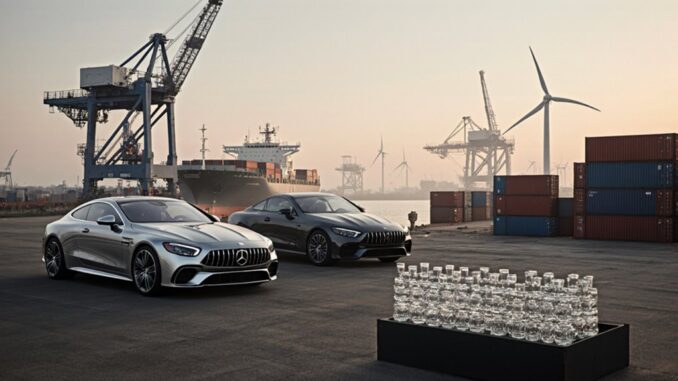
Germany’s biggest export industries are vehicles and auto parts, machinery, chemicals and pharmaceuticals, and industrial electrical equipment. Their strength comes from precision engineering, skilled labor, research investment, and EU-integrated supply chains rather than low-cost production. Major customers include the United States, France, the Netherlands, China, and Poland. Energy costs, Chinese EV competition, and trade rules are increasing pressure, while batteries, grid technology, and digital manufacturing are reshaping future growth. The sector breakdown explains these shifts in greater detail.
Germany’s Top Export Sectors at a Glance
Germany’s export economy is led by high-value manufacturing, with vehicles, machinery, chemicals, pharmaceuticals, electrical equipment, and precision instruments accounting for a substantial share of merchandise exports. This sectoral mix places Germany among the world’s largest goods exporters, alongside China, the United States, and Japan, while giving it a particularly strong position in capital goods and specialized industrial inputs.
Machinery and industrial equipment support sales to advanced and emerging markets, whereas chemicals and pharmaceuticals provide resilient demand through business cycles. Electrical engineering, medical technology, and measurement instruments reinforce export diversification by serving digitalization, energy-transition, and healthcare investment. Germany’s export model also benefits from deep European Union integration, which reduces trade barriers and connects domestic producers to regional supply chains.
Policy priorities include affordable energy, skilled labor, research investment, and streamlined trade procedures. Global branding centered on quality, reliability, and engineering expertise helps firms command premium prices, although exposure to external demand and geopolitical disruptions remains significant.
1. Vehicles and Auto Parts
Vehicles and auto parts form Germany’s largest single merchandise-export complex, spanning passenger cars, commercial vehicles, engines, transmissions, batteries, and specialized components. The sector’s export strength reflects dense supplier networks, premium branding, and integration with European production platforms. It competes directly with China, Japan, South Korea, and the United States, while relying on efficient global logistics for parts flows and overseas delivery.
- Passenger vehicles remain the highest-value export category.
- Components support German assembly plants and foreign manufacturers.
- Electric-vehicle demand is shifting investment toward batteries and software.
- EU emissions rules increasingly shape product design and market access.
Trade policy is central to competitiveness: tariff exposure, rules-of-origin requirements, and trade agreements affect sales in major destination markets. Germany benefits from the EU single market, but faces pressure from Chinese electric-vehicle producers and US subsidy programs. Maintaining export capacity requires investment in charging ecosystems, resilient supply chains, and lower-cost energy, while preserving employment across automotive regions. Producers also face stricter sustainability reporting, recycling targets, and sourcing due-diligence obligations worldwide.
2. Machinery and Industrial Equipment
Machinery and industrial equipment constitute Germany’s second major export pillar, covering machine tools, factory automation, pumps, compressors, agricultural machinery, and process-engineering systems. The sector supports high-value manufacturing and supplies capital goods to production sites across Europe, North America, and Asia. German firms compete through engineering precision, durability, customization, and integrated digital controls rather than low-cost mass production.
Its position in global trade depends on demand for factory upgrades, infrastructure investment, and energy-efficient equipment. Export services, including installation, maintenance, software updates, operator training, and spare-parts supply, extend revenue beyond initial equipment sales and strengthen customer retention. Dense logistics networks linking industrial clusters, ports, rail corridors, and European distribution hubs support reliable delivery of complex machinery.
Policy priorities include export finance, vocational skills, research incentives, and interoperable standards for automation. Compared with competitors in China, Japan, South Korea, and the United States, Germany retains particular strength in specialized mid-market machinery, although price pressure and supply-chain vulnerabilities remain significant challenges.
3. Chemicals and Pharmaceuticals
Chemicals and pharmaceuticals form Germany’s third major export industry, spanning basic chemicals, specialty materials, life-science products, and prescription medicines. The sector supports high-value trade through research intensity, integrated European supply chains, and strong demand from North America and Asia. Germany competes with the United States, Switzerland, China, and Belgium, while retaining advantages in process engineering, quality assurance, and established industrial clusters.
- Pharmaceuticals generate substantial export value through patented therapies, vaccines, and generic medicines.
- Specialty chemicals serve automotive, construction, agriculture, consumer goods, and medical applications.
- EU standards shape regulatory compliance, product safety, environmental reporting, and cross-border market access.
- Energy costs and carbon rules pressure basic chemical producers relative to lower-cost global competitors.
Policy priorities include affordable energy, faster permitting, research incentives, and resilient access to critical feedstocks. Export performance increasingly depends on market demand for sustainable materials and advanced therapeutics. Investment in low-carbon production can protect competitiveness while supporting European climate targets and maintaining Germany’s position in global chemical trade.
4. Electrical Equipment and Electronics
Electrical equipment and electronics constitute a major German export segment, led by industrial automation systems, power-generation technology, electrical components, measurement instruments, and telecommunications equipment. The sector supplies factory controls, grid hardware, sensors, medical electronics, and specialized machinery components to European, North American, and Asian customers.
Germany’s export profile is weighted toward high-value industrial applications rather than mass-market consumer devices, where East Asian producers hold larger global shares. EU single-market rules support cross-border sales, while common standards for energy efficiency, product safety, and digital connectivity shape demand. Export performance is also linked to investment in renewable power networks, semiconductor production, data infrastructure, and automated manufacturing.
Trade and tariffs remain material policy considerations, particularly for components moving through complex global supply chains. Exposure to China, the United States, and EU partners makes market diversification relevant as firms seek broader outlets in India, Southeast Asia, and emerging energy markets. Regulatory alignment and supply-security measures increasingly influence procurement patterns and export destinations.
Why German Export Industries Stay Competitive
Germany’s export competitiveness rests on high-value engineering, a skilled technical workforce, and integrated supply chains across Europe and global markets. Compared with many lower-cost manufacturing economies, German firms compete through precision, reliability, research intensity, and specialized industrial capabilities. Vocational training, EU single-market access, and supplier networks help sustain performance in machinery, vehicles, chemicals, and electronics.
Engineering Excellence
Engineering capability underpins Germany’s export competitiveness across machinery, vehicles, industrial equipment, and advanced manufacturing. Exporters benefit from sustained R&D intensity, rigorous standards, and production systems optimized for reliability in high-value global markets. Compared with lower-cost manufacturing hubs, German firms compete through measurable performance, lifecycle value, and regulatory readiness.
- Precision engineering supports tight tolerances and durable components.
- Safety compliance strengthens access to regulated EU, US, and Asian markets.
- Energy efficiency reduces operating costs and aligns products with decarbonization policy.
- Industry 4.0 integration improves quality control, predictive maintenance, and customization.
Public support for applied research, testing infrastructure, and technology transfer reinforces this position. German equipment suppliers accordingly retain strong demand where buyers prioritize uptime, certification, and long-term operating economics over initial purchase price, especially in capital-intensive sectors worldwide.
Skilled Workforce Advantages
The technical edge of German export industries is sustained by a workforce shaped through dual vocational training, university engineering education, and continuous in-company upskilling. Apprenticeship training combines classroom instruction with paid workplace experience, helping manufacturers maintain specialized capabilities in machinery, vehicles, chemicals, and medical technology. Roughly half of German school leavers enter vocational pathways, a participation level higher than in many advanced economies. This system reduces skill mismatches and supports consistent quality control on factory floors. Universities and applied-science institutes complement these routes by supplying engineers for research, automation, and product development. Policy coordination among employers, chambers of commerce, unions, and regional governments keeps curricula aligned with industrial standards. The result is a labor base particularly effective in precision engineering, where reliability, certification, and incremental improvement determine export competitiveness.
Global Supply Chain Strength
Across Europe and beyond, German exporters benefit from deeply integrated supply chains that link domestic high-value production with specialized suppliers in Central and Eastern Europe, Asia, and North America. This network supports automotive, machinery, chemicals, and electrical equipment exports while reducing unit costs and shortening innovation cycles. Compared with more domestically concentrated competitors, German firms combine regional proximity with global sourcing flexibility.
- Dense Mittelstand supplier clusters support precision components.
- EU single-market rules reduce customs and regulatory friction.
- Resilient logistics planning diversifies ports, rail corridors, and inventories.
- Supplier risk management strengthens continuity during shocks.
Public investment in rail freight, digital customs systems, energy infrastructure, and semiconductor capacity is increasingly central. Diversification policies also limit exposure to single-country dependencies, particularly for critical minerals and electronics. These measures preserve Germany’s reliability advantage in trade.
Germany’s Largest Export Markets
Within the European Union, Germany’s largest export markets are concentrated in neighboring high-income economies, with the United States, France, the Netherlands, China, and Poland consistently ranking among its leading destinations. France and Poland benefit from integrated EU production networks, while the Netherlands functions as a major logistics gateway through Rotterdam. The United States remains Germany’s most important non-European customer, particularly for vehicles, machinery, chemicals, and medical technology.
China has been a major destination for capital goods and premium automobiles, although its role differs from European markets because trade is less embedded in regional supply chains. Italy, Austria, Belgium, and the United Kingdom also remain significant buyers of German manufactured products. Brexit trade adjustments have altered administrative procedures with the UK but have not eliminated its commercial importance. Meanwhile, Emerging Asia markets, including South Korea, India, Vietnam, and Indonesia, offer expanding demand for industrial equipment, renewable-energy systems, and specialized engineering exports, supporting diversification beyond traditional European and Atlantic trade partners.
Challenges Facing German Export Industries
German export industries face a more difficult operating environment as weak global demand, higher financing costs, and persistent energy-price gaps erode competitiveness in energy-intensive manufacturing. Industrial electricity prices remain above those in the United States and China, pressuring chemicals, metals, glass, and paper producers. Automotive and machinery exporters also confront softer Chinese demand and more localized supply chains.
- Currency and tariffs complicate pricing, especially where exchange-rate movements weaken euro-area cost advantages.
- Trade compliance hurdles expand through sanctions screening, carbon-border reporting, and product-certification rules.
- Subsidy competition from the United States, China, and France raises the relative cost of domestic investment.
- Infrastructure constraints, including rail bottlenecks and delayed grid connections, increase delivery risks.
Germany’s export model is additionally exposed to concentrated dependence on external markets and imported inputs. Policy measures such as faster permitting, lower non-wage costs, reliable power supply, and coordinated EU trade enforcement could reduce structural disadvantages without distorting competition.
The Future of Germany’s Export Sectors
Germany’s export outlook will increasingly depend on competitiveness in green technologies, where EU climate policy and global demand for renewable-energy equipment are reshaping trade flows. The automotive sector faces a parallel shift toward electric vehicles, batteries, and software-defined systems amid strong competition from China and the United States. Expansion in digital manufacturing, supported by investment in automation, semiconductors, and industrial AI, could reinforce Germany’s position in higher-value global supply chains.
Green Technology Export Growth
As global decarbonization policies expand, green technology is positioned to become a larger component of Germany’s export base, particularly in renewable-energy equipment, grid infrastructure, energy-efficiency systems, hydrogen technologies, and industrial electrification.
Germany’s engineering base supports higher-value capital goods, although China retains scale advantages in solar modules and batteries. EU climate rules, public procurement, and Policy incentives can strengthen demand for German systems abroad. Export finance is especially relevant for large grid, electrolyzer, and offshore-wind contracts in emerging markets.
- Grid automation and transmission components
- Industrial heat pumps and efficiency equipment
- Electrolyzers, compressors, and hydrogen controls
- Wind-turbine systems and maintenance services
Competitiveness will depend on faster domestic deployment, lower energy costs, and coordinated European supply chains. Compared with US subsidy-led expansion, Germany’s advantage lies in specialized manufacturing, standards expertise, and project engineering for complex industrial transitions.
Automotive Industry Transformation
Although automotive exports remain central to Germany’s industrial economy, the sector is being reshaped by the global shift toward electric vehicles, software-defined platforms, and lower-carbon supply chains. German manufacturers retain strengths in premium brands, engineering, and export networks, but face sharper competition from China, whose EV producers benefit from scale, domestic demand, and integrated battery production. The battery revolution has increased dependence on critical minerals, cell capacity, and Asian component suppliers, prompting Berlin and the EU to expand subsidies, recycling rules, and strategic sourcing partnerships. Policies such as EU emissions targets and proposed tariffs on subsidized Chinese vehicles aim to protect investment while preserving open trade. Germany’s future competitiveness will depend on securing an EV supply chain, reducing production costs, and converting established automotive expertise into globally marketable electric models.
Digital Manufacturing Expansion
Digital manufacturing is becoming a strategic export advantage as German firms integrate industrial software, automation, artificial intelligence, and connected production systems into established machinery and engineering sectors. This shift strengthens competitiveness against US platform providers, Chinese scale manufacturers, and Japanese robotics specialists.
- Industrial IoT supports predictive maintenance and lower downtime.
- AI driven quality improves precision in automotive, chemicals, and machinery.
- Cybersecurity readiness protects exportable factories from supply-chain disruptions.
- EU data and digital-product rules encourage interoperable, trusted systems.
Germany’s policy focus combines Industry 4.0 investment, skills development, semiconductor capacity, and secure cloud infrastructure. Export growth increasingly depends on selling integrated production solutions rather than standalone equipment. Smaller Mittelstand suppliers face financing and talent constraints, yet digital standards can widen their access to global value chains. Success will hinge on faster deployment, reliable energy, and regulatory alignment across major markets.
The Automotive & Mobility Editorial Team follows one of Germany’s most important industries and its transformation. Coverage ranges from automotive manufacturers and suppliers to electric vehicles, batteries, automotive software, autonomous driving, rail, logistics and new mobility concepts. The team examines both established German mobility companies and the technologies that could shape transportation in the future.