Mercedes-Benz is a German premium automaker whose heritage reaches back to Karl Benz’s 1886 Patent-Motorwagen, widely regarded as the first automobile. It matters because its German plants, engineering centers, exports, and supplier networks support high-value manufacturing and skilled employment. With roughly 170,000 employees worldwide and major sites in Sindelfingen, Bremen, and Untertürkheim, it remains influential in vehicles, technology, and electric-transition investment. Its wider economic role becomes clearer through its factories, exports, and competitive challenges.
Why Mercedes-Benz Matters to Germany’s Economy
Mercedes-Benz matters to Germany’s economy because it combines the country’s industrial heritage with a globally competitive export business. Its roots in the invention of the automobile give the brand unusual symbolic importance, while its modern operations anchor high-value manufacturing, engineering, research, and financial services within Germany. The company’s investment decisions affect demand for advanced machinery, software, batteries, logistics, and specialized industrial inputs.
Its Workforce influence extends beyond direct employment: collective bargaining outcomes, training standards, and production technologies can shape expectations across the automotive labor market. The company also supports regional suppliers, particularly in Baden-Württemberg and other manufacturing centers, where component makers depend on long-term vehicle programs and technical collaboration. This ecosystem generates tax revenue, export earnings, and skilled-apprenticeship opportunities. During industry turnovers toward electric drivetrains and digital vehicles, Mercedes-Benz’s procurement and capital-allocation choices accordingly carry broader consequences for German industrial competitiveness, supplier adaptation, and the preservation of manufacturing capability.
Mercedes-Benz’s Scale in Germany and Worldwide
Mercedes-Benz maintains a substantial German manufacturing base, with major vehicle, engine, and component operations anchoring its industrial presence in Baden-Württemberg and other regions. Built from Germany’s long automotive tradition, the company now combines this domestic footprint with a global production network serving major markets in Europe, China, North America, and beyond. Its worldwide sales scale makes German engineering both a national industrial asset and an export-oriented premium-market business.
German Manufacturing Footprint
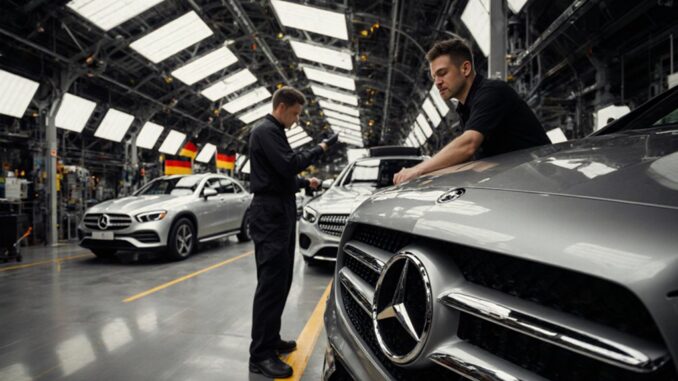
At the center of Germany’s automotive industrial base, Mercedes-Benz operates a manufacturing network that combines long-established domestic plants with production sites across Europe, North America, Asia, and Africa. Its German footprint remains strategically important for engineering, premium-vehicle assembly, powertrain development, and industrial employment. Historic sites in Sindelfingen, Bremen, Rastatt, Untertürkheim, and Düsseldorf anchor workforce distribution while supporting regional supplier networks and technical training ecosystems.
- Sindelfingen concentrates flagship model production and advanced manufacturing.
- Bremen provides flexible capacity for passenger-car assembly.
- Rastatt supports compact vehicles and electrification-oriented processes.
- Untertürkheim retains importance in drive systems, research, and components.
This domestic concentration gives Germany high-value production capability, preserves specialized skills, and reinforces local investment demand. It also exposes suppliers and labor markets to changes in technology, regulation, and premium-vehicle cycles.
Global Production And Sales
Beyond its German plants, the group’s economic weight is defined by a global production and sales system that places it among the world’s largest premium-vehicle manufacturers. Mercedes-Benz Cars delivered roughly 2.0 million vehicles in 2023, supported by assembly networks across Europe, North America, China, South Africa, and other key markets. China has become its largest single national market, illustrating the company’s reliance on affluent Asian consumers and locally produced models. U.S. production in Alabama and Chinese joint-venture manufacturing also reduce logistics costs and respond to regional demand. This international structure evolved from export-led growth after the Second World War into a localized industrial model. Its market reach strengthens German engineering’s global influence while linking domestic design, research, components, and headquarters functions to worldwide sales volumes, currency shifts, trade policy, and changing demand for electric vehicles.
How Mercedes-Benz Built Germany’s Car Industry
Mercedes-Benz’s origins in the 1886 Benz Patent-Motorwagen positioned it at the foundation of Germany’s automotive industry and established a long-running focus on engineering innovation. Its expansion into large-scale manufacturing helped build industrial clusters, supplier networks, and skilled employment across Germany. By exporting premium vehicles and technology worldwide, the company also strengthened the global market standing of German engineering.
Pioneering Automotive Innovation
From the late 19th century, the companies founded by Karl Benz and Gottlieb Daimler established the technical and industrial base of Germany’s automobile sector. Their patents, engineering standards, and early commercialization helped define a market in which German manufacturers competed through performance, safety, and precision rather than price alone.
- Benz’s 1886 Patent-Motorwagen created a reference point for motorized personal transport.
- Daimler’s high-speed engines expanded applications across cars, trucks, and buses.
- Mercedes-Benz later advanced diesel technology, crumple zones, anti-lock braking, and electronic stability systems.
- Current alternative R&D targets batteries, hydrogen fuel cells, software, and sustainable Mobility.
These innovations strengthened Germany’s premium-vehicle position, while supplier networks adopted the company’s technical requirements. Its development model also influenced export-oriented competition, making engineering leadership a central measure of automotive value.
Industrial Growth And Employment
Mercedes-Benz helped turn automobile production into a major pillar of Germany’s industrial economy by concentrating engineering, manufacturing, and supplier activity around large-scale vehicle plants. From the early twentieth century, its factories in Stuttgart, Sindelfingen, Untertürkheim, and Bremen supported industrial clustering, linking metalworking, machine tools, chemicals, logistics, and component production. This model expanded skilled employment beyond assembly lines, creating demand for designers, technicians, toolmakers, mechanics, and production specialists. Workforce training, often coordinated through apprenticeships and technical education, supplied capabilities needed for increasingly complex vehicles. Supplier ecosystems developed around major plants, allowing specialized firms to scale production of engines, electronics, interiors, and precision parts. Mercedes-Benz thus helped establish the high-value manufacturing base that strengthened Germany’s automotive labor market, supported regional incomes, and reinforced the sector’s position as a major contributor to national output and exports.
Globalizing German Engineering
The industrial capabilities built around Mercedes-Benz’s German plants also gave the company a platform to carry German engineering into international markets. Export growth after 1945 turned domestic production expertise into a global benchmark for premium vehicles, commercial transport, and automotive technology.
- International partnerships expanded market access while preserving German-led product development.
- Manufacturing networks in Europe, North America, Asia, and Africa localized assembly and reduced trade barriers.
- A skilled workforce transferred production knowledge through training, supplier coordination, and technical standards.
- Quality systems developed in German factories supported consistent performance across overseas plants.
This model strengthened Germany’s automotive export position and helped suppliers scale internationally. Mercedes-Benz’s global footprint also reinforced demand for German machine tools, components, logistics, and engineering services, linking national industrial competitiveness to worldwide vehicle markets. Its brand became a durable signal of reliability, safety, and technological depth.
Mercedes-Benz Jobs, Plants, and Supply Chains
With roughly 170,000 employees worldwide and major production sites concentrated in Germany, Mercedes-Benz remains a central industrial employer in the country’s automotive economy. Its core factories in Sindelfingen, Bremen, Untertürkheim, Rastatt, and Düsseldorf support vehicle assembly, powertrain production, research, and logistics, linking regional labor markets to a dense network of suppliers.
The company’s employment model reflects Germany’s long industrial tradition of co-determination, vocational training, and high-value manufacturing. Skilled apprenticeships feed technical roles in mechatronics, software, battery systems, and precision engineering, while workforce diversity has become increasingly important as production requires digital and electrification expertise. Thousands of small and midsized suppliers provide components, tooling, materials, and specialist services, making Mercedes-Benz a significant buyer across Baden-Württemberg and beyond. Supply-chain pressures since the semiconductor shortages and energy-price disruptions have increased attention to local sourcing, inventory resilience, and traceability. Its factory investments consequently influence not only direct payrolls, but also supplier capacity, infrastructure demand, and regional industrial planning.
Mercedes-Benz and Germany’s Export Strength
Across global premium-car markets, Mercedes-Benz has long served as a high-value export pillar for Germany, combining the country’s engineering reputation with demand from North America, China, Europe, and the Gulf states. Since postwar reconstruction, the brand’s international sales have supported Germany’s trade profile by converting domestic production into substantial Export Earnings and reinforcing its position in the Global Market.
- Premium pricing raises export value per vehicle compared with mass-market segments.
- Overseas demand diversifies revenue beyond Germany’s comparatively mature home market.
- China and the United States have remained central destinations for luxury-car volumes.
- Export activity supports related German industries, including logistics, finance, chemicals, and specialized components.
Mercedes-Benz’s importance is consequently measured not only in vehicles shipped abroad, but also in the trade surplus, tax base, and supplier revenue attached to each international sale. Currency shifts, tariffs, regional production, and changing demand can affect results, yet the marque remains a visible contributor to Germany’s export-led automotive economy.
Mercedes-Benz Technology and Engineering Leadership
Export success rests in part on Mercedes-Benz’s long-standing ability to convert engineering advances into premium-market differentiation. From Karl Benz’s 1886 patent motorcar to modern safety and digital systems, the company has helped establish technical benchmarks that support Germany’s high-value automotive manufacturing base. Its innovations have frequently moved from flagship models into broader production: crumple zones, anti-lock braking systems, airbags, electronic stability control, and advanced driver-assistance functions strengthened both pricing power and brand credibility.
Engineering leadership remains commercially significant because premium buyers reward performance, safety, comfort, and software capability. Mercedes-Benz invests heavily in research, development, testing, and global production engineering, while its German sites anchor specialized supplier networks and skilled employment. Current work on autonomous driving combines sensors, computing, mapping, and redundant vehicle controls, reflecting the industry’s shift toward software-defined vehicles. Development of battery systems also requires expertise in thermal management, energy density, packaging, and safety validation. These capabilities reinforce Mercedes-Benz’s role as a technological reference point for Germany’s automotive sector.
Electric Cars, Competition, and Industry Challenges
As global demand shifts toward battery-electric vehicles, Mercedes-Benz faces a defining shift from the combustion-engine strengths that long supported Germany’s premium-car exports. Electric vehicle adoption is reshaping investment priorities, factory design, and supplier relationships across its German base.
- Mercedes-Benz must protect premium margins while EV price competition intensifies, particularly in China, its largest single market.
- Chinese competition from BYD and other fast-moving manufacturers pressures European brands on cost, software, and model-development speed.
- Battery supply chains have become strategic: cell sourcing, raw-material access, and European production capacity increasingly determine resilience.
- Regulatory hurdles, including EU emissions rules, battery-passport requirements, and trade measures, raise compliance costs while influencing demand.
Historically, German manufacturers led through mechanical engineering, export scale, and supplier specialization. The EV conversion redistributes advantage toward battery chemistry, digital platforms, and charging ecosystems. Mercedes-Benz’s response consequently matters beyond one company: its investment decisions affect employment, suppliers, industrial exports, and Germany’s ability to retain automotive leadership in a rapidly changing global market.

The German Companies Editorial Team profiles the businesses behind Germany’s economy. Coverage ranges from internationally known corporations and DAX companies to family-owned Mittelstand businesses, hidden champions, technology companies and startups. Profiles place companies within their industry, region and economic context rather than simply presenting corporate information.