
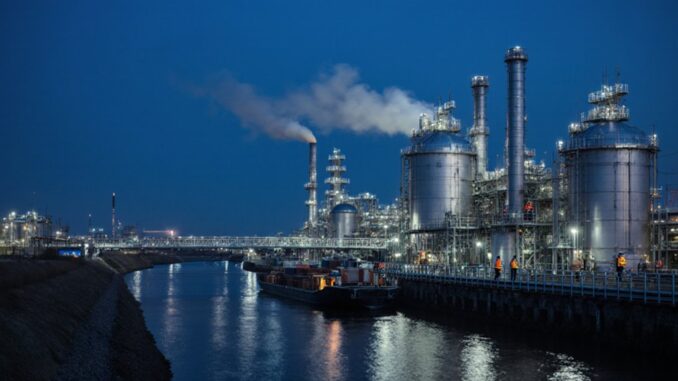
BASF, headquartered in Ludwigshafen, is Germany’s largest chemical company and a major global producer of chemicals, materials, agricultural products, catalysts, coatings, and battery materials. Its integrated Ludwigshafen Verbund links roughly 200 facilities through shared energy, pipeline, and logistics systems. BASF supplies automotive, construction, agriculture, pharmaceutical, and consumer-goods value chains, making it central to export-oriented manufacturing. Its response to energy costs, decarbonization requirements, and global competition will shape Germany’s industrial future.
What BASF Does and Where It Operates
BASF is one of the world’s largest chemical companies, producing materials, intermediates, and specialty products for industries including automotive, construction, agriculture, consumer goods, energy, and pharmaceuticals. Headquartered in Ludwigshafen, Germany, it operates an integrated production complex that is among the largest chemical sites globally, linking plants, logistics, energy systems, and research facilities.
Its footprint extends across Europe, North America, Asia-Pacific, and South America, supported by production sites, laboratories, and commercial offices in more than 90 countries. This global market reach enables BASF to supply regional industrial clusters while managing exposure to local demand cycles, energy costs, regulation, and trade conditions.
BASF history milestones reflect Germany’s industrial development: founded in 1865, the company expanded from dye chemistry into a multinational manufacturing and technology group. Its scale matters to Germany’s chemicals sector because its domestic operations anchor major supplier networks, skilled employment, export activity, and applied research, while its international presence connects German chemical production to global manufacturing demand.
BASF’s Main Businesses and Products
That global manufacturing footprint supports a diversified portfolio organized around chemicals, materials, industrial solutions, surface technologies, nutrition and care, and agricultural solutions. Its Chemicals segment supplies petrochemicals, intermediates, solvents, plasticizers and basic inorganic products that feed downstream manufacturing chains. Materials produces engineering plastics, polyurethane systems and performance materials for automotive, construction, electronics and consumer applications. Industrial Solutions provides dispersions, pigments, additives, resins and performance chemicals used in coatings, adhesives, paper, detergents and oilfield operations. Surface Technologies combines catalysts, battery materials and automotive coatings, positioning BASF in electrification and emissions-control supply chains. Nutrition and Care includes ingredients for personal care, home care, human nutrition and pharmaceuticals. Agricultural Solutions markets crop-protection products, seeds and digital farming tools. Across these businesses, Green innovation focuses on lower-emission processes, renewable feedstocks and energy-efficient products. Circular economy initiatives include chemical recycling, recycled-content polymers and product designs intended to keep materials in industrial use longer.
Why BASF Matters to Germany’s Economy
BASF matters to Germany’s economy because its chemical output feeds major manufacturing sectors, including automotive, construction, agriculture, and pharmaceuticals, while supporting export-oriented supply chains. Its Ludwigshafen headquarters and other German sites employ thousands directly and sustain extensive networks of suppliers, contractors, and logistics providers. Capital investment in production, research, and infrastructure also makes BASF a significant contributor to regional industrial development.
Industrial Output And Exports
Within Germany’s export-oriented industrial base, BASF functions as a major upstream supplier whose chemicals, materials, and agricultural products feed automotive, construction, consumer goods, pharmaceuticals, and manufacturing supply chains. Its output ranges from basic petrochemicals and engineering plastics to coatings, catalysts, battery materials, and crop-protection products, linking domestic production with global trade flows. Because chemical inputs are embedded in high-value manufactured exports, BASF’s operating performance can influence procurement costs, production reliability, and export competitiveness across German industry. The company’s Ludwigshafen complex also illustrates the scale economics of integrated chemical production, where shared energy, logistics, and feedstock systems support large-volume output. Changes in energy prices, demand in China and Europe, and international freight conditions consequently affect not only BASF’s sales but also the broader competitiveness of chemical-intensive German export sectors in world markets.
Employment And Regional Investment
Beyond its role in industrial production, BASF is one of Germany’s most significant private-sector employers and a central economic anchor for the Rhine-Neckar region. Its Ludwigshafen site supports roughly 39,000 employees, alongside contractors, logistics providers, engineering firms, and research institutions linked to the chemical complex. The company’s apprenticeship programs and Workforce training investments help sustain specialist capabilities in process engineering, laboratory science, maintenance, and digital manufacturing. Regional investment also extends to infrastructure, energy systems, and supplier networks, concentrating high-value industrial activity around Rhineland-Palatinate and Baden-Württemberg. BASF’s capital spending influences demand for local construction, equipment, transport, and technical services. At the same time, efforts to strengthen supply chain resilience affect procurement strategies, storage capacity, and domestic sourcing, reinforcing the region’s role in Germany’s broader industrial base.
How Ludwigshafen’s Verbund System Works
At Ludwigshafen, BASF’s Verbund system links roughly 200 production facilities through shared pipelines, utilities, and logistics infrastructure. By channeling chemical by-products and intermediates into subsequent processes, the network reduces raw-material use, transport needs, and waste relative to stand-alone plants. Integrated energy flows—including steam and electricity generation—further support cost efficiency and operational reliability across the site.
Integrated Production Networks
BASF’s Ludwigshafen site operates as a Verbund, or integrated production network, in which the output or by-products of one plant serve as inputs for another, reducing raw-material use, energy demand, and transport requirements. The model links major chemical value chains across a single industrial complex, allowing intermediates to move directly between production units rather than through external logistics channels. This arrangement supports scale economies in a sector where competitiveness depends on high asset utilization, reliable access to inputs, and rapid adjustment to customer demand. It also strengthens supply chain resilience by limiting dependence on third-party transport and fragmented suppliers. As chemical producers seek lower-carbon inputs, the Verbund can help incorporate circular feedstocks into established processing chains, provided quality specifications and regulatory requirements are met. Ludwigshafen thus remains central to BASF’s German manufacturing base.
Energy And Material Flows
The Ludwigshafen Verbund functions through tightly managed flows of feedstocks, steam, electricity, cooling water, and chemical intermediates across hundreds of interconnected production units. Its design reduces transport needs by routing by-products directly into downstream processes, supporting cost control and lowering the carbon footprint per tonne of output. Raw material sourcing links pipelines, Rhine shipping, rail, and road networks to crackers, ammonia plants, and specialty-chemical lines, although logistics constraints can disrupt operating rates.
- Steam from power and heat systems circulates through insulated pipe corridors.
- Intermediate molecules move between plants in continuous, measured streams.
- Cooling water returns through closed loops beside towers and river infrastructure.
The Ludwigshafen industrial transformation increases pressure to replace fossil-based energy while preserving reliable, high-volume production. Ludwigshafen’s integration makes efficiency gains systemic, but also concentrates exposure to energy prices and infrastructure interruptions.
BASF’s Rise as a Chemical Industry Leader
Founded in 1865 in Ludwigshafen, Germany, BASF emerged alongside Europe’s industrial expansion by commercializing synthetic dyes and scaling chemical production for textile, agricultural, and manufacturing markets. Its early growth reflected the advantages of Germany’s research universities, engineering base, transport networks, and expanding industrial customers.
BASF built industry leadership by integrating research, production, logistics, and downstream sales across broad chemical value chains. The Ludwigshafen site developed into one of the world’s largest integrated chemical complexes, enabling shared infrastructure and links between basic chemicals, intermediates, performance materials, crop products, and consumer-facing ingredients. This Verbund model reduced transaction costs and supported high-volume manufacturing.
Through acquisitions, overseas plants, and specialized product development, BASF extended its presence across Europe, the Americas, and Asia. Its scale gave Germany a globally significant chemical champion, while its patenting, process expertise, and diversified portfolio strengthened global competitiveness in markets where innovation, reliability, and efficient production determined long-term commercial position.
BASF’s Energy, Climate, and Competition Pressures
Yet the scale and integration that long supported BASF’s competitiveness also heighten its exposure to Europe’s energy, climate, and market pressures. Its Ludwigshafen complex depends on gas and electricity not only for heat but as chemical feedstocks, making volatile Power Prices a direct operating constraint. The Energy Transition requires costly electrification, renewable sourcing, hydrogen infrastructure, and process redesign across energy-intensive value chains.
- Steam crackers and ammonia units illustrate the challenge: high-temperature production cannot be cheaply decarbonized overnight.
- EU Regulation tightens emissions rules and reporting requirements, while Carbon Costs under the EU Emissions Trading System affect margins in bulk chemicals.
- Competition intensifies from US producers benefiting from comparatively inexpensive shale gas and from Asian suppliers with newer capacity and lower construction costs.
These forces are most acute in commodity chemicals, where products are standardized and price increases can be difficult to pass through. BASF must thus balance production efficiency, capital discipline, and emissions reduction while protecting utilization rates in cyclical global markets.
What BASF’s Future Means for Germany
For Germany, BASF’s trajectory is a test of whether an advanced industrial economy can retain energy-intensive manufacturing while meeting climate targets and managing higher input costs. The company’s Ludwigshafen complex anchors production networks spanning plastics, fertilizers, coatings, automotive materials, pharmaceuticals, and construction chemicals. Its investment decisions consequently influence employment, freight volumes, power demand, and the competitiveness of downstream producers.
The BASF renewal strategy, centered on cost reductions, portfolio discipline, lower-carbon technologies, and selective overseas expansion, illustrates the trade-offs facing German industry. If high electricity and gas prices persist, some basic-chemicals capacity may shift toward regions with cheaper feedstocks and faster permitting. That would affect Germany supply chains by increasing dependence on imported intermediates and reducing local industrial integration.
Conversely, reliable renewable power, hydrogen infrastructure, carbon-management systems, and predictable regulation could preserve higher-value chemical production. BASF’s future will indicate whether Germany can combine decarbonization with a durable manufacturing base.
The German Companies Editorial Team profiles the businesses behind Germany’s economy. Coverage ranges from internationally known corporations and DAX companies to family-owned Mittelstand businesses, hidden champions, technology companies and startups. Profiles place companies within their industry, region and economic context rather than simply presenting corporate information.