
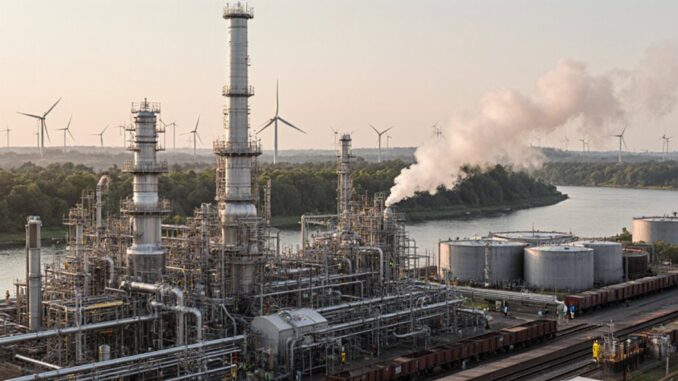
Germany’s chemical industry supplies essential inputs to pharmaceuticals, automotive, construction, agriculture, electronics, and consumer goods. Its model combines integrated petrochemical sites, global groups, specialty-focused Mittelstand firms, and shared-infrastructure park operators. Major hubs include Ludwigshafen, the Rhine-Ruhr corridor, Frankfurt-Höchst, and Marl. High energy costs, volatile demand, and global competition pressure commodity production, while circular feedstocks, electrification, hydrogen, and specialty materials shape investment. The sections below explain these structures, risks, and transformation pathways.
Why Germany’s Chemical Industry Matters
Germany’s chemical industry matters because it is a foundational supplier to manufacturing value chains, providing inputs for pharmaceuticals, automotive production, construction materials, agriculture, electronics, and consumer goods. Its products range from basic chemicals and polymers to high-value specialty materials, catalysts, coatings, and active pharmaceutical ingredients. This breadth makes chemical output a key determinant of industrial competitiveness, innovation capacity, and export performance.
The sector supports Global supply chains by supplying intermediate goods with strict quality, safety, and performance specifications. Disruptions in chemical availability can constrain downstream production, raise costs, and delay product launches across multiple end markets. Germany’s capabilities in process engineering, materials science, and applied research also strengthen its position in technically demanding segments.
Its importance is increasing as customers seek lower-carbon materials, circular feedstocks, and energy-efficient production. Investment in electrification, recycling, hydrogen-based processes, and bio-based chemistry can reinforce sustainability leadership while protecting margins, market access, and long-term demand resilience.
How Germany’s Chemical Industry Is Organized
Rather than operating as a single integrated system, the German chemical industry is organized around a mix of global diversified groups, specialized mid-sized firms, and large industrial-site operators. Its industry structure combines upstream basic chemicals, intermediates, specialty products, and downstream formulations serving automotive, construction, electronics, health care, agriculture, and consumer markets.
Large companies typically maintain broad portfolios and international sales networks, while Mittelstand enterprises concentrate on high-margin niches such as additives, catalysts, pigments, coatings, and performance materials. Site operators provide shared utilities, logistics, waste treatment, safety systems, and technical services, reducing fixed costs for resident manufacturers.
The value chain is strongly interconnected: feedstocks are converted into bulk chemicals, then processed into intermediates and application-specific products. Commercial relationships consequently depend on long-term supply contracts, quality certification, process reliability, and regulatory compliance. Research intensity is concentrated in specialty and life-science segments, where patent protection, customer qualification cycles, and tailored formulations create higher barriers to entry and support pricing power.
Germany’s Chemical Hubs and Major Producers
Production is concentrated in several integrated chemical corridors, led by the Rhine-Main/Lower Rhine region, Ludwigshafen, Leverkusen, Frankfurt-Höchst, Marl, and the central German cluster around Halle and Leipzig. These sites combine crackers, synthesis units, specialty plants, utilities, pipelines, rail terminals, and port access, lowering logistics costs and enabling high material integration.
Ludwigshafen, operated by BASF, is the country’s largest integrated chemical complex, producing petrochemicals, intermediates, performance materials, agricultural inputs, and coatings components. BASF Mannheim supports regional manufacturing and distribution activities. The Cologne–Leverkusen–Dormagen corridor hosts major polymer, rubber, and specialty-chemical capacity, including Lanxess Dormagen operations and Bayer-linked industrial infrastructure. Marl’s Chemiepark, anchored by Evonik, is significant for C4 chemistry, additives, and specialty intermediates. Frankfurt-Höchst accommodates pharmaceutical, fine-chemical, and industrial-biotechnology producers. In eastern Germany, Leuna, Bitterfeld-Wolfen, Halle, and Leipzig provide refinery-linked feedstocks, chlor-alkali products, silicones, and advanced materials capacity. These clusters serve European automotive, construction, healthcare, packaging, and electronics markets.
Challenges Facing Germany’s Chemical Industry
Despite the efficiency of these integrated clusters, Germany’s chemical industry faces a structural cost and competitiveness challenge. Energy-intensive production remains exposed to comparatively high electricity and natural-gas prices, while feedstock costs for naphtha, ethylene, chlorine, and ammonia directly affect margins. Producers also compete with lower-cost capacity in the United States, the Middle East, and China, where shale gas, subsidized inputs, or larger domestic demand can improve cost positions.
Demand volatility compounds pressure. Weak construction, automotive, packaging, and consumer-goods markets reduce operating rates across upstream and specialty chains, raising unit costs at capital-intensive plants. Global price swings in oil, gas, and petrochemical intermediates can quickly compress spreads, particularly for commoditized products.
Regulatory burdens add compliance costs through emissions trading, permitting, chemical safety rules, and reporting requirements. Carbon prices and decarbonization investment needs further affect capital allocation, while lengthy approval processes can delay modernization and capacity adjustments.
What’s Next for Germany’s Chemical Industry
The industry’s next phase will be defined by whether investment in decarbonized power, circular feedstocks, and higher-value specialty materials can offset Germany’s structural energy-cost disadvantage. Competitiveness will hinge on wholesale electricity and gas spreads, hydrogen availability, carbon-price exposure, and the speed at which crackers, ammonia units, and downstream plants can be retrofitted or replaced.
Next steps regulation reform should accelerate permitting for grids, renewable generation, carbon-capture infrastructure, and chemical-recycling facilities while preserving predictable rules for emissions trading and state-aid support. Policy design must lower capital risk without permanently insulating inefficient capacity.
The innovation research focus is likely to center on electrified steam cracking, green hydrogen, biomass residues, recycled pyrolysis oil, catalytic depolymerization, and process digitalization. Producers with proprietary formulations, regulated-market customers, and exportable low-carbon products should retain stronger margins. Commodity capacity, however, faces continuing rationalization unless feedstock and power economics improve materially.
The Business & Economy Editorial Team covers Germany’s economy, companies, markets and international trade. Its reporting focuses on economic developments, investment, exports, the Mittelstand, major corporations and the conditions affecting businesses in Germany. The team combines current economic news with background articles and analysis to explain what developments mean for companies, investors and international readers.