
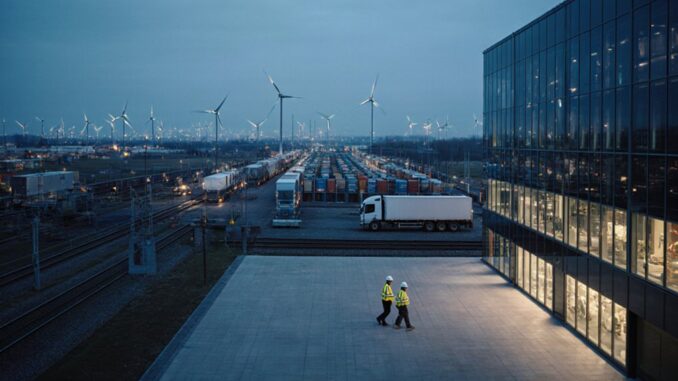
Germany’s industrial clusters concentrate manufacturers, suppliers, skilled workers, logistics systems, and research institutions in connected regional economies. Their boundaries follow commuting zones, transport corridors, supplier catchments, and knowledge flows rather than administrative lines. Proximity lowers coordination costs, supports specialized training, and accelerates innovation through universities and applied research institutes. Automotive Baden-Württemberg, Bavaria’s advanced manufacturing network, and Rhine-Ruhr chemicals illustrate how regional production depth strengthens export competitiveness. The regional patterns below show how these systems developed and continue to adapt.
What Defines Germany’s Industrial Clusters?
Germany’s industrial clusters are defined by the geographic concentration of interconnected manufacturers, suppliers, research institutions, skilled labor, and logistics networks within distinct regional economies. Their formation reflects Cluster defining criteria such as sectoral density, specialized capabilities, shared infrastructure, and recurring commercial linkages among locally situated firms.
Manufacturing specialization gives each cluster a recognizable production profile, whether automotive engineering in Baden-Württemberg, chemicals in the Rhine-Ruhr corridor, or precision technologies in Saxony. Spatial proximity supports frequent exchanges of materials, technical knowledge, and labor across production chains. Stakeholder collaboration patterns connect companies with universities, applied-research institutes, chambers of commerce, municipal authorities, and training providers. These relationships are structured through formal partnerships, supplier contracts, innovation networks, and vocational systems.
Regional ecosystem boundaries are not necessarily administrative borders. They follow commuting zones, transport corridors, supplier catchments, and knowledge flows that bind neighboring cities and industrial districts. Cluster scale thus varies according to functional economic connections rather than fixed territorial labels.
Why Germany’s Industrial Clusters Matter
Germany’s industrial clusters matter because geographic proximity strengthens regional innovation networks among firms, research institutions, and suppliers. Concentrated skilled workforces support specialized production, knowledge transfer, and long-term regional development. These localized capabilities also reinforce Germany’s global export competitiveness in high-value industries.
Regional Innovation Networks
Across Germany, industrial clusters function as regional innovation networks by concentrating manufacturers, suppliers, research institutes, universities, and specialized services within connected local economies. Geographic proximity reduces coordination costs, accelerates information exchange, and links applied research with production capabilities. In regions such as Baden-Württemberg, Bavaria, and North Rhine-Westphalia, firms operate through dense supplier relationships, joint development projects, and sector-specific institutions. These network collaboration dynamics support rapid testing, commercialization, and adaptation of industrial processes. Cluster boundaries also remain porous, enabling cross industry technology transfers between automotive engineering, machinery, chemicals, electronics, and digital services. Regional development agencies, chambers, and technology centers reinforce these connections by organizing partnerships and shared infrastructure. The resulting spatial ecosystems strengthen innovation capacity while distributing industrial specialization across interconnected urban and rural production regions throughout Germany.
Skilled Workforce Concentration
Within major industrial regions, the concentration of engineers, technicians, skilled tradespeople, and applied researchers gives German clusters a durable competitive advantage. Labor markets become dense and specialized, allowing firms to recruit locally while workers move between manufacturers, suppliers, laboratories, and service providers. This circulation preserves tacit knowledge within the region and shortens adjustment times when production needs change.
- Technical schools align curricula with nearby machinery, automotive, chemical, and electronics employers.
- The Apprentice pipeline links young residents to established workplaces and regional career paths.
- Inter firm training spreads practical capabilities across smaller suppliers and larger anchor companies.
Such workforce geography reinforces cluster stability. Skills are not distributed evenly across Germany; they accumulate around production corridors, university cities, and long-standing manufacturing districts, supporting local investment, occupational continuity, and regional resilience.
Global Export Competitiveness
The same dense networks of skills, suppliers, and applied research strengthen Germany’s position in export markets. Clustered regions reduce coordination costs, accelerate product refinement, and connect specialized producers with logistics corridors, ports, and international buyers. This geography supports an Export strategy centered on high-value machinery, vehicles, chemicals, medical technologies, and precision components. Supply chain exports benefit from localized supplier depth: firms can source inputs nearby while integrating into wider European and global production systems. Global market access is reinforced by trade infrastructure, certification expertise, and established commercial relationships. Regional specialization also spreads risk across sectors and locations, allowing clusters to adapt when demand or regulations shift. These competitiveness drivers make industrial districts more than production sites; they function as export platforms where innovation, scale, and reliability jointly sustain Germany’s global reach.
How German Industrial Clusters Developed
Germany’s industrial clusters developed through the concentration of resources, transport links, skilled labor, and specialized firms in particular regions. Industry history shaped this geography: coal and steel anchored the Ruhr, ports connected Hamburg and Bremen to trade, and southern manufacturing expanded around established engineering centers.
- The Ruhr’s river valleys, rail corridors, and coalfields supported dense heavy-industry districts.
- Baden-Württemberg and Bavaria benefited from dispersed towns, technical traditions, and strong engineering heritage.
- Northern coastal regions leveraged harbors, shipbuilding sites, and access to international markets.
Postwar reconstruction redirected investment toward modern plants, urban infrastructure, and export-oriented production zones, while the division and later reunification of Germany created uneven regional trajectories. Mittelstand growth reinforced many locations by sustaining locally rooted manufacturers near research cities and industrial estates. Over time, highways, airports, and federal planning improved connections between metropolitan cores and surrounding production areas. The result was not one national industrial belt, but a mosaic of regionally distinct economies shaped by geography, institutions, historical assets, and shifting market access.
How Clusters Build Skills and Supply Chains
Within German industrial clusters, firms, vocational institutions, and research centers concentrate specialized workforce development around local production needs. Dense supplier networks shorten coordination distances and link manufacturers to component makers, logistics providers, and technical services. These proximities also support knowledge-sharing ecosystems, where expertise moves through training partnerships, industry associations, and collaborative innovation.
Specialized Workforce Development
Across Germany’s industrial regions, specialized workforce development is organized through dense links among manufacturers, vocational schools, universities of applied sciences, research institutes, and supplier networks. Cluster proximity allows curricula, equipment, and labor demand to evolve together, reducing skills mismatches and supporting incremental innovation. The apprenticeship pipeline channels entrants into regionally relevant occupations, while employer led training updates competencies as production technologies change.
- In Baden-Württemberg, engineering programs align with automotive, machinery, and automation employment centers.
- In Saxony, semiconductor and electronics expansion strengthens technician training around Dresden’s research corridor.
- In North Rhine-Westphalia, advanced manufacturing institutes connect retraining programs to diversified industrial districts.
These arrangements create localized labor markets with transferable technical capabilities. They also retain younger workers, reinforce institutional knowledge, and give clusters greater capacity to adapt when product cycles, standards, or manufacturing methods shift.
Integrated Supplier Networks
Integrated supplier networks give industrial clusters a spatial advantage by concentrating specialized producers, logistics firms, engineering services, and lead manufacturers within short operational distances. In German regions, this proximity lowers transport times, simplifies quality coordination, and enables firms to adjust inputs rapidly when demand or technical specifications change. Tiered supply relationships create dense production geographies around automotive, machinery, chemicals, and electronics hubs. Supplier network governance helps coordinate delivery schedules, certification requirements, capacity planning, and risk management across firms of different sizes. Regional infrastructure, including rail links, freight corridors, and industrial parks, reinforces these connections. Cross industry collaboration also broadens local supply options, allowing materials specialists, software providers, and equipment makers to serve multiple sectors. The resulting network improves resilience, supports scale, and anchors investment within the regional economy.
Knowledge Sharing Ecosystems
Knowledge-sharing ecosystems strengthen German industrial clusters by linking manufacturers, suppliers, universities, applied research institutes, vocational schools, and industry associations through recurring local exchange. Proximity reduces coordination costs, allowing technical problems, labor needs, and production standards to circulate quickly across a regional supply base.
- Trade association forums connect firms with researchers, disseminating process improvements and market intelligence.
- Apprenticeship rotations move trainees between anchor companies and specialized suppliers, widening practical skills.
- Shared laboratories and pilot facilities lower entry barriers for smaller firms testing new components.
These networks create cumulative advantages: skilled workers remain in the region, suppliers align capabilities with lead manufacturers, and innovation spreads beyond individual plants. Over time, dense institutional ties reinforce cluster resilience, support upgrading, and make localized supply chains more adaptable to technological change and demand shifts.
Research Institutes Behind Cluster Innovation
Germany’s industrial clusters are reinforced by a dense geography of research institutes that links applied science to regional production networks. Fraunhofer institutes, technical universities, Max Planck facilities, and state-funded laboratories provide specialized capabilities near manufacturing centres, enabling firms to access testing, prototyping, materials analysis, and process development without building equivalent in-house capacity.
Institute led collaboration organizes contacts among suppliers, established manufacturers, start-ups, and public agencies around shared technological problems. This reduces coordination costs and helps smaller firms participate in innovation networks that might otherwise be dominated by larger companies. Applied technology transfer occurs through joint projects, demonstration plants, contract research, graduate training, and spin-off formation.
The regional effect is cumulative. Research infrastructure attracts skilled labour and complementary service providers, while local industrial demand shapes institute specialization. Over time, these reciprocal linkages create durable knowledge corridors, strengthening cluster adaptability as technologies, regulations, and export markets change. Public funding also stabilizes long-term research agendas beyond immediate commercial cycles.
Baden-Württemberg’s Automotive Cluster
Baden-Württemberg’s automotive cluster is anchored in Stuttgart, where major manufacturers, specialized suppliers, engineering firms, and research institutions form a dense production and innovation landscape. Proximity and industry networks support knowledge exchange, coordinated investment, and the diffusion of advanced manufacturing capabilities across the region. Electrification, software-defined vehicles, and new mobility services are reshaping these relationships while redirecting development toward emerging technologies and skills.
Stuttgart’s Automotive Ecosystem
Centered on Stuttgart, Baden-Württemberg’s automotive cluster combines global vehicle manufacturers, specialized suppliers, engineering firms, research institutes, and technical universities within a densely connected regional production system. Its geography extends through the Neckar corridor and surrounding medium-sized cities, where short distances support supplier collaboration, logistics coordination, and skilled-labor mobility. The cluster’s industrial fabric is being reorganized around electrified supplychains, linking established machining capabilities with battery, power-electronics, and software-related production.
- Stuttgart anchors headquarters, engineering offices, and high-value vehicle assembly.
- Heilbronn, Esslingen, Böblingen, and Ludwigsburg provide specialized manufacturing and services.
- Rail, motorway, and airport connections integrate regional plants with European markets.
This concentration sustains employment, export capacity, and municipal tax bases, while increasing pressure on local land, transport infrastructure, and workforce training systems.
Innovation Through Industry Networks
The cluster’s dense geography also accelerates innovation by linking manufacturers, suppliers, universities, applied-research institutes, and public agencies through frequent technical exchange. Short travel times and repeated face-to-face contact reduce coordination costs, allowing firms to test components, share specialized knowledge, and resolve production problems rapidly. Stuttgart, Karlsruhe, Ulm, and surrounding manufacturing districts form an interconnected regional system rather than isolated industrial sites. Cluster collaboration models, including joint research platforms, supplier associations, and university-industry partnerships, concentrate expertise while distributing capabilities across locations. These networks support incremental process improvements, advanced materials development, and workforce training tailored to local demand. Cross border industry links with Switzerland, France, and Austria extend access to research capacity, markets, and specialized suppliers. The result is a resilient innovation environment reinforced by proximity, institutional depth, and diversified industrial relationships.
Electrification And Future Mobility
As electrification reshapes automotive production, Baden-Württemberg’s cluster is adapting its established engineering base to batteries, power electronics, software, and connected-mobility systems. Stuttgart anchors this shift, linking vehicle manufacturers with suppliers, research institutes, and specialized machinery firms across the Neckar corridor.
- Gigafactory investments and battery supplychains are redirecting supplier networks toward cells, modules, recycling, and materials testing.
- Manufacturing modernization is reshaping factory sites through automated assembly, digital twins, and retraining for electric drivetrains.
- Grid integration and e mobility planning connect industrial demand with charging corridors, municipal fleets, and renewable-energy deployment.
The cluster’s strength lies in dense regional interdependence: universities, mid-sized suppliers, and global firms exchange expertise rapidly. Yet spatial benefits remain uneven, requiring coordinated investment to support smaller towns and legacy component producers during transition.
Bavaria’s Advanced Manufacturing Network
Bavaria’s advanced manufacturing network extends across Munich, Nuremberg, Augsburg, and Regensburg, linking automotive, aerospace, electronics, machinery, and industrial automation firms with research institutes and specialized suppliers. Munich functions as the coordination and innovation core, supported by university research, corporate headquarters, and venture-backed technology firms. Augsburg reinforces the western corridor through aerospace production, robotics, and precision engineering, while Nuremberg anchors automation, power electronics, and industrial software. Regensburg adds semiconductor capacity and export-oriented automotive production.
This spatially distributed system supports Advanced manufacturing through dense technical labor markets, shared testing facilities, and specialized supplier relationships. Cluster governance is shaped by state agencies, chambers, universities, and industry associations that coordinate training, technology transfer, and infrastructure priorities. Ecosystem partners reduce distance between design, prototyping, and production, enabling faster commercialization. Diversified regional capabilities also strengthen Supply chain resilience by providing alternative sourcing options, localized expertise, and adaptable manufacturing capacity during disruptions.
North Rhine-Westphalia’s Chemical Cluster
North Rhine-Westphalia concentrates Germany’s largest chemical-industrial complex along the Rhine and Ruhr corridors, where dense transport infrastructure, energy networks, and adjacent manufacturing markets support integrated production. Major sites around Cologne, Leverkusen, Dormagen, Marl, and Duisburg form a connected industrial geography, linked by waterways, rail freight, pipelines, and motorway access.
- Rhine ports move feedstocks and chemical products between inland plants, European markets, and seaborne gateways.
- Integrated sites place refineries, basic chemicals, specialty producers, utilities, and logistics providers within short operating distances.
- Universities and applied research institutions supply technical skills, process innovation, and environmental expertise.
Value chain synergies arise from shared inputs, by-product exchanges, common infrastructure, and close customer proximity in plastics, pharmaceuticals, automotive components, construction materials, and consumer goods. Cross industry partnerships help firms adapt sites for lower-carbon processes, circular-material flows, and more resilient energy supply. The cluster’s regional importance rests on its ability to combine large-scale production with dense downstream demand and coordinated investment.
Other Major German Industrial Clusters
Beyond North Rhine-Westphalia, Germany’s industrial system is organized around several specialized regional clusters with distinct production profiles and innovation networks. Baden-Württemberg anchors automotive engineering, machine tools, and precision manufacturing around Stuttgart and the Neckar corridor, supported by dense Mittelstand ecosystems and research institutions. Bavaria combines automotive production in Munich and Ingolstadt with aerospace, electronics, and digital industries concentrated around Munich, Nuremberg, and Augsburg.
Lower Saxony’s Hannover–Wolfsburg axis remains closely tied to vehicle assembly and supplier networks, while Hamburg functions as a northern hub for aviation, logistics, shipbuilding, and port-based commerce. Saxony has rebuilt advanced manufacturing around Dresden’s semiconductor sector and Chemnitz’s machinery base, linking production capabilities to university-led innovation.
Border regions also shape cluster geography: the Upper Rhine benefits from cross border trade with France and Switzerland, particularly in life sciences and specialized chemicals. Regional industrial policy supports infrastructure, training, and technology transfer, while cluster branding helps territories attract investment, suppliers, and skilled labor.
Why Germany’s Cluster Model Matters Worldwide
Taken together, these regional concentrations illustrate why Germany’s cluster model has global relevance: it links specialized production, research capacity, skilled labor, and supplier networks within geographically connected systems. Proximity lowers coordination costs, accelerates technology diffusion, and enables Systems collaboration among firms, universities, laboratories, and public institutions. The result is a regional economy that can refine complex products while sustaining export value across international markets.
- In southern automotive corridors, manufacturers and precision suppliers share engineering knowledge, testing facilities, and logistics links.
- In chemical and pharmaceutical regions, dense infrastructure supports scale, process innovation, and regulated production.
- In northern ports and renewable-energy zones, transport access connects local capabilities to global trade and offshore development.
This spatial organization also strengthens supply chain resilience. Firms can source specialized inputs nearby, coordinate responses to disruption, and diversify through connected regional partners. For other countries, the model demonstrates that industrial competitiveness depends not only on individual firms, but on durable place-based networks.
The Business & Economy Editorial Team covers Germany’s economy, companies, markets and international trade. Its reporting focuses on economic developments, investment, exports, the Mittelstand, major corporations and the conditions affecting businesses in Germany. The team combines current economic news with background articles and analysis to explain what developments mean for companies, investors and international readers.