
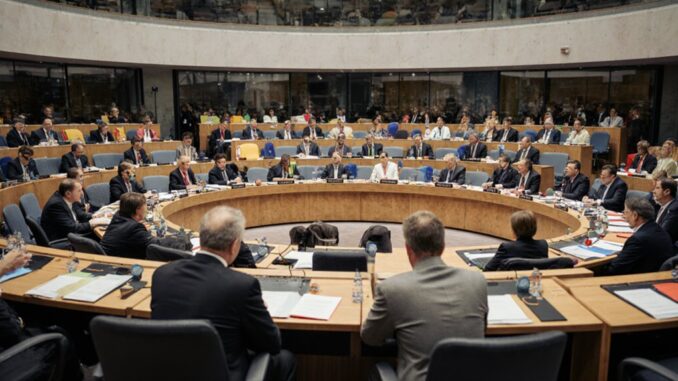
Germany is a cooperative federal state under the 1949 Basic Law, which divides authority between the Federation and 16 Länder. The federal level legislates in national fields such as defense, currency, and economic policy, while Länder lead education, policing, and administration. Many federal laws are implemented by Länder authorities. The Bundesrat gives state governments formal influence over national legislation, particularly measures affecting their finances or administration. The following sections explain these arrangements in greater detail.
How Does Germany’s Federal System Work?
Germany’s federal system is grounded in the Basic Law, which divides public authority between the Federation (Bund) and the 16 Länder. Its operation depends less on separate sovereign spheres than on intergovernmental coordination. Länder administer much federal legislation through their own civil services, while the Bundesrat gives state governments a formal role in national lawmaking. This arrangement resembles cooperative federalism more closely than the comparatively separated model of the United States.
Representation is paired with financial and legal safeguards. Fiscal equalization redistributes revenue among federal and state levels and among Länder, seeking comparable living conditions without eliminating regional responsibility. The courts and judiciary are largely organized by the Länder, although federal supreme courts promote consistency in major legal fields. Constitutional disputes between institutions, or challenges to legislation, may reach the Federal Constitutional Court. Through these mechanisms, Germany combines regional participation with nationally uniform standards, making federalism a continuing process of negotiation rather than a fixed territorial division.
The Basic Law and Germany’s Division of Powers
Adopted in 1949, the Basic Law (Grundgesetz) establishes the constitutional framework for allocating authority between the Federation and the Länder. Its design reflects postwar distrust of centralized rule, combining Constitutional supremacy with enforceable rights protections and institutional restraints. Unlike systems that treat regional authority as delegated, Germany constitutionally secures Länder participation in national decision-making.
The division of powers rests on three connected principles:
- Legislative competences are enumerated and interpreted within a federal constitutional order, limiting unilateral expansion by either level.
- Länder retain administrative autonomy, commonly implementing laws through their own authorities and procedures.
- The Bundesrat gives Länder governments a formal role in legislation, creating federal checks on measures affecting regional interests.
The Federal Constitutional Court arbitrates disputes over competences and protects the Basic Law’s hierarchy. Comparative federalism places Germany between highly decentralized models and centrally administered states: national coherence is pursued without eliminating constitutionally protected regional institutions, legal identities, or participation in shared governance.
What the Federal Government Is Responsible For
At the federal level, responsibility centers on policy areas requiring uniform rules, external representation, or nationwide coordination. Under the Basic Law, the Federation holds exclusive legislative powers in fields such as foreign affairs, defense, citizenship, currency, federal transport, and border protection. It also legislates extensively through concurrent powers, including civil and criminal law, economic regulation, labor law, energy, and public welfare frameworks.
Taxation authority is constitutionally shared but federally structured: the Federation establishes major tax rules, while revenue from key taxes is distributed among federal, state, and local levels. Federal institutions also manage national borrowing, customs, and macroeconomic policy.
Social benefits administration operates through federal statutes governing pensions, unemployment insurance, health insurance, and family support, often implemented by specialized agencies or self-governing insurance bodies. Compared with more centralized unitary systems, Germany combines national rulemaking with decentralized execution. The Bundesrat ensures that state governments participate where federal legislation affects administrative responsibilities or finances.
What Germany’s Länder Control
Germany’s Länder retain substantial authority over education, cultural policy, policing, and regional administration under the Basic Law. This allocation preserves regional autonomy while allowing institutional arrangements to vary across the federation. Compared with more centralized states, Germany thus assigns key public-facing functions primarily to state-level governments.
Education and Cultural Policy
Within Germany’s federal order, education and cultural policy fall primarily within the legislative and administrative competence of the Länder. This allocation reflects the Basic Law’s presumption that powers not assigned to the Federation remain regional, distinguishing Germany from more centralized European systems. Länder determine school structures, curricula, teacher training, university governance, and much of state funding for museums, theatres, archives, and other cultural institutions.
- Education ministries set standards, examinations, and pathways among secondary schools.
- Interstate agreements promote comparability of qualifications while preserving Land autonomy.
- Cultural policy protects regional traditions and supports pluralistic artistic life.
Federal involvement is limited but significant where constitutional competencies overlap, particularly research support, higher-education cooperation, and nationwide framework measures. The resulting arrangement combines territorial diversity with coordination through the Standing Conference of the Ministers of Education and Cultural Affairs.
Police and Regional Administration
Beyond education and culture, the Länder exercise primary responsibility for ordinary policing and much of regional administration. Their police forces enforce criminal law, maintain public order, and manage emergency responses, while municipal and state authorities administer planning, building regulation, public health, and local infrastructure. The Basic Law reserves federal police powers for defined fields, including border protection, rail security, and constitutional protection, limiting central intervention in routine policing. This allocation contrasts with more centralized European systems, where national ministries direct local forces. Administrative autonomy permits each Land to organize agencies, training, and procedures according to regional conditions. Yet federal legislation often supplies common substantive rules, requiring Länder administrations to implement national statutes. Cooperative governance thus depends on ministerial conferences, shared databases, and coordinated crisis arrangements, balancing territorial self-government with nationwide legal uniformity and accountability.
Which Powers Are Shared Between Both Levels?
German federalism distributes authority through a system of concurrent and cooperative powers rather than a rigid separation of functions. The Basic Law assigns the Federation broad legislative competence where national uniformity is considered necessary, while Länder commonly administer resulting rules and retain influence through the Bundesrat. Shared legislative areas include civil and criminal law, economic regulation, labor relations, social welfare, transport, environmental protection, and higher-education frameworks.
- Concurrent legislation permits Länder action unless and until federal law occupies the field, subject to constitutional limits.
- Frameworks of cooperative federalism combine federal standards, Länder implementation, and intergovernmental financing, particularly in infrastructure, research, and regional development.
- Bundestag versus Bundesrat reflects two sources of democratic legitimacy: population-based federal representation and territorial representation of Länder governments.
Compared with more decentralized federations, Germany concentrates lawmaking nationally but preserves substantial regional leverage through administration, consent requirements, and constitutional review. This arrangement seeks legal coherence without eliminating Länder autonomy.
How the Bundestag Passes Federal Laws
Federal bills may be introduced by the federal government, members of the Bundestag, or the Bundesrat, reflecting Germany’s constitutionally distributed legislative initiative. In the Bundestag, proposals proceed through readings, committee scrutiny, amendment, and final voting, combining plenary decision-making with specialized review. This process resembles other parliamentary systems but is shaped by federal safeguards, particularly where Bundesrat participation is required.
Legislative Proposal Process
Under Germany’s Basic Law, most federal legislation begins as a bill introduced by the Federal Government, the Bundesrat, or members of the Bundestag. This distributed right of initiative reflects federal and parliamentary principles, unlike systems that concentrate agenda control in a single executive. Government bills ordinarily undergo prior consultation with Länder through the Bundesrat, while parliamentary initiatives require support from a parliamentary group or five percent of deputies.
- Ministries draft executive proposals and coordinate interdepartmental review.
- The Bundesrat may initiate measures representing Länder interests.
- Deputies may introduce bills shaped by party programs or constituency concerns.
Committee agenda setting subsequently determines whether proposals receive structured expert attention. Constitutional veto options remain relevant at the proposal stage, particularly where Länder competences or Basic Law requirements are implicated. Formal initiation accordingly channels competing institutional interests before legislative deliberation begins.
Parliamentary Approval Stages
Once a bill is formally introduced, the Bundestag subjects it to a constitutionally structured sequence of readings, committee review, and final voting. The first reading typically establishes the proposal’s political direction and refers it to specialized committees. There, Committee oversight permits detailed examination of legal compatibility, fiscal effects, and administrative feasibility, often with expert hearings and amendments.
The second reading provides the principal forum for parliamentary debate and clause-by-clause decisions. Coalition negotiation is especially influential in Germany’s proportional, multiparty system, because governing majorities must reconcile party positions before votes occur. During the third reading, the Bundestag adopts the finalized text, normally by a simple majority of votes cast. Constitutional amendments require two-thirds majorities. Unlike some bicameral systems, federal legislation may then require Bundesrat consent or permit its objection, reflecting Länder participation in national lawmaking.
How the Bundesrat Represents the Länder
The Bundesrat serves as Germany’s institutional bridge between national lawmaking and Länder governments, giving the states a direct role in federal decision-making. Unlike a territorially elected upper chamber, it is composed of members of state governments, whose votes are cast uniformly by each Land. This design embeds executive federalism within the constitutional order and distinguishes Germany from bicameral systems such as the United States Senate.
Its representative function operates through:
- Mandatory consent: Laws affecting Länder administration, finances, or constitutional competences require Bundesrat approval.
- Suspensive objection: For other legislation, it may object, though the Bundestag can often override that objection.
- Intergovernmental coordination: Ministerial delegations and committee oversight enable state executives to scrutinize proposals before plenary votes.
Voting weight reflects population, while minimum representation protects smaller Länder. Coalition dynamics matter because state governments may differ politically from the federal majority, making the Bundesrat a forum for negotiated compromise. It therefore restrains centralization while preserving Länder influence over shared legislative responsibilities.
How Federalism Affects Daily Life in Germany
Across Germany, federalism shapes daily life by assigning major responsibilities—especially education, policing, cultural policy, and much public administration—to the Länder and municipalities. Constitutional autonomy means school curricula, teacher recruitment, police organization, and cultural institutions may differ across state borders. Residents therefore encounter federalism through varying academic standards, regional holidays, administrative procedures, and public-service priorities.
This arrangement resembles other federal systems, but Germany combines Länder authority with extensive national framework legislation and fiscal equalization. The Basic Law protects state competences while requiring cooperation where uniform conditions are constitutionally or economically necessary. Local services variability can thus arise in childcare capacity, transport provision, digital administration, and housing support, although federal programs may narrow disparities.
State level budgeting determines how far each Land can expand personnel, infrastructure, and social provision. Municipalities implement many policies but depend on local revenues, transfers, and Land rules. Federalism thus permits regional adaptation while creating continuing debates over equal living conditions, accountability, and the appropriate balance between national coordination and territorial self-government.

The Germany Explained Editorial Team provides accessible background information on Germany for an international audience. The team explains institutions, economic concepts and terminology that are often difficult to understand from outside the country, from the Bundestag, Bundesrat and federal states to the Mittelstand, Ausbildung, Energiewende and Industry 4.0. The objective is simple: to make Germany easier to understand.