Germany is Europe’s largest economy, combining export-oriented manufacturing with a high-tax social market system. Industry produces about 18–20% of value added, while trade equals roughly 90% of GDP, far above levels in the United States, France, or the United Kingdom. Large exporters and Mittelstand suppliers rely on skilled apprenticeships, EU market access, and social insurance. Aging workers, energy costs, weak investment, and fiscal limits now test this model; its institutions, industries, and global links explain why.
How Germany’s Economy Works
Germany operates a social market economy, combining private enterprise and export-oriented industry with extensive labor protections, public infrastructure, and welfare institutions. Compared with more market-led systems, Germany relies more heavily on coordinated wage bargaining, compulsory social insurance, and regional public services, while maintaining competitive private firms.
How fiscal policy functions reflects constitutional limits on federal borrowing, although emergency spending and investment funds can expand support during shocks. Taxes finance pensions, health insurance, unemployment protection, education, transport, and municipal services; social contributions form a particularly large share of labor costs. This structure stabilizes household income but can constrain consumption through high deductions.
Labor union impact remains significant despite declining membership. Sectoral agreements, works councils, and employer associations influence pay, training, working time, and workplace conditions. Germany’s co-determination rules give employee representatives seats on large-company supervisory boards, a feature less common in Anglo-American economies. The model seeks to balance productivity, social security, and price competitiveness across economic cycles.
Industries Powering Germany’s Economy
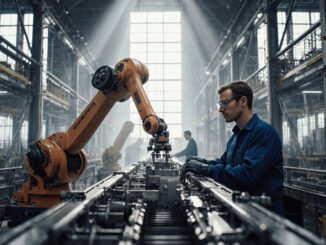
Manufacturing remains the central engine of the German economy, accounting for roughly one-fifth of gross value added—far above the shares in the United States, United Kingdom, or France. Its strength rests on an unusually broad industrial base: machinery, electrical equipment, metals, pharmaceuticals, medical technology, and precision engineering complement automotive manufacturing, the largest single industrial employer.
Germany’s vehicle sector contributes heavily to research spending and supplier activity, although its transition toward electric vehicles has intensified competition from China and the United States. Chemical production is another major pillar, led by globally significant firms and clusters along the Rhine; it supplies inputs for agriculture, construction, consumer goods, and advanced materials.
Services generate the larger share of employment and output, especially business services, finance, logistics, health care, and retail. Yet industrial firms remain unusually interconnected with specialized mid-sized suppliers, known as the Mittelstand. This structure supports high productivity and technical innovation, while also exposing growth to energy costs, labor shortages, and shifting global demand.
How Germany’s Export Model Works
At the core of the export model is a large industrial sector that sells high-value goods—vehicles, machinery, chemicals, electrical equipment, and medical technology—into global markets. Germany consistently ranks among the world’s leading merchandise exporters, despite having a smaller population than the United States, Japan, or China. Its trade strength reflects specialized production, engineering capacity, reliable logistics, and deep access to the European Union’s single market.
Unlike economies dependent on commodities or consumer electronics, Germany earns much of its export revenue from capital goods used by factories, hospitals, transport networks, and energy systems. Export incentives are shaped less by direct subsidies than by infrastructure, vocational training, export credit support, and EU-wide trade agreements. German firms also operate through global supplychains, importing components and raw materials before exporting finished equipment. This model creates substantial trade surpluses, but it also exposes output to foreign demand, exchange-rate conditions, shipping disruptions, and slower investment cycles in major customer markets.
The Mittelstand’s Role in Germany’s Economy
Although often overshadowed by major corporations such as Volkswagen, Siemens, and BASF, the Mittelstand—typically small and medium-sized, often family-owned firms—forms the broad base of Germany’s private-sector economy. Germany counts roughly 3.5 million SMEs, representing more than 99 percent of companies and about half of private-sector employment. Unlike more concentrated corporate structures in some advanced economies, German production is distributed across specialized manufacturers, service providers, and suppliers in smaller cities and industrial districts.
Many Mittelstand firms occupy narrow global niches, supplying precision components, machinery, chemicals, and technical services rather than consumer-facing brands. Their long-term ownership structures can support patient investment, while close ties to local customers and suppliers strengthen regional economic resilience. Innovation driven SMEs also complement large exporters by providing inputs and engineering expertise across industrial value chains. This decentralized business landscape broadens Germany’s tax base and limits dependence on a few metropolitan centers, although smaller firms remain more exposed to financing constraints, energy costs, and weak domestic demand.
Germany’s Workforce and Vocational Training
Germany’s dual education system combines classroom study with paid apprenticeships, helping align training more closely with employer demand than in many university-centered systems. Roughly half of German school leavers enter vocational pathways, supplying the manufacturing, engineering, and skilled-trades firms central to the Mittelstand. However, an aging population, retirements, and shortages in areas such as IT, healthcare, and construction are increasing pressure on the labor market.
Dual Education System
Unlike more academically oriented systems in many advanced economies, Germany’s dual education model combines classroom instruction at vocational schools with paid, employer-based apprenticeships, creating a direct pathway into skilled work. Typically lasting two to three-and-a-half years, programs divide time between regulated curricula and practical training in firms. Around half of German school leavers enter vocational routes, a substantially higher share than in many countries where university enrollment dominates. Chambers of commerce, trade unions, employers, and state authorities jointly define occupational standards and examination requirements, supporting nationally recognized qualifications. Student placements are embedded in formal training contracts rather than short-term work experience. Employer incentives include access to productive trainees, influence over job-specific skills, and lower recruitment costs. The system is especially significant in manufacturing, construction, logistics, retail, and technical services, linking education closely to Germany’s export-oriented industrial base.
Skilled Labor Challenges
Despite its well-developed apprenticeship system, Germany faces a growing shortage of skilled workers as population aging, retirements, and weaker labor-force growth outpace new entrants. Compared with younger economies, Germany’s demographic profile creates sharper vacancies in technical trades, healthcare, construction, and digital services.
- Nearly one in five workers is approaching retirement age.
- Employers report persistent shortages in engineering and nursing.
- immigration barriers slow recognition of foreign qualifications.
- wage pressure raises costs for firms competing for talent.
Vocational training remains a comparative strength, linking schools and employers more closely than many Anglo-American systems. Yet fewer school leavers, changing career preferences, and regional mismatches limit its capacity to replace retirees. Labor shortages also constrain output and investment, while a smaller contributor base increases pension strain. Policymakers consequently emphasize faster visas, childcare expansion, later retirement, and improved training pathways for women, migrants, and older workers.
Taxes, Welfare, and the Social Market Economy
Rooted in the postwar idea of the *soziale Marktwirtschaft*—or social market economy—Germany combines competitive markets with extensive social insurance and progressive taxation. Tax revenue equals roughly 40 percent of GDP, above the OECD average, financing pensions, health insurance, unemployment support, family benefits, and public infrastructure. Employers and employees share mandatory contributions, making labor costs comparatively high but providing broad coverage.
The model emphasizes social safety over the lighter-tax, more individual-risk approach common in the United States. Universal statutory health insurance covers most residents, while pension and unemployment systems cushion income shocks. Means-tested benefits provide a minimum living standard, although eligibility rules link support to job-search requirements.
Progressive income taxes and social contributions redistribute income, contributing to lower post-tax inequality than in many advanced economies. At the same time, policymakers seek to preserve Economic incentives through tax allowances, wage supplements, and differentiated benefit rules. Germany accordingly frames welfare less as a substitute for markets than as an institutional foundation for participation, consumption, and social cohesion.
Germany’s Economic Challenges and Risks
The same institutions that cushion household risk also shape Germany’s economic constraints: high labor costs, complex regulation, and substantial public commitments can weigh on investment and adaptability. Compared with the United States, Germany relies more heavily on manufacturing and faces slower productivity growth, while its working-age population is projected to decline without sustained immigration.
- Energy phase transition risk: volatile power costs challenge energy-intensive chemicals, metals, and manufacturing.
- Demographic headwinds: retirements strain labor supply, pensions, health spending, and potential output.
- Fiscal pressures: debt-brake rules limit borrowing even as infrastructure, defense, and climate investment needs rise.
- Supply chain vulnerabilities: dependence on imported energy, critical minerals, and external components exposes firms to disruptions.
Germany’s export-oriented industrial model remains competitive in engineering and premium capital goods, but adjustment is costly. Investment has lagged some advanced peers in digital networks, housing, and transport. Faster permitting, skilled migration, workforce participation, and predictable energy policy could reduce these constraints. The central challenge is preserving social protection while improving growth capacity.
Why Germany’s Economy Matters Globally
Germany remains Europe’s largest economy and one of its leading industrial exporters, giving its manufacturing performance outsized regional importance. Its trade links span major markets in the United States, China, and across the European Union, connecting German demand and supply chains to global production. As a result, shifts in German output, exports, or investment can influence European growth, commodity demand, and world market sentiment.
Europe’s Industrial Powerhouse
Although it accounts for roughly one-quarter of the euro area’s economic output, Germany exerts influence beyond its size through its concentration in manufacturing, exports, and advanced engineering. Industry contributes about 18% of German value added, compared with lower shares in France and the United Kingdom, supporting high-productivity employment and supplier networks across Europe.
- Automotive, machinery, chemicals, and electrical equipment anchor industrial capacity.
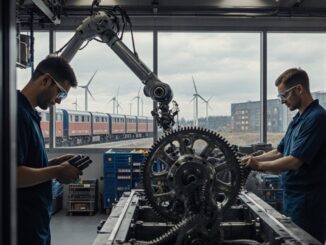
- Automation and robotics raise output per worker in export-oriented factories.
- Mittelstand firms specialize in precision components and industrial technology.
- Energy transition strategies reshape investment toward grids, efficiency, and low-carbon production.
Germany’s industrial scale affects European demand for capital goods, standards, and technical skills. Its performance consequently matters not only for domestic growth, but also for the euro area’s investment cycle, manufacturing competitiveness, and capacity to modernize established industries.
Global Trade Connections
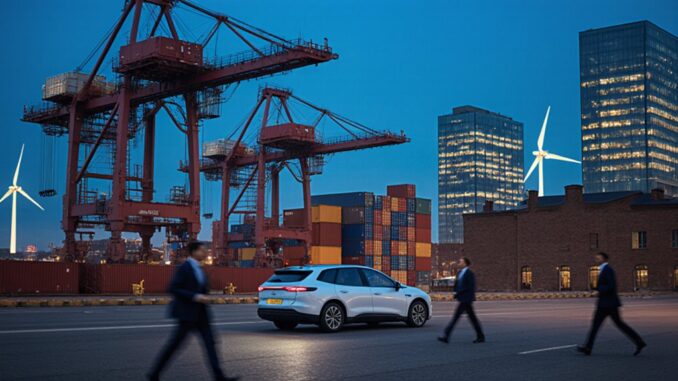
Trade links make Germany one of the world’s most consequential export economies: goods and services trade equals roughly 90% of GDP, a higher share than in the United States, France, or the United Kingdom. Its largest trade partners are European Union members, especially France, the Netherlands, Italy, and Poland, while China and the United States remain major non-European destinations and suppliers.
This geographic mix connects German manufacturers to nearby single-market customers and to global demand centers. Cars, machinery, chemicals, pharmaceuticals, and electrical equipment account for much of merchandise trade, whereas imported energy, components, and raw materials support domestic production. Integrated supply chains extend across Central and Eastern Europe, where German firms source intermediate goods and maintain production links. Compared with more consumption-led economies, Germany’s growth, investment, and employment are more closely tied to cross-border commercial activity.
Influence on World Markets
Why does Germany’s economy command attention far beyond its borders? As Europe’s largest economy, Germany shapes regional demand, industrial output, and investor confidence. Its manufacturing base links automotive, machinery, chemicals, and engineering firms to markets worldwide, making domestic shifts visible in global trade data.
- German exports influence European growth more than those of most neighboring economies.
- Supply chain logistics disruptions can affect factories from Central Europe to East Asia.
- Exchange rate sensitivity alters the competitiveness of euro-denominated exports against US and Asian rivals.
- Changes in German energy costs can reshape prices for industrial goods internationally.
Compared with service-led economies, Germany transmits shocks through production networks more directly. Weak German orders may reduce commodity demand, freight volumes, and supplier revenues, while stronger investment often supports wider European expansion.
The Business & Economy Editorial Team covers Germany’s economy, companies, markets and international trade. Its reporting focuses on economic developments, investment, exports, the Mittelstand, major corporations and the conditions affecting businesses in Germany. The team combines current economic news with background articles and analysis to explain what developments mean for companies, investors and international readers.