
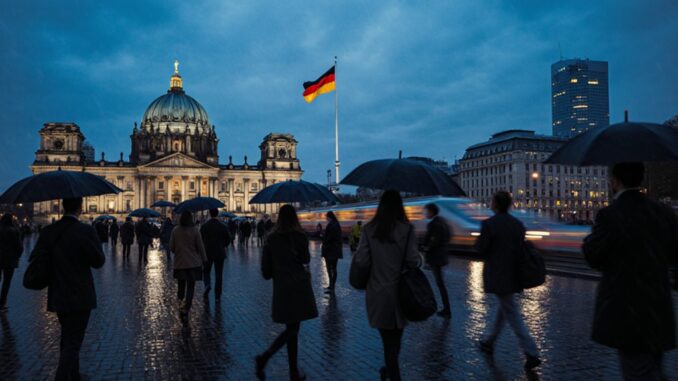
Germany’s main developments this month center on coalition strains, budget negotiations, migration pressures, and weak industrial confidence. Berlin is balancing high energy costs, labor shortages, climate investment, and demands from municipalities struggling with housing and integration. Internationally, Germany remains pivotal to EU debates on defense financing and competitiveness while expanding military readiness and support for Ukraine. Its ability to reconcile fiscal discipline with strategic investment will shape Europe’s outlook. The sections ahead provide essential context.
Germany News: The Month’s Biggest Developments
As Germany navigates a shifting European security and economic landscape, the month’s leading developments have centered on coalition governance, industrial competitiveness, migration policy, and Berlin’s role in supporting Ukraine. For international observers, the clearest signal is Germany’s continuing effort to balance domestic pressures with responsibilities as Europe’s largest economy and a pivotal NATO and EU member.
Berlin’s economic outlook remains closely watched as weak manufacturing demand, energy costs, and export uncertainty affect confidence across European supply chains. These trade impacts extend beyond Germany, particularly for partners linked to its automotive, machinery, and chemicals sectors. Meanwhile, support for Ukraine continues to shape international relations, reinforcing Germany’s importance in European defense planning and transatlantic coordination.
The country also faces scrutiny over its ability to sustain investment, preserve industrial capacity, and maintain political credibility abroad. Its decisions will influence EU competitiveness, security policy, and the broader rules-based order amid growing geopolitical rivalry.
Germany Politics News: Coalition, Budget, and Migration
Germany’s political agenda is shaped by coalition tensions, difficult federal budget negotiations, and renewed debate over migration policy. These issues carry implications beyond Berlin, affecting European coordination, fiscal credibility, and border-management discussions. International observers are watching whether governing partners can maintain consensus amid competing domestic and regional pressures.
Coalition Stability Challenges
Berlin’s governing coalition faces renewed strain as budget constraints, migration policy disputes, and diverging party priorities test its capacity to maintain a coherent domestic and European agenda. Differences among the Social Democrats, Greens, and Free Democrats increasingly shape public perceptions of governmental effectiveness, while coalition infighting complicates efforts to present common positions abroad.
For international observers, the central issue is not an immediate collapse but whether partners can preserve functional compromise amid economic uncertainty, security commitments, and pressure over asylum management. Germany’s influence in European decision-making depends heavily on predictable leadership in Berlin. Prolonged disputes could weaken voter confidence, strengthen opposition parties, and limit the government’s room for diplomatic initiative. The coalition’s resilience will be assessed by its ability to reconcile competing mandates without allowing tactical disagreements to become a broader crisis.
Federal Budget Negotiations
Federal budget negotiations have become a critical test of whether the governing coalition can translate competing fiscal, social, and security priorities into a credible policy framework. Ministers must balance investment demands in infrastructure, defense, energy resilience, and industrial competitiveness against constitutional borrowing constraints and pressure to restrain spending. The outcome will shape Germany’s capacity to support European security and meet wider EU economic expectations.
For the Germany public, the debate carries practical implications for household costs, public services, and long-term growth. Coalition partners differ over taxation, subsidies, and the pace of fiscal consolidation, making compromise politically sensitive. International observers are watching whether Berlin can preserve fiscal oversight while financing strategic priorities. A durable agreement would reassure markets and partners; prolonged disputes could weaken confidence in Germany’s policy predictability and its leadership role in Europe.
Migration Policy Debates
Migration policy has emerged as a central pressure point for the governing coalition, linking domestic political tensions with wider European debates over asylum, border management, and labor shortages. Ministers face difficult trade-offs between tighter procedures, humane reception standards, and municipalities seeking predictable asylum funding. Germany’s choices also carry weight for EU partners negotiating burden-sharing and external border rules.
- Overstretched towns: Local authorities warn that housing, schools, and services are nearing capacity, fueling public anxiety.
- Economic urgency: Employers argue that managed migration remains essential to address labor shortages and sustain competitiveness.
- European responsibility: Berlin seeks common EU solutions, while critics fear national restrictions could weaken solidarity and protections.
The coalition’s ability to reconcile security, integration, and fiscal discipline will influence both domestic confidence and Germany’s diplomatic standing in Europe.
Germany Economy News: Jobs, Industry, and Business Confidence
Germany’s labor market and wage trends remain closely watched indicators of household resilience and domestic demand. Industrial output and business confidence, meanwhile, offer a wider measure of how energy costs, global trade conditions, and investment uncertainty are affecting Europe’s largest economy. Together, these signals carry implications for partners and markets across the euro area.
Employment Trends and Wages
As Europe’s largest economy adjusts to weaker industrial demand and demographic pressures, Germany’s labor market remains relatively resilient but increasingly uneven across sectors. Employment remains supported by services, healthcare, and public administration, while employers report persistent skills shortages and labor shortages in technical and care occupations. Wage growth has eased household pressures, yet higher living costs still weigh heavily on lower-income workers and recent arrivals.
- Remote work remains a valued bargaining tool, widening differences between office-based staff and frontline employees.
- An aging workforce intensifies competition for qualified workers, raising concern among families and small businesses.
- Migration policy and training investment remain central to sustaining participation and social cohesion.
For international observers, Germany’s challenge is balancing competitiveness with inclusion, while preserving labor standards amid shifting demographic realities.
Industrial Output and Confidence
Beyond the labor market, industrial output remains a central gauge of Germany’s broader economic health. Recent industrial production trends reflect pressure from weak external demand, high energy costs, financing constraints, and uncertainty surrounding the shift to lower-carbon manufacturing. Automotive, chemicals, machinery, and export-oriented suppliers remain particularly important because their performance influences European supply chains and global trade partners.
Business confidence surveys offer a complementary measure of how firms assess orders, investment plans, and future risks. Cautious sentiment does not necessarily signal a sustained downturn, but it can delay hiring, capital spending, and capacity expansion. International readers should watch whether improving inflation conditions, easing monetary policy expectations, and clearer industrial policy strengthen confidence. Germany’s response also carries diplomatic significance, as its competitiveness affects EU economic coordination, transatlantic commerce, and demand across emerging-market export relationships.
Germany Energy News: Prices, Supply, and Climate Targets
Energy policy remains central to Germany’s economic and diplomatic agenda as households and industry navigate volatile prices, efforts to secure diversified supplies, and the costly changeover away from fossil fuels. Energy prices remain above the levels many manufacturers once considered normal, sharpening concerns about competitiveness and investment. Berlin is balancing liquefied natural gas imports, European grid cooperation, and faster renewable deployment while reducing exposure to supply risks.
- Households face lingering anxiety over heating and electricity bills, despite wholesale-price easing.
- Industry confronts difficult choices as energy-intensive producers weigh domestic production against relocation.
- Communities await credible progress toward climate targets, including expanded wind, solar, storage, and transmission capacity.
For international partners, Germany’s transition carries wider implications: its demand influences global gas markets, its renewable policies shape European infrastructure, and its regulatory choices affect investors. The challenge is diplomatic as well as economic—maintaining reliable supply, affordability, and public consent while preserving credibility on emissions reduction.
Germany Security News: Defense Spending and Ukraine
Germany’s security policy remains under close international scrutiny as Berlin expands defense spending, rebuilds military readiness, and sustains support for Ukraine amid Russia’s continuing war. The shift reflects a broader reassessment of European deterrence after years of limited investment and dependence on diplomatic engagement with Moscow.
Berlin is accelerating procurement, improving ammunition stocks, and addressing personnel and infrastructure gaps within the Bundeswehr. These measures are intended to strengthen NATO readiness, particularly on the alliance’s eastern flank, while reassuring partners that Germany can assume a more credible military role.
Ukraine support remains central to this approach. Germany continues to provide air-defense systems, armored equipment, training, financial assistance, and humanitarian aid, while emphasizing coordination with allies and avoiding steps that could widen the conflict. International observers are watching whether procurement reforms and industrial capacity can translate budget commitments into usable capabilities. Germany’s choices will influence transatlantic burden-sharing, European deterrence, and Kyiv’s ability to withstand prolonged pressure.
Germany’s EU Role: Budget, Rules, and Leadership
As the European Union confronts pressure to finance defense, competitiveness, and support for Ukraine, Berlin remains pivotal to debates over the bloc’s budget, fiscal rules, and institutional direction. Germany’s influence rests on its economic weight, its insistence on fiscal discipline, and its capacity to broker compromises with France, smaller member states, and EU institutions.
- Budget choices carry emotional stakes: shared borrowing could strengthen Europe’s resilience, while tighter limits reassure taxpayers wary of permanent transfers.
- Fiscal-rule reform tests whether safeguards for debt and deficits can coexist with investment in industry, energy, and security. Berlin seeks credibility without appearing indifferent to partners’ constraints.
- EU leadership depends increasingly on coalition-building. Germany’s rulemaking strategy favors predictable standards, open markets, and enforceable commitments, yet must accommodate a more fragmented political landscape.
For international observers, Berlin’s choices matter beyond Europe. Its stance can shape the EU’s ability to act collectively, preserve financial trust, and convert economic scale into durable geopolitical influence amid sharpening global competition.
Germany Social News: Housing, Migration, and Protests
Housing shortages, migration policy, and recurring street protests have become closely linked tests of Germany’s social cohesion, exposing pressure on municipalities, public services, and political trust. In major cities, Berlin housing costs and limited supply remain acute concerns for tenants, newcomers, and lower-income households, while construction constraints complicate local responses.
Migration debates increasingly focus on administrative capacity, border management, and the practical demands of refugee integration, including language instruction, schools, employment access, and accommodation. Municipal leaders have stressed that federal and state funding must match responsibilities transferred to local authorities.
Public demonstrations reflect wider disagreement over immigration, cost-of-living pressures, climate policy, and international conflicts. Most remain peaceful, though authorities monitor risks of intimidation, antisemitism, anti-Muslim hostility, and extremist recruitment. For international observers, the central issue is not simply migration numbers or rental prices, but whether institutions can deliver equitable services while preserving civic dialogue. Germany’s experience illustrates how domestic resilience depends on coordinated governance, credible communication, and locally workable compromises.
What to Watch in Germany Next Month
Against a backdrop of economic uncertainty and political fragmentation, Germany next month will face several closely watched tests: coalition decision-making, industrial competitiveness, migration management, and the capacity of local authorities to sustain public services.
International observers will monitor budget negotiations, energy-policy signals, and whether municipal funding keeps pace with arrivals and housing pressures. Regional rail upgrades will offer a practical measure of investment credibility, while Berlin weekend markets and fall cultural events may reveal whether consumer confidence and civic life remain resilient amid uncertainty.
- Jobs and industry: Manufacturers’ orders and automotive investment could shape confidence across Europe.
- Migration and cohesion: Federal-state coordination will test Germany’s ability to balance humanitarian obligations with local concerns.
- Political trust: Coalition compromises, or visible deadlock, may influence Germany’s diplomatic weight within the European Union.
For partners abroad, the central question is whether Berlin can translate cautious rhetoric into predictable action. Germany’s choices will affect supply chains, EU solidarity, and perceptions of European stability.
The Germany News Editorial Team follows current developments across Germany and places them in context for international readers. Coverage brings together important developments from business, industry, technology, politics, energy and society. Rather than simply reproducing headlines, the team focuses on why a story matters and how it connects to broader developments in Germany and Europe.