
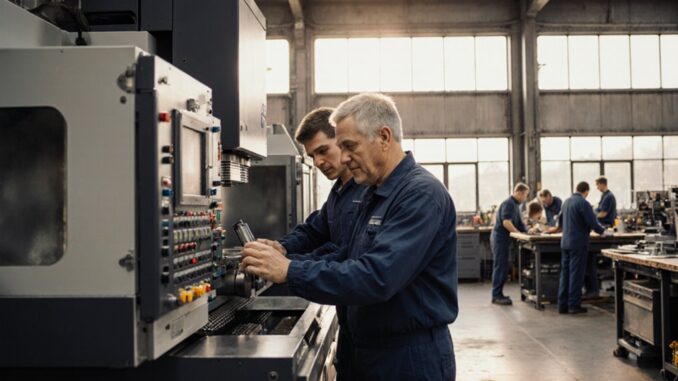
Germany’s dual apprenticeship system combines paid company training with part-time vocational school instruction. National regulations, chambers, employers, schools, and public authorities align skills, assessments, and recognized qualifications. Businesses value it because apprentices develop job-ready technical ability, safety awareness, workflow discipline, and firm-specific knowledge. Although wages, mentoring, equipment, and administration require investment, employers gain stronger recruitment, retention, and workforce planning. The sections below explain its governance, costs, benefits, and current pressures.
What Is Germany’s Apprenticeship System?
Germany’s apprenticeship system, known as the dual vocational training model, combines paid workplace training with structured instruction at vocational schools. It is a nationally recognized route into skilled occupations across manufacturing, engineering, logistics, healthcare, hospitality, retail, and digital services. Employers use the system to develop job-ready talent aligned with operational standards, equipment, customer requirements, and sector regulations.
Programs lead to regulated qualifications that signal verified occupational competence to employers throughout Germany. Apprentice selection criteria commonly include academic readiness, practical aptitude, reliability, communication skills, and motivation for the chosen trade or profession. Companies may also assess technical interest, safety awareness, and capacity to work within established teams.
Training contract duration is generally defined by the occupation and qualification pathway, providing employers and apprentices with a clear framework for workforce planning and skills development. The system supports succession pipelines, reduces recruitment uncertainty, and helps firms maintain capabilities in roles where experience and certified expertise are commercially important.
How Germany’s Dual Apprenticeship Model Works
Germany’s dual apprenticeship model combines vocational classroom instruction with paid, practical training in a workplace. Employers, vocational schools, and chambers share responsibility for delivering structured curricula, evaluating competencies, and maintaining industry standards. Apprentices progress toward recognized certification while building job-specific skills aligned with employer demand.
Combining Classroom And Workplace Learning
Rather than separating theory from practice, the dual apprenticeship model integrates vocational school instruction with paid, structured training inside a company. Learners alternate between lessons on technical principles and workplace tasks that reveal how those principles operate under commercial conditions. Classroom integration helps employers receive trainees who can connect calculations, regulations, materials, and customer requirements to daily production or service work.
- A machining apprentice applies blueprint measurements beside operating equipment.
- A retail trainee links sales theory to inventory checks and customer conversations.
- An IT apprentice tests network concepts while supporting a live business system.
Workplace mentorship gives apprentices regular exposure to experienced employees, workflow standards, and team communication. Businesses benefit from recruits who develop practical judgment, understand operational expectations, and contribute with growing confidence while learning.
Structured Training And Certification
This workplace learning is governed by nationally recognized training regulations that define each apprenticeship’s required skills, curriculum, duration, and assessment standards. These regulated pathways give employers a consistent framework for developing occupational competence across regions and sectors. Training ordinances specify practical capabilities, technical knowledge, safety requirements, and documentation expectations for each recognized occupation. Apprentices progress through clearly sequenced competencies rather than informal job exposure, helping firms plan supervision, equipment access, and productive assignments.
Certification standards are reinforced through formal examinations that test both applied performance and occupational knowledge. Successful candidates receive credentials recognized by employers throughout Germany, making skills more portable and easier to verify during recruitment. For businesses, the system reduces uncertainty about entry-level capability, supports workforce planning, and establishes transparent benchmarks for quality, progression, and readiness for skilled roles across competitive labor markets.
Shared Responsibility Between Partners
Because vocational competence is developed across both work and education settings, Germany’s dual apprenticeship model assigns distinct responsibilities to employers, vocational schools, chambers, and public authorities. Employers provide workplace instruction, equipment, mentors, and paid training positions, reinforcing employer accountability for job-ready skills. Schools deliver technical theory, general education, and curriculum-based assessment. Chambers register contracts, monitor training quality, advise firms, and administer standardized final examinations. Public authorities set legal frameworks and fund schools, creating a reliable Training partnership across industries.
- A machinist apprentice measures precision parts beside a qualified supervisor.
- A classroom instructor links engineering drawings to production calculations.
- Chamber examiners assess practical tasks using nationally recognized standards.
This shared structure gives businesses influence over occupational requirements while protecting consistency, portability, and credibility of qualifications. It also aligns training capacity with regional labor-market demand.
Who Runs Germany’s Apprenticeship System?
Germany’s apprenticeship system operates under federal legal oversight, which sets national standards for recognized occupations and training quality. Chambers coordinate apprenticeship registration, examinations, and employer support, while companies provide workplace-based skills training. Vocational schools complement this training with technical knowledge and general education aligned to industry needs.
Federal Government Oversight
At the federal level, Germany’s apprenticeship system is guided by the Federal Ministry of Education and Research, which sets the legal and policy framework for vocational training under the Vocational Training Act. It coordinates national priorities, updates occupational regulations, and supports consistent skill requirements across industries. Federal oversight helps employers plan workforce development around recognized qualifications while safeguarding training standards compliance and Employer regulation.
- Updated training ordinances outline the machinery, tools, and competencies apprentices must master.
- National qualification frameworks connect workshop learning with classroom-based technical knowledge.
- Research bodies track labor-market shifts, informing new occupations in fields such as automation and digital manufacturing.
This structure gives businesses confidence that apprentices develop portable, industry-relevant capabilities. It also enables training programs to respond to technology, safety, and productivity demands without fragmenting qualification quality across regions.
Chambers and Employers
While federal authorities set the legal framework, chambers of commerce, industry, crafts, and agriculture administer apprenticeship training locally with participating employers. Chambers register training contracts, verify that companies meet training standards, advise firms, and organize final examinations. Their oversight links occupational requirements to real workplace conditions across regions and sectors. Employers provide the practical training environment, assign qualified trainers, and expose apprentices to current equipment, workflows, safety procedures, and customer expectations. This shared structure strengthens workforce development by ensuring that qualifications reflect labor-market demand rather than isolated academic criteria. Employer engagement is central: companies help identify emerging skill needs, support examination committees, and maintain training capacity in occupations significant to production, services, construction, and technical maintenance. Chambers provide a neutral coordinating function, protecting training quality while helping businesses develop dependable pipelines of skilled workers.
Vocational Schools’ Role
Vocational schools deliver the classroom-based component of Germany’s dual apprenticeship system, complementing training provided by employers. State-run institutions translate workplace requirements into structured instruction, covering technical theory, safety standards, business processes, and general education. Their Germany curriculum is developed with industry input and aligned with recognized occupational qualifications, helping firms receive apprentices with consistent baseline knowledge.
- Workshops feature diagnostic equipment, wiring panels, machine controls, and simulation tools.
- Classrooms connect production calculations, quality procedures, and digital documentation to daily tasks.
- Teachers coordinate with employers to identify skill gaps and monitor apprentice progress.
Schools typically operate part-time alongside company training, allowing learners to apply lessons immediately. This coordination strengthens job placement outcomes, reduces onboarding demands, and gives employers confidence that apprentices can perform reliably across changing production environments and regulated sectors.
How Employers Help Set Training Standards
Employers play a central role in Germany’s apprenticeship system by defining the practical skills, technologies, and workplace competencies trainees must master. Through employer associations, chambers, unions, and vocational experts, industry representatives help update training regulations for occupations ranging from mechatronics to logistics and healthcare. Their input ensures curricula reflect current production methods, digital tools, safety requirements, quality controls, and customer-facing processes.
Employer standards are translated into nationally recognized occupational profiles, training plans, and examination requirements. Companies identify which tasks apprentices should perform independently, which equipment they must run, and what degree of technical knowledge supports competent work. This creates consistent expectations across regions and firms while allowing training to stay aligned with changing industrial practice.
Chambers of commerce and crafts act as assessment bodies, overseeing training quality, registering apprenticeship contracts, and organizing final examinations. Their involvement connects workplace requirements with formal certification, ensuring qualifications remain credible to employers across Germany.
Why Businesses Invest in German Apprenticeships
German businesses invest in apprenticeships to build workforces with job-specific technical skills and company knowledge. Training apprentices internally can reduce external recruitment costs and improve hiring reliability. Over time, this talent pipeline supports productivity, retention, and long-term competitiveness.
Building Skilled Workforces
Germany’s apprenticeship system gives businesses a direct role in developing the technical, operational, and workplace skills they need. Training plans combine classroom instruction with supervised production, allowing firms to shape skills development around real equipment, standards, and workflows. Industry alignment helps employers prepare workers for changing technologies while maintaining consistent quality and safety practices. Employer incentives include stronger capability planning, clearer progression pathways, and apprentice retention through early integration into teams and company culture.
- A trainee calibrates a CNC machine beside an experienced technician on a busy shop floor.
- An electrical apprentice traces control-panel wiring while following documented safety procedures.
- A hospitality learner coordinates service tasks during a full restaurant shift.
This structured approach creates workforces familiar with company processes, sector expectations, and the practical discipline required for sustained performance.
Reducing Recruitment Costs
By training apprentices for specific roles, firms reduce dependence on external hiring markets, recruitment agencies, and repeated onboarding cycles. Training is aligned with operational processes, equipment, safety standards, and departmental workflows, allowing employers to fill vacancies with personnel already familiar with workplace requirements. Although apprenticeships involve upfront expenses for instruction, supervision, materials, and wage investment, these costs can be more predictable than repeated external recruitment. Contract stability also helps employers schedule training capacity and staffing needs with greater certainty. This approach limits disruption caused by turnover during entry-level hiring and reduces the administrative burden of advertising, screening, interviewing, and induction. Rather than relying on Short term planning to address immediate labour gaps, firms create structured entry routes that lower recruitment frequency and improve the efficiency of workforce deployment across business units.
Strengthening Long-Term Competitiveness
As technology, production methods, and service standards evolve, German apprenticeships help firms build a workforce capable of adapting to long-term operational change. Employers shape training around current equipment, quality controls, and customer expectations, creating skills pipelines aligned with strategic investment. This approach supports Workforce resilience by preparing employees to troubleshoot, learn new systems, and maintain standards during market shifts. It also produces productivity gains through faster onboarding, fewer process errors, and stronger coordination between shop-floor teams and technical specialists.
- A trainee calibrates a CNC machine beside an experienced machinist.
- A retail apprentice applies updated digital inventory procedures during a busy shift.
- A mechatronics team diagnoses a sensor fault before it disrupts production.
How German Apprenticeships Build Job-Ready Skills
German apprenticeships build job-ready skills through a dual model that combines structured vocational schooling with paid, supervised work in companies. Apprentices learn occupation-specific theory in vocational schools while applying it to real production, service, maintenance, logistics, and administrative processes. This alignment gives employers visibility into developing capabilities and helps trainees understand quality standards, safety requirements, customer expectations, and team workflows.
Practical training is guided by recognized occupational regulations and company mentors, ensuring that learning reflects current tools, technologies, and operating procedures. Workplace readiness develops through repeated exposure to schedules, accountability, documentation, communication, and problem-solving under professional supervision. Assessments conducted by chambers and other authorized bodies provide Skill certification that signals verified competence across employers and regions. Because qualifications are linked to defined occupational profiles, job matching becomes more reliable: businesses can recruit candidates whose demonstrated skills correspond to specific roles, while apprentices enter employment with experience that is immediately relevant to operational needs.
What Do Apprenticeships Cost Employers?
For employers, apprenticeships require upfront investment in trainee wages, instructor time, workplace equipment, and coordination with vocational schools and chambers. Apprentice wage costs typically rise across training years, while productive output may initially remain limited as learners develop technical competence, safety awareness, and workflow discipline.
- A machine operator pauses beside a trainee, explaining tolerances over the steady sound of production equipment.
- A workshop bench holds calibrated tools, protective gear, and practice components reserved for supervised instruction.
- An HR coordinator reviews training records, school schedules, examination dates, and chamber documentation.
Costs also include mentor capacity, reduced line speed during instruction, assessment preparation, and administrative overhead planning. Smaller firms may feel these demands more sharply because experienced specialists are harder to release from daily operations. However, structured training can direct spending toward occupation-specific capabilities rather than generic recruitment or remedial onboarding. Employers therefore budget apprenticeships as a managed skills-development function, balancing immediate expenditure against the operational value of building certified competence within the business.
Why Do Apprentices Stay With Employers?
Apprentices often remain with their training employers because the company has invested directly in their occupation-specific skills, work routines, and professional networks. During training, they learn firm-specific processes, quality standards, equipment, customer requirements, and team responsibilities that make immediate employment after qualification efficient for both parties. Employers also gain a reliable view of each apprentice’s technical capability, reliability, and fit within operational teams.
Effective retention strategies extend beyond offering a permanent contract. Businesses that provide defined career progression, further certification, mentoring, and opportunities to assume greater responsibility create practical reasons to stay. Competitive pay, predictable schedules, and transparent performance expectations further reinforce workplace loyalty. Employer engagement during the final training phase is particularly important, as supervisors can discuss future roles, departmental needs, and development plans before qualification. Retaining trained apprentices reduces recruitment costs, protects accumulated knowledge, and supports continuity in production, service delivery, and skilled workforce planning.
Apprenticeship Challenges: Skills Gaps and Demographics
Demographic change and persistent skills shortages are placing increasing pressure on Germany’s apprenticeship system. Employers in manufacturing, construction, logistics, and care services report difficulty filling training places while experienced staff approach retirement. The aging workforce reduces the pool of mentors, supervisors, and specialist technicians needed to transfer practical knowledge on the shop floor.
- Empty workshop benches highlight unfilled places in metalworking and electrical trades.
- Retiring master craftspeople carry decades of process knowledge toward the exit.
- Competing job offers pull school leavers into immediate employment or academic routes.
Businesses must recruit earlier, improve career guidance, and make training environments more flexible. Smaller firms face particular constraints because limited staffing leaves little capacity for coaching apprentices. Digital skills requirements also change faster than some training curricula, increasing the need for updated equipment and instructor development. Migration, retention initiatives, and targeted support for underrepresented groups can widen participation, but employers still require dependable candidates with foundational literacy, numeracy, and technical aptitude.
What Other Countries Can Learn From Germany
Germany’s apprenticeship system shows that workforce development is strongest when employers, vocational schools, and industry bodies share responsibility for training standards, curriculum design, and practical assessment. Other countries can adapt this model by giving employers a formal role in defining occupational competencies, updating qualifications, and providing paid workplace learning. The key lesson is not to copy German structures exactly, but to build credible pathways aligned with local labor-market needs.
Effective systems require consistent national standards, qualified trainers, portable credentials, and clear progression into skilled employment or further education. Businesses benefit when training reflects current equipment, production processes, safety requirements, and digital capabilities. Public investment can support school capacity, career guidance, and access for smaller firms that cannot train independently.
Examples such as Sweden vocational programs demonstrate the value of coordination between education providers and employers. Industry led training also helps ensure that apprentices develop job-ready capabilities while companies build reliable talent pipelines, improve retention, and reduce recruitment risk across sectors.

The Work & Careers Editorial Team covers Germany’s labour market and the changing world of work. Topics include skilled workers, employment trends, vocational training, Ausbildung, professional qualifications, immigration, demographics and workplace transformation. The team provides international readers with context on how Germany’s employment and training systems work.