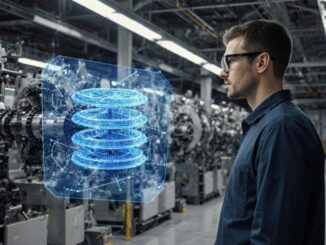
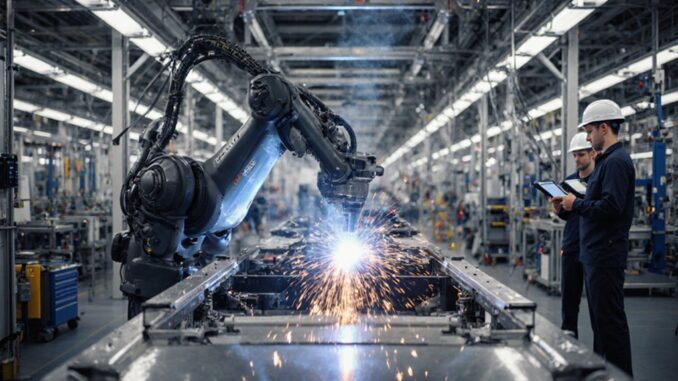
Robotics is central to German manufacturing, where automated cells improve throughput, repeatability, quality control, and production flexibility. Industrial robots, cobots, machine vision, and AGVs support welding, assembly, machine tending, inspection, and intralogistics across automotive, electronics, and machinery plants. Connected sensors and MES data enable traceability, predictive maintenance, and faster fault correction. Automation also offsets labor shortages by shifting workers toward technical oversight. The following sections explain the applications, constraints, and emerging factory trends.
Robotics in German Manufacturing Today
Germany remains one of the world’s most robot-intensive manufacturing economies, with industrial robots deployed extensively across automotive, machinery, electronics, metals, and chemical production. Current installations combine articulated robots, cobots, automated guided vehicles, and machine-vision systems within digitally connected production cells. These systems perform welding, assembly, material handling, palletizing, machining support, and precision dispensing under programmable controls.
German manufacturers increasingly integrate robotics with manufacturing execution systems, industrial IoT sensors, and data analytics to monitor cycle times, equipment status, and process deviations. Machine vision strengthens quality inspection by identifying dimensional errors, surface defects, and incomplete assemblies at line speed. Flexible robotic cells also support shorter production runs and greater product variation without extensive mechanical reconfiguration.
Workforce upskilling remains linked to this operating model, particularly in robot programming, maintenance, safety validation, data interpretation, and human-machine interface management. Deployment patterns vary by sector and company size, with larger plants generally operating more integrated automation architectures than smaller suppliers.
Why Robotics Matters for German Factories
Robotics matters for German factories because it raises throughput, repeatability, and process control in production environments facing high quality requirements, cost pressure, and skilled-labor constraints. Automated systems stabilize cycle times, reduce variation, and generate operational data that supports faster corrective action. This improves quality consistency while limiting rework, scrap, and unplanned downtime.
Robotics also strengthens workforce productivity by allocating personnel toward supervision, maintenance, programming, and higher-value technical tasks. Integrated sensors, machine vision, and control software enable traceable production parameters and more predictable output. Flexible automation allows factories to adjust capacity, product variants, and process sequences without extensive mechanical redesign, supporting shorter product lifecycles and volatile demand patterns. By reducing dependence on scarce labor and improving internal material flow reliability, robotic infrastructure contributes to supply chain resilience. Its strategic value consequently extends beyond direct labor savings: it increases manufacturing responsiveness, protects process knowledge, and helps German producers maintain competitive performance under demanding industrial conditions and strict customer specifications across domestic and export markets.
Common Robotics Applications in German Factories
Across German factories, robots perform repeatable, high-volume tasks such as welding, assembly, machine tending, material handling, palletizing, painting, and inspection. Articulated arms execute programmed trajectories with consistent cycle times, while collaborative robots support operators in lower-force assembly, fastening, and packaging workflows. Automated guided vehicles and autonomous mobile robots transport components between workstations, reducing manual logistics and stabilizing material flow.
Machine vision enables robots to identify part orientation, verify dimensions, detect surface defects, and guide pick-and-place operations from variable positions. Vision data can also support traceability by linking inspection results to production records. In machine tending, robots load raw stock, unload finished parts, and coordinate with CNC equipment through industrial control interfaces. Palletizing systems optimize stacking patterns and manage changing package sizes. Predictive maintenance platforms monitor robot joints, motors, gearboxes, and controllers for abnormal vibration, temperature, or current signatures, allowing planned intervention before unplanned downtime affects throughput.
Robotics in Germany’s Key Manufacturing Sectors
Germany’s automotive sector applies robotics to welding, painting, assembly, and in-line quality control at high production volumes. Electronics manufacturers use precision robots for component placement, soldering, testing, and handling sensitive parts. In machinery manufacturing, robotic cells are integrated with CNC systems and material-flow equipment to automate fabrication and support flexible production.
Automotive Production Automation
Within Germany’s automotive industry, automation is concentrated in high-volume, repeatable processes such as body-in-white welding, painting, powertrain assembly, and end-of-line inspection. Industrial robots execute programmed joining, dispensing, fastening, and handling tasks with controlled cycle times and traceable parameters. Flexible carlines support mixed-model production through rapid tool changes, configurable robot paths, and modular fixtures. Autonomous material transport supplies components to workstations, while seamless AGV coordination balances routes, inventory levels, and production priorities. Adaptive welding systems adjust trajectories and process settings using sensor feedback to accommodate dimensional variation. Vision guided quality verifies weld seams, surface finish, component presence, and assembly alignment before vehicles advance. Real time process monitoring integrates robot data, torque records, environmental measurements, and fault diagnostics, enabling predictive maintenance and faster containment of deviations. These systems increase throughput, consistency, and operational resilience across vehicle manufacturing plants.
Electronics Assembly Robotics
Electronics assembly in German manufacturing relies on high-precision robotics for printed circuit board handling, surface-mount device placement, soldering, dispensing, testing, and final module assembly. Vision-guided manipulators verify component orientation, fiducial alignment, and placement accuracy before boards move through reflow and inspection stages. Automated optical inspection systems identify solder bridges, missing parts, polarity errors, and trace defects at production speed. Collaborative robots support selective soldering, connector insertion, enclosure loading, and functional-test fixture tending where flexible routing is required. In high mix assembly, programmable cells reduce changeover time through recipe-driven tooling, feeder configuration, and traceable process parameters. Data from torque sensors, cameras, and electrical test stations enables closed-loop quality control, supporting repeatability, defect containment, and documented compliance across industrial, medical, communications, and consumer-electronics production lines.
Machinery Manufacturing Integration
Machinery manufacturing integrates robotics across the production of machine tools, industrial equipment, pumps, drives, and specialized automation systems, where part variation and tight tolerances require adaptable handling. Six-axis robots, cobots, and vision-guided cells support machining load/unload, welding, assembly, inspection, and material transport. Flexible grippers and force-control systems accommodate castings, shafts, housings, and precision components without dedicated fixtures. Lean production integration links robotic workstations with MES, CNC controllers, and intralogistics systems, reducing queue time, changeover losses, and manual handling variability. Digital twins validate cycle times, reachability, collision risks, and tooling configurations before deployment. Sensor data from robots, spindles, conveyors, and end effectors enables predictive maintenance by identifying wear, vibration anomalies, and declining accuracy. This architecture improves equipment availability, traceability, and consistent quality across low-volume, high-mix production environments while supporting rapid engineering changes.
How Cobots Support Skilled Manufacturing Workers
Cobots support skilled manufacturing workers by automating repetitive, ergonomically demanding, and tightly controlled tasks while preserving human oversight for complex assembly, inspection, and process adjustment. In German production environments, these systems can handle screwdriving, machine tending, dispensing, polishing, and component transfer with repeatable force, position, and cycle-time parameters. Workers remain responsible for setup validation, exception handling, quality decisions, and optimization of manufacturing sequences.
Effective human robot collaboration depends on safeguarded workspaces, force-limiting controls, vision systems, and interfaces that allow rapid adjustment without extensive programming. Cobots can be redeployed between product variants, supporting flexible batch production and reducing manual exposure to fatigue-inducing operations. Their operational data also enables traceability, predictive maintenance, and analysis of process deviations.
Training and reskilling are required for operators to configure end effectors, interpret sensor feedback, manage safety functions, and diagnose faults. This approach positions cobots as controlled productivity tools that extend technical capability rather than replace skilled judgment in precision manufacturing.
Robotics and Germany’s Labor Shortage
Beyond task-level support for skilled operators, robotics provides German manufacturers with a scalable response to persistent labor shortages driven by demographic aging, retirements, and limited availability of qualified technical personnel. Automated cells can sustain throughput in welding, machining, intralogistics, inspection, and packaging where vacancies constrain shift coverage. Robots also reduce dependence on repetitive manual assignments, allowing available employees to concentrate on process control, quality assurance, maintenance, and exception handling.
Workforce Augmentation is achieved through coordinated deployment of industrial robots, autonomous mobile robots, machine vision, and manufacturing execution systems. These technologies stabilize cycle times, improve equipment utilization, and preserve production capacity despite smaller workforces. Labor Reskilling supports this change by preparing technicians and operators to program cobots, supervise automated stations, analyze production data, and perform preventive maintenance. Rather than functioning solely as headcount substitution, robotics reallocates human capability toward higher-value technical activities while maintaining output reliability and operational continuity across German manufacturing sites.
Barriers and Future Trends for Factory Robotics
Although German manufacturers continue to expand automation, adoption is constrained by high integration costs, legacy equipment interfaces, limited robotics engineering capacity, and the need to validate safety, cybersecurity, and process reliability in mixed human–machine environments. Small and medium-sized firms face particular difficulty financing cells, retrofitting PLC architectures, and training operators for data-driven maintenance. Regulatory compliance adds requirements for machine safety, documentation, AI governance, and secure industrial communications, extending deployment timelines.
Future investment is likely to prioritize modular robotic platforms, standardized interfaces, digital twins, and vision-guided systems that reduce commissioning effort. Collaborative robots will support flexible assembly, while autonomous mobile robots will improve intralogistics and material traceability. Edge computing and predictive analytics should enable faster fault detection, adaptive scheduling, and lower unplanned downtime. Greater use of domestic automation suppliers, dual sourcing, and reconfigurable production assets can strengthen supply chain resilience. Adoption will depend on interoperable standards, workforce upskilling, and demonstrable returns across production volumes, product variants, and operating conditions.
The Industry & Manufacturing Editorial Team focuses on Germany’s industrial economy and the technologies transforming production. Coverage includes mechanical engineering, manufacturing, automation, robotics, process industries, supply chains and industrial digitalisation. Particular attention is given to the German Mittelstand, specialised manufacturers and hidden champions that play an important role in global industrial markets.