Industrial clusters matter to Germany’s economy because they concentrate manufacturers, suppliers, research institutes, skilled labor, and logistics within connected regions. Automotive networks in Bavaria and Baden-Württemberg, chemicals in North Rhine-Westphalia, and semiconductors in Saxony support productivity, exports, and faster technology transfer. Federal and Länder policies reinforce these ecosystems through infrastructure, innovation funding, training, and energy planning. Dense regional links also improve supply-chain resilience and accelerate green industrial investment. The regional mechanisms behind these effects become clearer below.
Germany’s Industrial Clusters Explained
Germany’s industrial clusters are geographically concentrated networks of manufacturers, suppliers, research institutions, and specialized service providers that operate within linked value chains. They are distributed unevenly across the federal landscape, reflecting historic industrial specialization, transport corridors, university capacity, and regional labor markets. Automotive production is prominent in Baden-Württemberg, Bavaria, and Lower Saxony; chemicals concentrate along the Rhine-Ruhr and Rhine-Neckar corridors; advanced optics and microelectronics hold strong positions in Thuringia and Saxony.
Federal and Länder policies support these territories through research funding, industrial land planning, rail and energy infrastructure, and technology-transfer programs. Spatial proximity helps regions retain technical skills, strengthen workforce resilience during demand shifts, and align vocational training with local production needs. Cluster-oriented investment also supports startup incubation near laboratories, applied-research institutes, and established industrial sites. Their economic significance lies in the density of specialized assets: skilled employment, export-oriented facilities, testing capacity, and institutions able to support manufacturing modernization across distinct regional economies.
How Germany’s Cluster Networks Work
Germany’s cluster networks concentrate specialized firms, suppliers, and skilled labor within identifiable regional economies, from automotive production in Baden-Württemberg to life sciences in Bavaria. Their performance depends on formal links between businesses, universities, applied-research institutes, and public agencies that shorten innovation and technology-transfer cycles. Federal and state policy supports these connections through targeted funding, shared infrastructure, and regional innovation programs.
Regional Industry Specialization
Across Germany, industrial activity is concentrated in regional networks that link manufacturers, suppliers, research institutions, and specialized service providers. Bavaria’s automotive and engineering belt, Baden-Württemberg’s machinery corridor, North Rhine-Westphalia’s chemicals base, and Saxony’s semiconductor hub illustrate how specialization follows infrastructure, skills, and historical investment patterns. These concentrations lower transport and transaction costs while supporting cluster driven productivity through dense supplier markets and labor pools. Regional specialization also shapes public investment priorities: transport capacity, energy reliability, vocational training, and land-use planning must match local production profiles. Policymakers increasingly assess exposure to supply disruptions, energy prices, and demographic change at the cluster level rather than through national averages. Diversified local supplier bases and adaptable industrial sites strengthen spatial economic resilience, helping regions absorb shocks without losing their manufacturing capacity or export position.
Research And Business Collaboration
These regional production systems depend on structured collaboration between firms, applied-research institutes, universities, and public agencies. In regions such as Baden-Württemberg, Bavaria, and Saxony, cluster organizations coordinate collaborative research around automotive engineering, microelectronics, robotics, and clean-energy manufacturing. Fraunhofer institutes and technical universities provide testing capacity, patent expertise, and pathways for transferring prototypes into local supply chains. Shared technology centers reduce capital barriers for small and medium-sized manufacturers by offering laboratories, pilot lines, and digital infrastructure. Public funding from federal and Länder programs supports cross-company projects, workforce training, and commercialization. Geographic proximity shortens feedback loops between developers, producers, and customers, while formal networks connect anchor firms with specialized suppliers. This arrangement concentrates innovation spending, raises regional productivity, and helps Germany retain advanced manufacturing capabilities within domestic industrial corridors.
Major Cluster Regions and Industries
Industrial activity in Germany is concentrated in several high-capacity regional clusters whose sectoral specialization reflects infrastructure, labor markets, research institutions, and export networks. Bavaria innovation hubs, centered on Munich, Nuremberg, and Augsburg, combine automotive engineering, electronics, aerospace, software, and advanced manufacturing. Baden-Württemberg’s Stuttgart and Karlsruhe corridor remains pivotal for vehicle production, machinery, industrial automation, and applied research.
North Rhine metalmaking centers around the Ruhr and Rhine corridors retain major positions in steel, chemicals, energy-intensive processing, logistics, and engineering services. Hamburg supports maritime industries, aviation, trade, and renewable-energy development, while Lower Saxony links Wolfsburg’s automotive base with agricultural technology and wind-power capacity. Saxony’s Dresden-Leipzig-Chemnitz axis specializes in semiconductors, microelectronics, battery-related production, and precision engineering.
Policy priorities differ by region: transport access and grid capacity are central in northern ports; decarbonization investment is urgent in western heavy industry; and skills, laboratory capacity, and digital infrastructure underpin southern and eastern technology clusters.
How Clusters Strengthen German Supply Chains
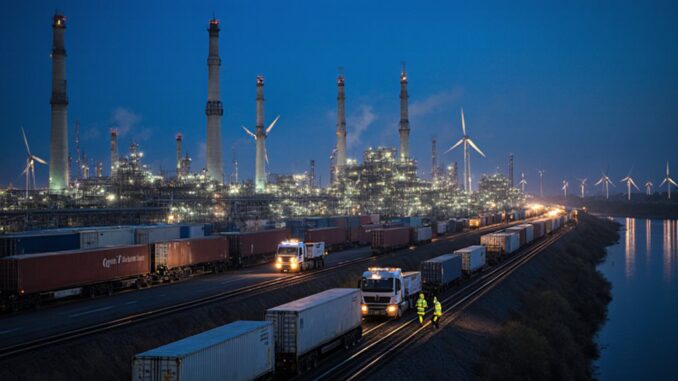
Germany’s regional clusters shorten supply chains by locating manufacturers, specialized suppliers, research institutes, and logistics providers within connected production corridors. In Baden-Württemberg, Bavaria, and North Rhine-Westphalia, dense road, rail, inland-waterway, and freight-terminal networks reduce transport distances between component makers and assembly plants. This proximity supports Just in time coordination, lowering inventory requirements and limiting delays caused by long-distance shipping.
Supply chain resilience also improves when firms can qualify nearby alternative suppliers, share warehousing capacity, and reroute freight through multiple regional hubs. Cluster-based procurement reduces exposure to congested ports, border disruptions, and volatile intercontinental freight rates. Public policy reinforces these advantages through industrial-zoning plans, rail-freight investment, digital logistics platforms, and reliable energy infrastructure. Coordinated local planning can preserve access to skilled labor and commercial sites while preventing bottlenecks around major production corridors. The result is a more responsive production system, with shorter lead times and stronger continuity during shocks.
How Industrial Clusters Drive Innovation
Innovation accelerates when firms, universities, applied-research institutes, and investors operate within the same regional ecosystem. Germany’s clusters concentrate laboratories, pilot facilities, specialist talent, and venture networks within short travel distances, reducing the time between research, prototyping, testing, and commercialization. In regions such as Munich, Stuttgart, Dresden, and Aachen, proximity supports repeated technical exchange and shared access to high-cost infrastructure.
Technology transfer is strengthened when universities and Fraunhofer-style institutes maintain formal partnerships with industrial sites, public agencies, and commercialization offices. Cluster governance can align research grants with regional priorities, including semiconductors, battery systems, industrial software, and clean manufacturing. Public funding also lowers early-stage risks by supporting demonstrators, testbeds, and collaborative research programs.
Startup acceleration benefits from nearby corporate customers, specialized suppliers, and experienced engineers. Policy *consequently* matters: reliable transport links, digital infrastructure, skilled-migration pathways, and predictable innovation funding help clusters convert scientific capability into scalable products, patents, and exportable technologies.
How Industrial Clusters Support German SMEs
For Germany’s small and medium-sized enterprises, cluster locations reduce the costs of specialization by placing suppliers, technical services, applied-research partners, and skilled labor within a concentrated regional market. In regions such as Baden-Württemberg, Bavaria, and North Rhine-Westphalia, shorter supplier distances can lower coordination time, accelerate prototyping, and improve access to specialized machinery without requiring every firm to internalize those capabilities.
Clusters also give SMEs more structured routes into export markets. Chambers of commerce, sector associations, trade-fair networks, and shared testing facilities help smaller manufacturers meet certification requirements and identify international buyers. This reduces entry barriers that are particularly significant for firms with limited administrative capacity.
Policy support is most effective when it strengthens local connective infrastructure: vocational training partnerships, technology-transfer offices, incubators, and transport links. Networked financing, including regional banks, cooperative lenders, and investor partnerships, can further improve access to patient capital. These arrangements help smes scale up while retaining regional production bases and supplier relationships.
Industrial Clusters and the Green Transition
Germany’s industrial clusters can accelerate the green evolution by concentrating renewable-energy demand, grid investments, and storage infrastructure within identifiable production regions. Co-located firms can also build circular manufacturing networks that shorten material loops and reduce transport-related emissions. Targeted regional policy is needed to align green-skills training with cluster-level demand in sectors such as chemicals, automotive production, and machinery.
Renewable Energy Integration
Industrial clusters are central to Germany’s renewable-energy integration because they concentrate large electricity and heat demand near shared grid, storage, and hydrogen infrastructure. Coastal regions linking North Sea offshore wind hubs with chemical, steel, and port complexes can reduce transmission bottlenecks while anchoring predictable industrial offtake. In northern Länder, planned electrolyser corridors and reinforced high-voltage lines are intended to connect variable generation to demand centers in Lower Saxony, Hamburg, and North Rhine-Westphalia.
Grid scale storage strengthens this spatial model by smoothing renewable output, providing balancing capacity, and limiting curtailment during high-wind periods. Policy instruments consequently need to align grid permitting, connection charges, and hydrogen-network planning at cluster level. Targeted contracts for difference and accelerated approvals can improve investment certainty, ensuring that industrial electrification proceeds alongside generation and network expansion.
Circular Manufacturing Networks
Circular manufacturing networks can lower Germany’s industrial emissions by linking firms that exchange secondary metals, waste heat, CO₂, water, and production residues within compact regional systems. In Ruhr, Rhine-Neckar, and chemical parks along the Rhine, short transport distances can reduce material losses and logistics emissions while improving input security for energy-intensive producers. Shared pipelines, sorting facilities, industrial wastewater treatment, and digital material registries support closed loop valuechains across steel, chemicals, cement, and manufacturing.
Policy can accelerate waste to resource flows through standardized by-product classifications, faster permitting for inter-firm infrastructure, and procurement rules favoring recycled-content materials. Cluster-level planning also enables municipalities, utilities, and manufacturers to coordinate land use and network investments. Measurable targets for secondary-material use, heat recovery, and water reuse would allow regional authorities to track performance and direct funding toward the highest-emission industrial sites.
Green Skills Development
As decarbonization reshapes production in regions such as the Ruhr, Lower Saxony, and the Rhine corridor, industrial clusters can concentrate green-skills training around local demand for hydrogen systems, electrified processes, circular-material handling, and grid integration. Shared training centres allow manufacturers, utilities, vocational schools, and research institutes to align curricula with nearby investment pipelines. Workforce upskilling can target technicians maintaining electrolyzers, engineers redesigning heat-intensive plants, and logistics staff handling secondary materials. A STEM apprenticeship model linked to cluster employers can lessen shortages while giving smaller suppliers access to specialised instruction they could not finance alone. Federal and Länder funding should prioritize programs tied to measurable regional indicators: projected clean-technology capacity, vacancy rates, completion outcomes, and worker transitions. Such coordination strengthens local labour markets and helps secure that capital spending translates into operational capability across Germany.

The Industry & Manufacturing Editorial Team focuses on Germany’s industrial economy and the technologies transforming production. Coverage includes mechanical engineering, manufacturing, automation, robotics, process industries, supply chains and industrial digitalisation. Particular attention is given to the German Mittelstand, specialised manufacturers and hidden champions that play an important role in global industrial markets.