Germany’s largest export industries are vehicles and auto parts, industrial machinery, chemicals and pharmaceuticals, and electrical and precision equipment. Vehicle exports exceed €250 billion annually, while machinery serves automation and industrial investment worldwide. Chemicals and pharmaceuticals earn high margins through research, patents, and specialized production. EU integration supports market access, but energy costs, Chinese competition, supply-chain risks, and regulatory demands remain constraints. The sections below compare each sector’s markets, strengths, and policy exposure.
Germany’s Leading Export Industries at a Glance
Germany’s export economy is led by high-value manufacturing, with vehicles, machinery, chemicals, pharmaceuticals, and electrical equipment accounting for a substantial share of overseas sales. This concentration distinguishes Germany from commodity-dependent exporters and supports persistent trade surpluses, although energy-import dependence remains a strategic constraint.
Machinery and industrial equipment serve factory automation, construction, energy, and transport markets, while chemical and pharmaceutical shipments provide comparatively resilient demand and higher margins. Electrical goods, medical technology, optical instruments, and specialized components further broaden the export base. European Union partners remain the principal destination market, but the United States and China are also significant customers, increasing exposure to external demand cycles and trade-policy shifts.
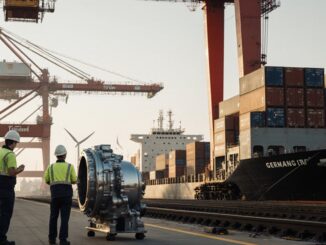
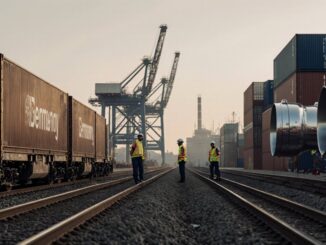
World class logistics, including Rhine corridors, rail freight networks, seaports, and airports, connects producers to global trade hubs efficiently. Policy priorities consequence include safeguarding open markets, lowering administrative barriers, expanding digital infrastructure, and accelerating affordable clean-energy investment to preserve industrial competitiveness amid stronger competition from the United States and Asia.
Cars and Auto Parts: Germany’s Largest Export Sector
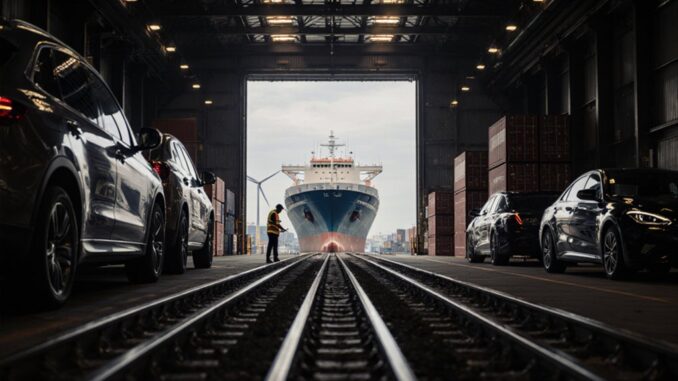
Within this manufacturing-heavy export mix, cars and automotive parts form Germany’s largest single goods-export sector, generating well over €250 billion in annual foreign sales in recent years. The category combines finished passenger vehicles, commercial vehicles, engines, components, and electrical systems, placing it decisively above other entries in Germany’s export rankings.
- Scale: Vehicle and parts exports account for roughly one-sixth of total goods exports, underscoring the sector’s weight in the national trade balance.
- Markets: EU partners remain central, while China, the United States, and the United Kingdom provide major non-European demand.
- Policy exposure: Emissions rules, electric-vehicle incentives, battery supply chains, and trade tariffs increasingly shape competitiveness.
The Sectors overview also shows a distinctive concentration: Germany exports premium brands and high-value components rather than relying solely on volume. Compared with lower-cost vehicle exporters, its advantage rests on engineering, supplier networks, and product positioning. However, electrification and Asian competition are narrowing established margins, making industrial adaptation and market diversification policy priorities.
Industrial Machinery and Equipment Exports
Industrial machinery and equipment ranks among Germany’s most competitive export categories, supported by advanced engineering, high R&D intensity, and specialized manufacturing networks. Major markets across the EU, United States, China, and other industrializing economies sustain demand, although competition from Asian producers has increased. Rising investment in factory automation, robotics, and energy-efficient production systems reinforces the sector’s strategic importance for export and industrial policy.
Engineering Excellence and Innovation
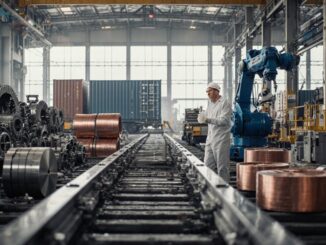
Supported by a dense network of specialized manufacturers, Germany remains one of the world’s leading exporters of industrial machinery and equipment, supplying production systems, machine tools, automation technologies, and process equipment to global markets. Its advantage rests on engineering depth, coordinated vocational training, and export oriented R&D that translates laboratory advances into commercially scalable equipment. Compared with lower-cost producers, German firms compete through precision, lifecycle reliability, and integrated services.
- Industry 4.0 adoption strengthens productivity through sensors, software, robotics, and predictive maintenance.
- Sustainable engineering reduces energy use, material waste, and emissions across industrial processes.
- Advanced manufacturing supports customized, high-value machinery for regulated and technically demanding sectors.
Public policies supporting digital infrastructure, research partnerships, and energy-efficient investment reinforce this model. Continued competitiveness depends on accelerating commercialization while managing high energy costs, skills shortages, and investment gaps.
Key Machinery Export Markets
Germany’s industrial machinery and equipment exports are concentrated in advanced manufacturing economies, with the United States, China, France, Italy, the Netherlands, and Poland among the most important destination markets. These countries combine large industrial bases, investment capacity, and established import channels. The United States and China offer scale, while EU markets benefit from single-market rules, shorter delivery times, and integrated supply chain logistics. France and Italy remain significant buyers of production equipment, whereas the Netherlands functions partly as a European distribution hub. Poland’s importance reflects manufacturing expansion and EU-supported capital investment. Trade policy, technical standards, and procurement requirements shape market access across destinations. German suppliers face stronger competition from Asian and North American producers, increasing pressure for competitive pricing strategies. Emerging regional markets in Central Europe and Southeast Asia can diversify demand, although financing conditions, local certification, and after sales service demand influence export performance.
Automation Equipment Demand
Automation equipment demand is a major driver of German machinery exports, as manufacturers worldwide invest in robotics, programmable controls, sensors, machine-vision systems, and digitally integrated production lines to raise productivity and address labor shortages. Germany benefits from engineering depth, interoperability standards, and strong after-sales networks, competing chiefly with Japan, South Korea, China, and the United States.
- Robotics adoption supports exports of precision drives, controllers, and collaborative robot components.
- Smart manufacturing policies, including EU digitalization funding, increase demand for connected factory equipment and industrial sensors.
- Autonomous systems expand orders for logistics automation, automated guided vehicles, and safety-certified control technology.
Demand is strongest in automotive, electronics, pharmaceuticals, and warehousing, where downtime costs are high. Export growth depends on energy competitiveness, cybersecurity rules, and access to skilled technicians, while Chinese suppliers increasingly challenge lower-cost market segments.
Chemical and Pharmaceutical Exports
Germany ranks among the world’s leading chemical exporters, supported by large-scale production clusters, advanced research capacity, and integrated EU supply chains. Pharmaceuticals add a high-value export segment, with German firms competing strongly in patented medicines, vaccines, and specialty therapies. Industrial, trade, and regulatory policies accordingly affect the sector’s competitiveness more directly than in many lower-value manufacturing industries.
Chemical Manufacturing Leadership
Supported by a dense research base, integrated EU supply chains, and strong intellectual-property protections, the chemical and pharmaceutical sector ranks among the country’s highest-value export industries. Germany’s chemical manufacturers compete through specialty materials, industrial gases, polymers, and process engineering rather than low-cost bulk output. Compared with many global rivals, domestic producers benefit from proximity to automotive, machinery, and construction customers, but face higher energy prices and stricter environmental rules.
- EU harmonization improves market access across neighboring economies.
- Regulation hurdles raise compliance costs for emissions, product safety, and hazardous substances.
- Import dependence for feedstocks and critical inputs increases supply chain risks.
Policy priorities center on affordable energy, faster permitting, and trade agreements that preserve standards while expanding export opportunities. These factors determine whether Germany retains its premium position against US and Asian producers.
Pharmaceutical Export Strength
Within the broader chemical sector, pharmaceuticals provide Germany with a high-value, research-intensive export base centered on patented medicines, vaccines, biologics, and specialized therapies. Germany benefits from dense clusters around Berlin, Munich, Rhine-Main, and North Rhine-Westphalia, where multinational manufacturers, universities, and suppliers support Pharmaceutical R&D and scale-up capacity. Export performance relies less on commodity volume than on intellectual property, quality assurance, and reliable access to EU and global markets. Compared with lower-cost generic producers, German firms compete through advanced formulations, precision manufacturing, and established hospital and pharmacy distribution networks. Policy priorities include maintaining research incentives, accelerating clinical-trial approvals, securing active-ingredient supply chains, and reducing energy-related production costs. Global regulatory compliance remains a central advantage, enabling exporters to meet stringent standards in the United States, Japan, and other regulated markets.
Electrical Equipment, Electronics, and Precision Exports
Electrical equipment, electronics, and precision instruments form a high-value pillar of German exports, combining industrial machinery with advanced components for automotive, medical, energy, and communications applications. This segment spans control systems, sensors, optical devices, power equipment, and semiconductor-related tools, serving both EU markets and major destinations in North America and Asia.
- Global trade dynamics expose producers to Asian component competition and shifting demand for electrification technologies.
- Export compliance is increasingly shaped by EU dual-use controls, cybersecurity rules, product safety standards, and sanctions screening.
- Supply chain resilience depends on diversified sourcing of chips, rare materials, and specialized subcomponents, while market entry strategies must account for local certification and procurement rules.
Compared with lower-value consumer electronics trade, Germany’s position is concentrated in specialized business-to-business equipment. Public policy supports grid modernization, digital infrastructure, and semiconductor capacity, although firms face energy-cost pressures and technology restrictions in strategically sensitive markets. Precision exports also require calibrated testing, traceability, and post-sale servicing.
Why German Export Industries Remain Competitive
Germany’s export competitiveness rests on a combination of high-value manufacturing, specialized engineering, and deep integration into the EU single market. Automotive, machinery, chemicals, and medical-technology producers compete less on price than on reliability, technical performance, and long product lifecycles. Germany’s research intensity, vocational training system, and dense network of Mittelstand suppliers support manufacturing skills that are difficult to replicate quickly in lower-cost economies.
EU membership reduces regulatory and customs barriers across Germany’s largest regional market, while common standards help firms scale specialized products internationally. Export financing, including guarantees and credit insurance, lowers risk for capital-goods sales to emerging markets. Compared with many advanced economies, Germany also retains a larger industrial base, supporting supplier coordination and applied innovation.
However, competitiveness increasingly depends on supply chain resilience amid energy-price volatility, Chinese competition, and geopolitical disruption. Global trade policy consequently matters directly: predictable market access, diversified sourcing, and targeted investment in digitalization, clean technologies, and workforce upgrading will determine whether German exporters preserve their advantage.
The Business & Economy Editorial Team covers Germany’s economy, companies, markets and international trade. Its reporting focuses on economic developments, investment, exports, the Mittelstand, major corporations and the conditions affecting businesses in Germany. The team combines current economic news with background articles and analysis to explain what developments mean for companies, investors and international readers.