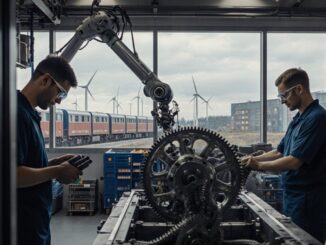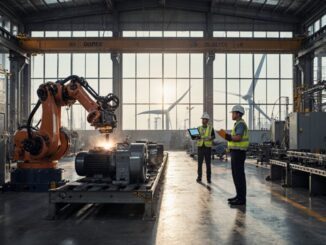
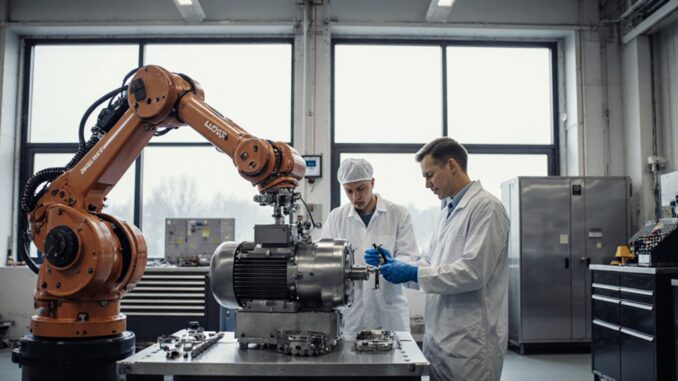
Germany’s engineering sector combines automotive, machinery, electrical systems, energy technology, and industrial software within globally integrated supply chains. Its competitiveness rests on specialized Mittelstand firms, dual vocational training, applied research institutes, and DIN-based quality assurance. Demand spans robotics, sensors, process equipment, grid infrastructure, hydrogen, and efficient manufacturing systems. Industry 4.0 technologies raise productivity, while aging workforces, energy costs, and regulatory delays create constraints. The sections below outline the capabilities, institutions, and pressures shaping its future.
German Engineering: Sector Overview
Germany’s engineering sector is a core component of the national industrial economy, spanning automotive, mechanical and plant engineering, electrical engineering, automation, energy systems, and industrial software. It operates through a dense network of large exporters, specialized Mittelstand firms, research institutes, technical universities, and standards bodies. Its performance depends on high-value production, applied research expenditure, skilled labor availability, and integration within European and global supply chains.
The sector’s global competitiveness is supported by precision manufacturing, strong patent activity, advanced vocational training, and established quality-certification systems. Digitalization is reshaping design, production, maintenance, and product-service models through simulation, sensors, cloud platforms, and artificial intelligence. A sustainability focus is also altering engineering requirements, increasing demand for energy efficiency, lifecycle assessment, material circularity, and lower-emission processes. Key constraints include demographic labor shortages, volatile energy costs, investment requirements for digital infrastructure, and exposure to international demand cycles. Overall, engineering remains a critical source of productivity, exports, and technological capability.
Industries Driving German Engineering
Across the industrial economy, automotive manufacturing, mechanical and plant engineering, electrical equipment, and automation form the principal demand base for German engineering capabilities. Vehicle producers require advanced powertrain systems, lightweight materials, battery technologies, embedded software, and production-line modernization. Machinery users generate demand for precision tools, industrial robotics, process control, fluid systems, and energy-efficient capital equipment.
Electrical and digital industries expand requirements for semiconductors, sensors, grid equipment, telecommunications hardware, and industrial software. The energy transformation also stimulates engineering activity in wind components, photovoltaic manufacturing equipment, hydrogen infrastructure, heat pumps, and transmission networks. Chemical, pharmaceutical, medical-device, and food-processing plants require specialized process engineering, validation systems, and automated packaging solutions.
Export and logistics reinforce these sectors through demand for port equipment, warehouse automation, rail technology, and supply-chain data platforms. Workforce mobility supports cross-regional project delivery, plant commissioning, technical maintenance, and access to specialized engineering labor across industrial clusters.
The Mittelstand’s Engineering Advantage
Although large corporations anchor many global supply chains, the Mittelstand provides a distinct engineering advantage through specialized expertise, long investment horizons, and close integration of design, production, and customer service. Typically family-owned or privately held, these firms concentrate on narrow industrial niches, including precision tooling, automation components, measurement systems, and process equipment. Their operating model supports rapid technical iteration without the quarterly pressure common in publicly traded groups.
- Niche leadership enables high margins and defensible patents.
- Integrated manufacturing shortens prototype-to-production cycles.
- Customer-specific configurations strengthen retention in capital-goods markets.
- International distributor networks convert specialization into scalable exports.
This structure reinforces Global competitiveness by combining engineering depth with disciplined quality control and reliable delivery. Export driven innovation is evident in products adapted to demanding foreign regulations, production environments, and lifecycle requirements. Rather than competing primarily on volume, Mittelstand companies monetize precision, durability, and application-specific performance. Their decentralized decision-making also permits investments in machinery and digital process controls that protect productivity across volatile demand cycles.
Engineering Education and Skilled Talent
A dual education model supplies Germany’s engineering sector with a structured pipeline of skilled talent by combining university study, vocational instruction, and paid workplace training. Dual Education links curricula to occupational standards, enabling firms to recruit technicians, mechatronics specialists, and production engineers with verified competencies. Applied Apprenticeships typically alternate classroom modules with supervised factory assignments, reducing the gap between theoretical knowledge and equipment-specific practice.
Technical Vocational schools support this system through qualifications in machining, automation, electrical systems, and industrial maintenance. Employers, chambers, and schools jointly define examination requirements, creating nationally recognized credentials and comparable skill levels across regions. This coordination supports quality control in export-oriented manufacturing and helps smaller firms access trained entrants.
Workforce Upskilling remains essential as digital production, electrification, and advanced software alter job requirements. Continuing-training programs allow existing employees to acquire capabilities in programmable controls, data analysis, robotics, and energy-efficient operations. The resulting talent system strengthens labor-market responsiveness while preserving specialized engineering knowledge within industrial supply chains.
Research Institutes Powering Innovation
Germany’s research infrastructure converts scientific capability into industrial applications through institutions such as the Fraunhofer Society, Max Planck Society, Helmholtz Association, and Leibniz Association. Their complementary mandates link fundamental discovery, prototype development, systems testing, and market-oriented transfer across automotive, machinery, energy, and digital sectors.
- Fraunhofer institutes concentrate on contract research, translating Applied robotics, sensing, and manufacturing concepts into deployable industrial systems.
- Max Planck institutes generate long-horizon scientific knowledge, particularly in physics, chemistry, computation, and advanced materials science.
- Helmholtz centers operate large-scale facilities and national research programs in energy, aerospace, health, climate, and transport technologies.
- Leibniz institutions connect interdisciplinary research with regional industry, public infrastructure, and specialized collections or data resources.
This distributed model reduces innovation risk by giving firms access to laboratories, pilot lines, simulation capacity, and domain expertise. Collaborative projects typically combine public funding with corporate participation, accelerating technology maturation from validated concepts toward production-ready engineering solutions.
Quality Standards Behind German Engineering
German engineering quality is structured around DIN standards that define measurable requirements for materials, dimensions, safety, and performance. Precision manufacturing protocols translate these specifications into controlled production processes with documented tolerances and traceability. Continuous quality control, including in-process inspection and final verification, limits variation and supports consistent compliance across industrial output.
Rigorous DIN Standards
Behind much of the sector’s reliability is the Deutsches Institut für Normung (DIN), which develops technical standards for dimensions, materials, safety, testing, and interoperability. DIN specifications translate engineering requirements into measurable acceptance criteria, reducing ambiguity across suppliers, regulators, and customers. Their value lies in repeatable validation and documented conformity rather than brand reputation.
- Defined tolerances establish compatible interfaces between components.
- Material standards specify properties, test methods, and traceability requirements.
- Safety provisions identify performance thresholds and hazard-control criteria.
- DIN compliance verification confirms that products meet applicable clauses.
Certification documentation records test results, declarations, revisions, and responsible entities, creating auditable evidence for procurement and market access. DIN standards also align many national requirements with European and international frameworks, limiting technical barriers in cross-border projects. This standards architecture supports comparable quality assessments throughout Germany’s engineering supply base.
Precision Manufacturing Protocols
Precision manufacturing protocols convert design specifications into controlled production outcomes through calibrated equipment, documented process parameters, and statistically verified inspection. German manufacturers translate DIN-defined tolerances into machine instructions, tooling specifications, material certificates, and measured acceptance criteria. Coordinate measuring systems, CNC compensation tables, and gauge-management schedules establish repeatable dimensional capability across batches. Process documentation records approved settings for cutting speeds, torque values, thermal cycles, surface treatments, and operator authorizations, creating an auditable production record. Assembly traceability links components to supplier lots, serial numbers, revision levels, and defined assembly sequences. Statistical capability targets, commonly expressed through Cp and Cpk indices, assess whether production variation remains compatible with specified limits. Metrology laboratories maintain calibration chains traceable to national standards, reducing measurement uncertainty. These protocols support interchangeability, controlled configuration, and reliable conformance in automotive, machinery, medical-device, and industrial-equipment manufacturing.
Continuous Quality Control
Continuous quality control extends manufacturing verification from final inspection to each production stage, using defined measurement plans, in-process sensors, sampling rules, and corrective-action thresholds. German engineering firms typically integrate statistical process control with traceable Quality documentation, allowing deviations to be detected before assemblies exceed tolerance limits.
- Sensor data monitors dimensions, torque, temperature, and vibration in real time.
- Control charts compare measured variation against capability targets, including Cp and Cpk indices.
- Process verification confirms that machines, tooling, and operator procedures remain within validated parameters.
- Nonconformance systems trigger containment, root-cause analysis, and documented corrective actions.
This framework reduces scrap, rework, and warranty exposure while supporting repeatable output across shifts and suppliers. Audit trails link material batches, inspection results, calibration records, and production settings, enabling rapid fault isolation and evidence-based compliance reviews.
Industry 4.0 and Smart Factories
Germany’s engineering sector is applying digital manufacturing systems to integrate design data, production planning, and machine control across factory operations. Connected technologies—including industrial IoT sensors, edge computing, and interoperable automation platforms—enable real-time monitoring of throughput, quality, and equipment status. This infrastructure supports more adaptive production, predictive maintenance, and traceable manufacturing processes.
Digital Manufacturing Systems
Digital manufacturing systems form a central component of Germany’s Industry 4.0 strategy, integrating industrial automation, cyber-physical systems, industrial internet connectivity, and real-time data analytics across production operations. Their value lies in synchronizing design, planning, execution, and quality-control data to reduce variation, downtime, and material waste. German manufacturers assess industrial automation readiness through equipment interoperability, workforce capability, process standardization, and measurable return on investment.
- Digital twins model production parameters before physical deployment.
- Manufacturing execution systems track throughput, defects, and energy consumption.
- Predictive analytics identifies maintenance risks from machine-condition data.
- Production data security protects intellectual property, operational continuity, and regulated records.
Implementation typically requires common data models, validated sensor inputs, and disciplined governance. Performance indicators include overall equipment effectiveness, first-pass yield, changeover time, and energy intensity, enabling managers to prioritize capital upgrades using quantified operational evidence.
Connected Factory Technologies
Building on digital manufacturing systems, connected factory technologies link machines, sensors, enterprise platforms, and supply-chain interfaces into interoperable cyber-physical production networks. German manufacturers deploy industrial IoT gateways, OPC UA protocols, edge computing, and digital twins to synchronize shop-floor data with planning, quality, and logistics functions. Real time monitoring enables condition-based maintenance, energy optimization, traceability, and faster deviation detection across production cells. Analytics platforms combine sensor streams with ERP and MES records, improving forecast accuracy and reducing unplanned downtime. Implementation depends on standardized data models, low-latency connectivity, and workforce capability in automation software and data engineering. Cybersecurity readiness is equally critical: segmented networks, identity management, encrypted communications, and continuous vulnerability assessment protect operational technology from disruption. These systems support flexible, high-mix production while generating measurable efficiency, resilience, and resource-use gains.
German Engineering in the Green Transition
As decarbonization targets reshape industrial investment, German engineering firms are applying established strengths in mechanical systems, power electronics, process automation, and grid infrastructure to renewable-energy deployment and efficiency upgrades. Their role extends from equipment design to integrated plant optimization, supporting lower lifecycle emissions across manufacturing, transport, and utilities.
- Wind systems: Suppliers produce gearboxes, converters, bearings, and monitoring equipment for higher-capacity turbines.
- Solar and storage: Firms develop inverters, battery-management systems, and renewable energy components that stabilize distributed generation.
- Hydrogen infrastructure: Engineering groups design electrolyzer balance-of-plant systems, compression units, pipelines, and refueling equipment for industrial hydrogen use.
- Efficiency retrofits: Automation, heat-recovery modules, electrified drives, and digital controls reduce energy intensity in chemical, steel, and process industries.
German technical capabilities are especially relevant where variable renewable output requires precise control, high reliability, and interoperable equipment. Engineering value increasingly depends on system-level integration: matching generation assets, storage, demand response, and industrial loads within increasingly electrified energy networks.
Challenges Shaping German Engineering’s Future
The same system-integration strengths that support low-carbon industrial investment are being tested by structural pressures on German engineering. Workforce demographics are tightening the supply of experienced technicians, project managers, and design engineers as retirement rates exceed entry into several industrial occupations. This constraint raises delivery risk for grid expansion, factory retrofits, rail modernization, and semiconductor projects.
Cost competitiveness is also under pressure. Energy-intensive suppliers face volatile electricity prices, while global competitors scale production in regions with lower labor and permitting costs. Engineering firms must therefore increase productivity through digital twins, modular design, robotics, and AI-assisted validation. However, adoption depends on stronger automation skills across both shop-floor and engineering roles.
Regulatory complexity presents a further bottleneck. Lengthy approval procedures, fragmented data standards, and cybersecurity requirements can delay capital deployment. Future performance will depend on accelerating training pipelines, integrating international talent, standardizing industrial data infrastructure, and converting research capacity into scalable manufacturing systems.
The Business & Economy Editorial Team covers Germany’s economy, companies, markets and international trade. Its reporting focuses on economic developments, investment, exports, the Mittelstand, major corporations and the conditions affecting businesses in Germany. The team combines current economic news with background articles and analysis to explain what developments mean for companies, investors and international readers.