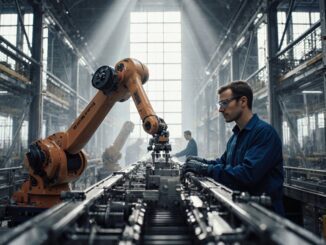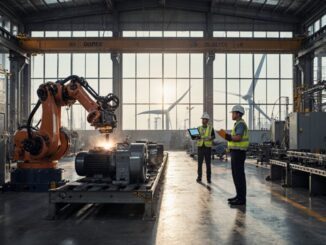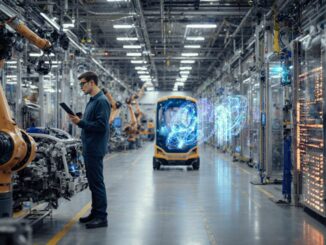
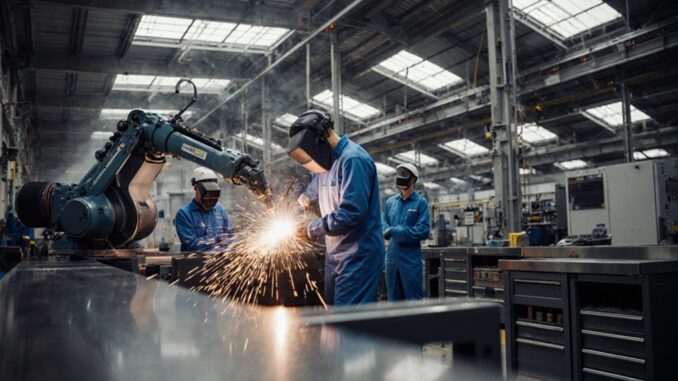
Germany’s manufacturing industry contributes roughly one-fifth of national gross value added and is highly export-oriented. Automotive, machinery, chemicals, electrical engineering, and metalworking generate much of its value and trade strength. Competitiveness rests on specialized engineering, skilled labor, research capacity, and dense supplier networks. However, energy costs, labor shortages, regulation, supply disruptions, and weaker global demand are increasing pressure. Current investment prioritizes electrification, automation, industrial AI, hydrogen, and resilient digital supply chains. The sections below examine these shifts further.
Germany’s Manufacturing Industry at a Glance
Germany’s manufacturing industry is a core pillar of the national economy, combining high-value production with export-oriented specialization. It contributes roughly one-fifth of gross value added, a significantly higher share than in many advanced European economies. Its performance depends on dense supplier networks, applied research capacity, skilled technical labor, and extensive integration with European and global trade flows.
Manufacturing output is concentrated in capital-intensive, technology-led activities, while small and medium-sized firms provide specialized components, engineering services, and production equipment. The sector’s competitiveness is reinforced by quality standards, patent activity, vocational training, and long-established industrial clusters. Export demand remains a major determinant of capacity utilization, investment, and employment, making the export market sensitive to global growth, trade conditions, and currency movements.
Recent investment priorities emphasize automation modernization, energy efficiency, digital production systems, and supply-chain resilience. These changes are intended to protect productivity as labor shortages, energy costs, and geopolitical disruptions increase operating pressure.
Industries Driving Germany’s Manufacturing Industry
Automotive manufacturing, machinery and equipment, chemicals, electrical engineering, and metalworking account for the largest share of Germany’s industrial value creation and exports. Vehicle production anchors extensive auto supply chains, linking assemblers with component makers in drivetrains, electronics, batteries, plastics, and precision parts. Machinery producers serve factory automation, energy, construction, and process industries, generating high-value capital goods for global customers.
Chemicals form another major export-oriented base, supplying pharmaceuticals, polymers, coatings, fertilizers, and industrial inputs. Electrical engineering spans power systems, automation controls, sensors, medical technology, and communications equipment, increasingly tied to electrification and digital production. Metalworking supports these sectors through steel, aluminium, fabricated components, tools, and specialized processing.
The industrial structure is characterized by dense regional clusters and a large Mittelstand supplier base. A skilled workforce is concentrated across technical occupations, while research-intensive manufacturers generate substantial patent activity. Together, these industries connect domestic production with European markets and international investment flows.
Why German Manufacturing Remains Competitive
German manufacturing remains competitive because it combines high productivity, specialized engineering, and tightly integrated supplier networks across export-intensive sectors. Automotive, machinery, chemicals, electrical equipment, and medical technology benefit from dense clusters linking manufacturers, component makers, research institutes, and technical service firms. This structure shortens development cycles, supports quality control, and enables customized production for industrial customers.
Competitiveness also reflects sustained investment in automation, precision tools, industrial software, and workforce training. German firms typically compete less on unit labor costs than on reliability, technical performance, energy efficiency, and long product lifecycles. The Mittelstand contributes strongly through niche leadership in machine components, sensors, process equipment, and specialized materials.
A central European location strengthens access to major consumer and industrial markets. Advanced logistics, rail corridors, inland ports, and cross-border distribution networks support efficient delivery schedules. Participation in Global supply chains expands sales reach while allowing firms to source specialized inputs and maintain internationally integrated production systems.
Challenges Facing Germany’s Manufacturing Industry
Despite its industrial strengths, the sector faces rising energy costs, labor shortages, regulatory complexity, and weaker external demand. Energy-intensive branches, including chemicals, metals, glass, and paper, have been particularly exposed to energy price volatility, which compresses margins and weakens Germany’s cost position against regions with lower power and gas prices.
Supply chain shocks have also revealed dependence on imported components, critical minerals, and global shipping routes. Automotive, machinery, and electronics producers have faced production interruptions when semiconductors or specialized inputs were unavailable. Meanwhile, demographic change is tightening the skilled-labor market, affecting engineering, maintenance, machining, and technical occupations.
Compliance demands add administrative burdens, especially for small and medium-sized suppliers managing environmental, reporting, and product standards. Slower demand from major export markets, especially China, has reduced orders for capital goods and vehicles. Together, these pressures constrain capacity utilization, delay investment decisions, and intensify competition across manufacturing value chains.
What’s Next for German Manufacturing?
These pressures are accelerating a restructuring of German manufacturing rather than signaling its disappearance. Automotive producers are reallocating investment toward electric drivetrains, battery systems, software, and charging technologies, while machinery firms expand automation, robotics, and industrial AI offerings. The green transition will reshape energy-intensive segments such as chemicals, steel, and glass, where competitiveness increasingly depends on renewable-power access, hydrogen availability, and carbon-cost management.
Supply chain shifts are also prompting greater sourcing diversification, higher inventories of critical inputs, and selective nearshoring within Europe and neighboring regions. Germany’s export model will accordingly rely less on volume growth in conventional vehicles and more on specialized capital goods, advanced materials, and climate technologies.
Digital resilience will become a core production requirement, requiring secure data infrastructure, interoperable factory systems, and stronger cybersecurity. The Future workforce must combine engineering depth with software, electronics, and sustainability skills. Policy outcomes on energy prices, permitting, and investment incentives will determine the speed and scale of industrial adaptation.
The Industry & Manufacturing Editorial Team focuses on Germany’s industrial economy and the technologies transforming production. Coverage includes mechanical engineering, manufacturing, automation, robotics, process industries, supply chains and industrial digitalisation. Particular attention is given to the German Mittelstand, specialised manufacturers and hidden champions that play an important role in global industrial markets.