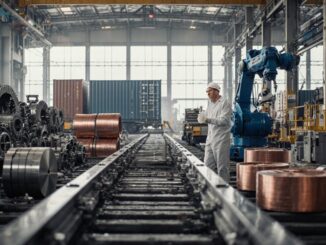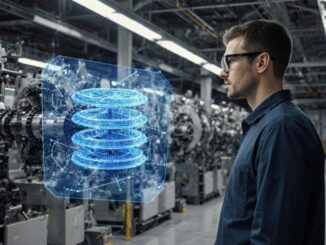
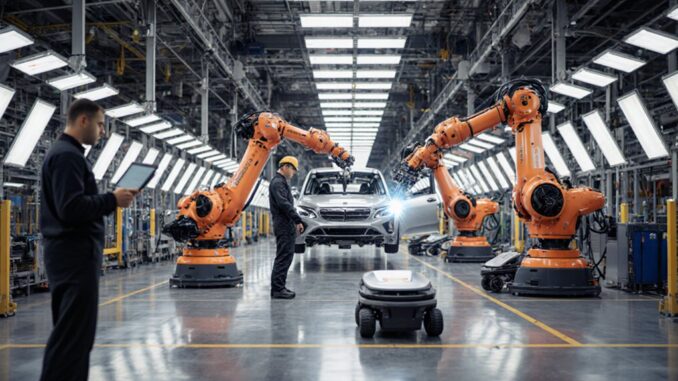
Automation is changing German factories through robotics, machine vision, connected sensors, and real-time data platforms. Robots perform repetitive assembly, handling, and palletizing tasks with consistent timing and precision. AI supports quality-risk detection, production scheduling, and predictive maintenance using equipment data. Connected systems improve traceability, reduce defects, and limit unplanned downtime. Workers increasingly supervise automated cells and manage digital workflows. Scaling depends on interoperable standards, cybersecurity, investment, and reskilling. The following sections explain these operational shifts in greater detail.
How Factory Automation Is Changing German Manufacturing
German manufacturing is being reshaped by factory automation through the integration of robotics, machine vision, industrial sensors, and connected control systems. These technologies link production assets with real-time data platforms, enabling tighter process control, traceability, and faster response to material, quality, and maintenance deviations. Manufacturers are redesigning plant architectures around interoperable equipment, standardized interfaces, edge computing, and secure industrial networks.
Automation also improves resource efficiency by monitoring energy use, cycle times, scrap rates, and equipment condition across production lines. Predictive analytics supports scheduled interventions before failures disrupt output, while digital twins assist with commissioning, capacity planning, and process validation. Human centered automation guides implementation by assigning systems to augment operator decision-making, safety, and technical oversight rather than merely replacing roles. Industry 4.0 governance establishes rules for data ownership, cybersecurity, system accountability, and supplier interoperability. Together, these measures create more adaptable factories capable of maintaining quality under shifting demand, regulatory requirements, and supply-chain constraints.
Robots Handle Repetitive Factory Tasks
Robots now execute repetitive assembly sequences with consistent positioning, torque control, and cycle timing. Their precision reduces variation in component fit and supports stable production quality. By taking over repetitive labor, these systems allow workers to focus on monitoring, maintenance, and exception handling.
Precision in Assembly
Across German manufacturing lines, automated assembly cells execute repetitive tasks with consistent force, positioning, and cycle timing. Vision guided assembly aligns components against calibrated reference points, while servo controlled fastening verifies torque, angle, and seating depth in real time. These controls reduce variation across high-volume production without interrupting throughput.
- A precisely seated bolt protects confidence in vehicles and machinery.
- Stable tolerances prevent the quiet anxiety of hidden defects.
- Traceable process data offers reassurance when every unit must perform.
- Predictable cycles support delivery commitments during volatile demand.
Integrated sensors feed programmable logic controllers, which compare measured values with digital specifications and isolate nonconforming parts. Tool wear, fixture drift, and component orientation are detected early through closed-loop feedback. The result is an assembly system that converts repeatability into measurable quality, lower rework rates, and dependable product performance.
Reduced Repetitive Labor
Automated workstations now assume repetitive tasks such as part loading, palletizing, welding, dispensing, and machine tending, reducing reliance on manual motion-intensive labor. In German factories, robotic cells integrate sensors, vision systems, and programmable controls to maintain cycle times, repeatable positioning, and stable throughput across shifts. Automated material handling also limits bottlenecks between machining, assembly, and inspection stages.
This redistribution of work reduces exposure to lifting, awkward postures, and high-frequency movements. Companies can direct ergonomic upgrades toward collaborative work areas, safer tool access, and optimized line layouts. Worker training increasingly focuses on robot supervision, fault recovery, quality verification, and basic programming rather than continuous manual handling. Production managers gain more predictable labor allocation, while maintenance teams use operational data to schedule servicing before failures interrupt output. The result is a more resilient manufacturing system with lower physical strain, fewer process variations, and improved capacity utilization.
AI Improves Quality and Production Planning
AI systems strengthen factory control by predicting quality risks from process data before defects reach later stages. Real-time vision and sensor analytics identify deviations immediately, while automated alerts support rapid corrective action. Production schedules can also be optimized against demand, machine capacity, and material availability to reduce downtime and waste.
Predictive Quality Control
In German factories, predictive quality control combines machine-learning models with sensor, vision, and process data to identify defect risks before nonconforming parts reach downstream operations. Sensor driven inspection tracks dimensional drift, surface anomalies, torque variation, and thermal signatures in real time. Machine learning validation compares predictions against measured outcomes, maintaining traceability and reducing false alerts.
- Early warnings prevent costly rework and protect customer confidence.
- Automated image analysis detects flaws invisible during routine manual checks.
- Closed-loop parameter adjustments stabilize processes and reduce scrap.
- Audit-ready data records provide assurance during safety-critical investigations.
Quality engineers receive prioritized exception reports rather than raw data streams. Models are retrained with verified defect labels, process changes, and material-batch histories. This architecture improves first-pass yield, supports consistent tolerances, and limits waste without replacing accountable human approval for critical release decisions.
Smarter Production Scheduling
Smarter production scheduling uses AI to align machine capacity, material availability, workforce constraints, and quality-risk signals across German factory operations. Planning systems combine ERP, MES, supplier, and maintenance data to generate sequences that protect throughput while reducing changeovers, idle time, and inventory exposure. Each production order receives priority scores based on delivery commitments, process capability, energy demand, and available tooling.
A real time resource model recalculates feasible schedules when suppliers delay components, equipment requires service, or labor availability changes. Automated constraint handling identifies bottlenecks, tests alternative routings, and assigns work to compatible lines without disrupting validated process parameters. Planners retain approval authority, but receive ranked scenarios with projected output, utilization, and risk effects. This approach shortens response cycles, stabilizes delivery performance, and directs factory capacity toward orders with the strongest operational value.
Real-Time Defect Detection
Real-time defect detection integrates machine vision, sensor data, and process analytics to identify quality deviations as parts move through German production lines. AI models compare live measurements against tolerances, triggering optical sorting or surface inspection before flawed components reach downstream assembly. Connected quality systems feed results into production planning, adjusting machine parameters, maintenance priorities, and material allocation.
- Operators gain confidence when hidden faults are caught immediately.
- Customers receive reassurance through more consistent product quality.
- Manufacturers avoid the costly frustration of recalls and scrap.
- Production teams see relief as automated alerts isolate root causes quickly.
The system links cameras, vibration sensors, and thermal readings to manufacturing execution platforms. Defect patterns become actionable data, enabling closed-loop corrections, shorter inspection cycles, and higher first-pass yield across automotive, machinery, and electronics facilities.
Predictive Maintenance Cuts Factory Downtime
Predictive maintenance is reducing unplanned downtime in German factories by using sensor data, machine-learning models, and equipment histories to identify failure patterns before they interrupt production. Vibration, temperature, pressure, and power-consumption readings are streamed from critical assets into maintenance platforms that calculate condition scores and forecast component degradation.
Instead of servicing machines on fixed intervals, plants can schedule interventions during planned production gaps, reducing emergency repairs, spare-parts waste, and line stoppages. Integration with enterprise resource planning systems helps synchronize technician availability, inventory, and work orders across production cells.
Implementation depends on reliable data quality, calibrated sensors, and clear asset hierarchies. Cybersecurity concerns increase as operational technology networks connect more equipment to analytics services, requiring access controls, segmentation, and continuous monitoring. Workforce reskilling is also necessary, since maintenance teams must interpret diagnostic alerts, validate model outputs, and combine digital recommendations with mechanical expertise. The result is a more stable production system with improved equipment utilization and traceable maintenance decisions.
Why German Manufacturers Invest in Automation
German manufacturers invest in automation to improve productivity, stabilize quality, and protect competitiveness in high-cost production environments. Integrated robotics, machine vision, and data-driven controls reduce process variation while increasing throughput across machining, assembly, and packaging lines. Investment decisions typically target measurable cost reduction through lower scrap rates, tighter energy management, and more consistent cycle times.
- Fewer defects prevent costly recalls and preserve customer trust.
- Stable output protects delivery schedules when demand becomes volatile.
- Energy-efficient systems reduce exposure to rising utility costs.
- Faster, repeatable production strengthens a company’s competitive advantage.
Automation also improves capital utilization by enabling equipment to operate within defined parameters for longer periods. Connected production systems provide real-time visibility into material flow, bottlenecks, and quality deviations, allowing managers to allocate resources with greater precision. For export-oriented manufacturers, these capabilities help sustain premium standards while defending margins against lower-cost international competitors. The result is a factory system designed for reliability, traceability, and scalable performance.
Automation Creates New Skills and Factory Roles
As automated systems assume repetitive production tasks, factory roles shift toward programming, maintenance, data analysis, and process optimization. Operators increasingly supervise automated cells, verify output quality, respond to system alerts, and coordinate material flow through connected production lines. Technicians require competence in sensors, PLCs, industrial networks, machine vision, and predictive maintenance tools.
Training programs now combine mechanical knowledge with software, cybersecurity, and digital workflow management. Structured upskilling initiatives help existing employees interpret production dashboards, adjust robot parameters, and diagnose faults before they interrupt throughput. These capabilities support faster changeovers, higher equipment availability, and more consistent product quality.
Automation also creates new job roles, including robotics technicians, manufacturing data analysts, automation engineers, and digital production coordinators. In human robot collaboration environments, workers handle exception cases, precision tasks, and final verification while collaborative robots execute repeatable movements. This division of labor integrates human judgment with machine consistency, strengthening operational control across increasingly flexible factory systems.
Challenges to Scaling Factory Automation in Germany
Scaling factory automation in Germany is constrained by high capital requirements, legacy equipment integration, and uneven digital infrastructure. Manufacturers must align robotics, sensors, MES platforms, and cybersecurity controls without interrupting tightly scheduled production. Workforce integration requires retraining plans that preserve operational knowledge while enabling human-machine collaboration. Supplier coordination is equally critical, because component delays, proprietary interfaces, and inconsistent data standards can stall commissioning.
Key scaling pressures include:
- Capital exposure: expensive retrofits can leave mid-sized firms fearing stranded assets and lost competitiveness.
- Interoperability gaps: aging PLCs and closed vendor systems create fragile connections, raising downtime risks.
- Skills scarcity: insufficient automation engineers and technicians can turn promising deployments into stressful bottlenecks.
- Network reliability: weak rural broadband and cyber vulnerabilities threaten real-time control and trust.
Effective programs as a result use phased deployment, standardized interfaces, digital twins, and measurable throughput targets. This limits disruption, improves asset utilization, and gives factories a clearer path from isolated pilots to resilient, scalable automated operations across complex production networks.
The Industry & Manufacturing Editorial Team focuses on Germany’s industrial economy and the technologies transforming production. Coverage includes mechanical engineering, manufacturing, automation, robotics, process industries, supply chains and industrial digitalisation. Particular attention is given to the German Mittelstand, specialised manufacturers and hidden champions that play an important role in global industrial markets.